
When you ask a language model to “think step by step,” something useful happens. The model’s accuracy on certain tasks improves, sometimes dramatically. The Google Brain paper that popularized chain-of-thought prompting in 2022 showed measurable gains on math word problems and symbolic reasoning benchmarks. Developers noticed, adopted the technique, and many quietly concluded that the prompt was triggering genuine deliberation inside the model. That conclusion is wrong, and building on it leads to subtle, expensive mistakes.
What the model is actually doing
A large language model is a next-token predictor. It takes a sequence of tokens (roughly, word-fragments) and produces a probability distribution over what comes next. That’s the whole mechanism. When you add “let’s think step by step” to a prompt, you are not activating a reasoning module or switching the model into a more careful mode. You are changing the distribution of likely next tokens in a way that tends to surface intermediate steps before a final answer.
Those intermediate steps are consequential because the model then conditions on them. If the model writes “first, we know that 17 times 4 equals 68,” the next tokens it generates treat 68 as an established fact. The chain-of-thought effectively provides scratch space: the model writes partial answers that become part of its own context, which nudges subsequent tokens toward answers that cohere with what came before. It is a form of structured self-conditioning, not deliberation.
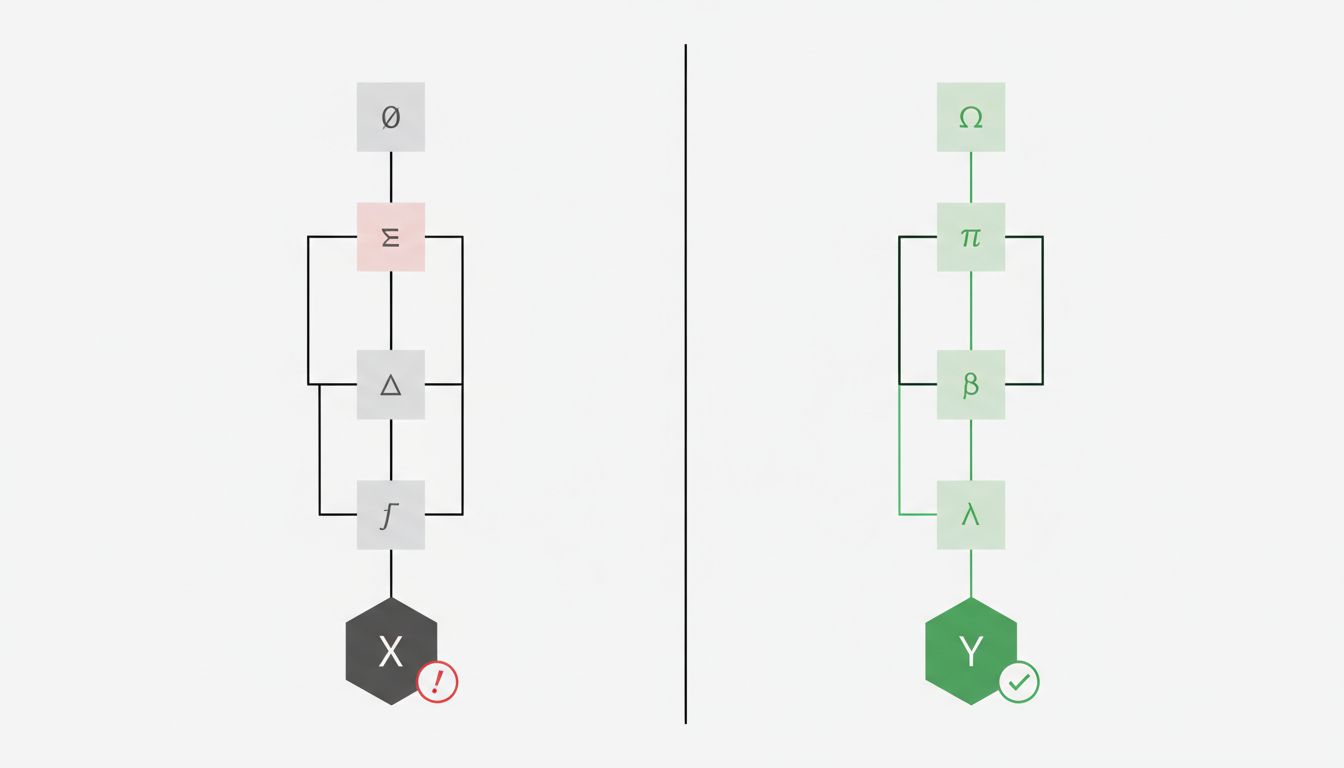
This distinction is not pedantic. A system that is genuinely reasoning can catch its own errors mid-process. A system that is generating plausible intermediate text will confidently produce a chain of steps that all follow from one wrong early assumption, and then arrive at the wrong answer with apparent certainty. If you have ever watched a model work through a logic puzzle, get one relationship backwards in step two, and then correctly apply all subsequent steps to the wrong premise, you have seen this failure mode firsthand.
Why the performance gains are real anyway
None of this means chain-of-thought prompting is a trick or a placebo. The gains are real, and the mechanism explains why they happen without requiring us to invoke reasoning. Forcing the model to emit intermediate tokens before emitting a final answer means the final answer must cohere with those tokens. For problems where the answer is easier to verify given a visible decomposition, this constraint genuinely helps. It also shifts the task away from single-step lookup (“what is the answer to this math problem”) toward a form of constrained generation that happens to match how correct answers to hard problems are usually structured in the training data.
The model has seen enormous quantities of human mathematical and logical reasoning. That reasoning follows patterns: premises first, operations next, conclusions last. Prompting the model to produce output in that pattern increases the probability that the output resembles correct reasoning. It is a probabilistic effect, not a cognitive one. The difference only becomes important when you start relying on it.
Where this goes badly wrong in production
Developers who believe chain-of-thought triggers genuine reasoning tend to make two mistakes. The first is over-trusting long chains. A response with twelve detailed steps feels more credible than a one-sentence answer, but the length is not evidence of correctness. It is evidence that the model found a lot of plausible-sounding things to say. The second mistake is using chain-of-thought to compensate for insufficient context. If the model doesn’t have the right information, asking it to reason carefully about the wrong information produces carefully-reasoned wrong answers.
This connects to a broader issue with LLM context management. The model’s ability to track and use information degrades as context grows, which means long chains of intermediate steps can themselves introduce noise. Why Your LLM Gets Dumber With More Context covers the attention mechanics behind this in more detail. A chain-of-thought that spans hundreds of tokens is not free.
The counterargument
The strongest pushback here is that newer models, particularly those trained with reinforcement learning on verifiable tasks (like OpenAI’s o-series), may actually be doing something closer to genuine search or planning. These models are trained not just to predict text but to produce outputs that score well on objective tests, which creates selection pressure for intermediate steps that actually help. That is a meaningful architectural and training difference, and I think it warrants a different framing for those specific systems.
But most developers are not using o3 for most tasks. They are using general-purpose chat models or API completions where chain-of-thought is a prompting strategy, not a trained capability. For those systems, the “reasoning” label does real harm because it creates false confidence in outputs that deserve scrutiny.
What to do with this
Chain-of-thought prompting is a genuinely useful technique. Use it. But treat the intermediate steps as hints about where the model’s confidence is high or low, not as a verifiable audit trail. When the stakes are real, check the work the same way you would check a junior developer’s pull request: assume good faith, verify the logic independently. The model is not thinking. It is very fluently doing what comes next.