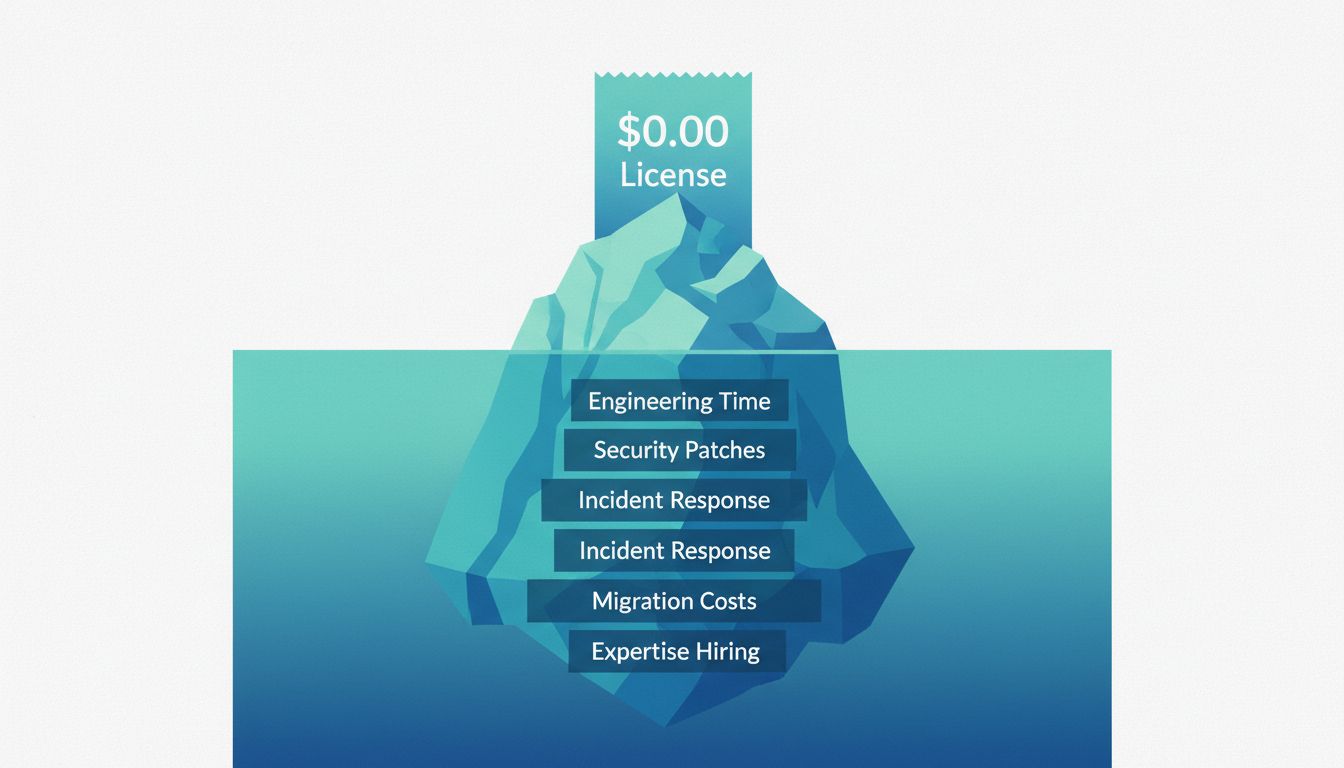
A startup I know adopted Kubernetes early because it was free and everybody said it was the future. Within eighteen months they had hired two dedicated platform engineers, both expensive, to manage it. They were running it on infrastructure that cost more than a comparable managed service would have. And they had experienced two production outages traced to misconfigured cluster settings that a managed provider would have caught. The total cost of their “free” infrastructure choice ran well into the hundreds of thousands before they finally moved to a managed solution. The license was still free.
This is the puppy problem. The puppy itself is free. The vet bills, food, boarding, damage to your furniture, and the hours of training are not. Nobody who has owned a dog is surprised by this. But somehow, the same people who understand this immediately will download an open-source database, declare victory, and budget zero dollars for what comes next.
The Cost Is Hidden in the Verb “Run”
When someone says a piece of software is free, they mean the acquisition cost is zero. What they quietly omit is that acquisition is the cheapest part of using software. The expensive part is running it: keeping it secure, keeping it available, updating it, debugging it, integrating it, and eventually migrating away from it.
With proprietary software, the vendor absorbs many of these costs and rolls them into the price. You pay more upfront, but you’re also paying for uptime guarantees, security patches pushed to you automatically, and a support line you can call when things break at 2 a.m. The price is visible. The value is negotiable but at least it’s on the table.
With open source, you get the software and a community, and then you’re largely on your own. The costs don’t disappear. They get transferred to your team, your time, and your infrastructure budget, spread across enough line items that they never appear as a single number on a spreadsheet. This is not a flaw in open source. It’s just economics, and it’s worth being clear-eyed about it.
Where the Money Actually Goes
There are four categories where open source costs materialize, and they compound on each other.
The first is talent. Running PostgreSQL well requires someone who understands PostgreSQL deeply. Running Kafka requires Kafka expertise. These are not interchangeable skills, and engineers who have them know their value. When you adopt a complex open-source tool, you are implicitly committing to either hiring someone with that expertise or developing it in-house. The development path takes time you might not have and produces risk in the interim.
The second is operations. Someone has to watch the thing. Configure it. Tune it. Respond when it pages. These are not glamorous tasks, and in most organizations they land on people who have other jobs already. The unpaid labor holding up the internet is a real phenomenon at scale, but inside a company it manifests as engineers pulled away from product work to babysit infrastructure.
The third is security. Open-source software is not inherently more or less secure than proprietary software, but managing security patches is your problem. When a critical CVE drops for a library you’re running, nobody is going to push an update to you. You find out when you read the security mailing list (if you’re subscribed) or when someone exploits it. The Log4Shell vulnerability in late 2021 exposed exactly this: organizations running Log4j in their infrastructure scrambled to inventory every place the library appeared, which turned out to be a significant project in itself for many companies.
The fourth is integration and migration. Getting open-source software to talk to the rest of your stack takes engineering time. And when you eventually outgrow it or move to a different solution, migration costs can dwarf everything that came before. Nobody budgets for migration when they’re adopting something. Everybody pays for it eventually.

The Complexity Tax Gets Heavier as You Scale
A small team running Redis for caching has a fairly manageable situation. A team running a Redis cluster with persistence, replication, and failover across multiple availability zones, integrated into a microservices architecture, is in a different situation entirely. The complexity that seemed manageable at one scale becomes load-bearing at another, and load-bearing complexity is expensive.
This is why many companies follow a predictable arc. They start with open-source tooling because it’s free and flexible. They scale until the operational burden becomes painful. Then they migrate to managed services that cost real money but actually cost less in total once you account for engineering time. The managed service was cheaper all along. They just couldn’t see it because the open-source costs were distributed and invisible while the managed service costs appeared as a line item.
Kafka is a good example. Running Kafka yourself is entirely possible and many large organizations do it well. But it requires genuine expertise, careful operations, and ongoing attention. Confluent’s managed Kafka offering costs real money, but for teams without deep Kafka expertise, it is frequently the more economical choice when you price in engineer time. The same dynamic plays out with Elasticsearch and Elastic Cloud, with Redis and Redis Cloud, with dozens of other open-source tools that have commercial managed counterparts.
Why the Free Framing Persists Anyway
Given that the costs are real and well-documented, why does the “free” framing stick around? A few reasons.
Organizations tend to budget in categories. Software licenses are a procurement line item that requires approval. Engineering time is a payroll line item that’s already been approved. When you adopt open-source software, you’re spending the second kind of money, not the first, and it’s much easier to spend money that was already budgeted than to request new budget. The free software is free in the sense that it doesn’t require a purchase order, which is actually what many engineers and managers mean when they say free.
There’s also an optimism bias in adoption. When you’re evaluating a new tool, you’re thinking about what it will do for you when it works. You are not spending much time thinking about the Saturday morning it fails, or the security audit you’ll have to perform, or the engineer you’ll have to hire. Those costs are hypothetical. The license savings are immediate and concrete.
And there is genuine value in open source that shouldn’t be dismissed. The flexibility to modify the software, the absence of vendor lock-in for the core technology, the ability to audit the code, the community of other users dealing with the same problems. These are real. The argument is not that open source is bad. The argument is that its costs deserve the same rigor as its benefits.
The Honest Calculation
The companies that get this right treat open-source software like any other build-versus-buy decision. They estimate engineering hours for setup, integration, and ongoing operations. They estimate the cost of the expertise they’ll need, whether hired or developed. They factor in a realistic guess at incident response time and security maintenance. Then they compare that to the total cost of managed alternatives, which are getting cheaper and more capable every year.
Sometimes open source wins that calculation decisively. If you have the in-house expertise already, if the tool is central enough to your product that customization matters, if the managed options in your category are genuinely poor, then running your own infrastructure makes sense. Many core pieces of internet infrastructure exist because organizations made exactly this calculation and built serious expertise around open-source components.
But “it’s free” is not a calculation. It’s an assumption in place of one. And the companies that get burned by open-source adoption costs almost always skipped the calculation and started with the assumption.
The Vendors Know This Better Than Anyone
Here’s what I find telling: the companies most aggressive about open-sourcing their software are often the ones who also sell managed versions of that software. HashiCorp, Elastic, MongoDB, Confluent and others built major businesses on the back of open-source software by understanding that the license being free actually drives demand for their paid offerings. If running the software were simple, nobody would pay for the managed version. The complexity is the business model.
This is not a criticism. It’s a genuinely functional arrangement: the open-source software benefits from broad adoption and community contribution, and the commercial offering captures value from organizations that don’t want to deal with the operational burden. But understanding that this is the model helps you understand where you sit in it. You’re either capable of and interested in handling the operational work yourself, or you’re a customer for the managed service. The license cost is almost beside the point.
What This Means
If you’re evaluating open-source software for your organization, do the actual math. Estimate the engineering hours for initial setup. Estimate the ongoing operational load. Look at who on your team will own this and what it displaces. Check whether there are managed alternatives and what they actually cost when you compare total numbers, not sticker prices versus zero.
If you’re already running open-source infrastructure and feeling the pain, the question worth asking is whether the savings on the license are actually covering the costs you’re incurring. For a lot of teams, the answer is no, and switching to a managed service would free up engineering capacity for work that actually matters.
Open-source software has built enormous amounts of real value. Linux runs most of the internet. PostgreSQL is a genuinely excellent database that has saved organizations real money. The software is often outstanding. The accounting just needs to be honest about what you’re actually signing up for when you adopt it.
The puppy is worth it. Just know what you’re getting into.