

The Pioneer Tax Is Real
VisiCalc invented the spreadsheet in 1979. Lotus 1-2-3 arrived three years later and became the defining product of the PC era. Lotus then held its position until Microsoft Excel surpassed it in the late 1980s. Three companies, one category, and the original inventor finished last.
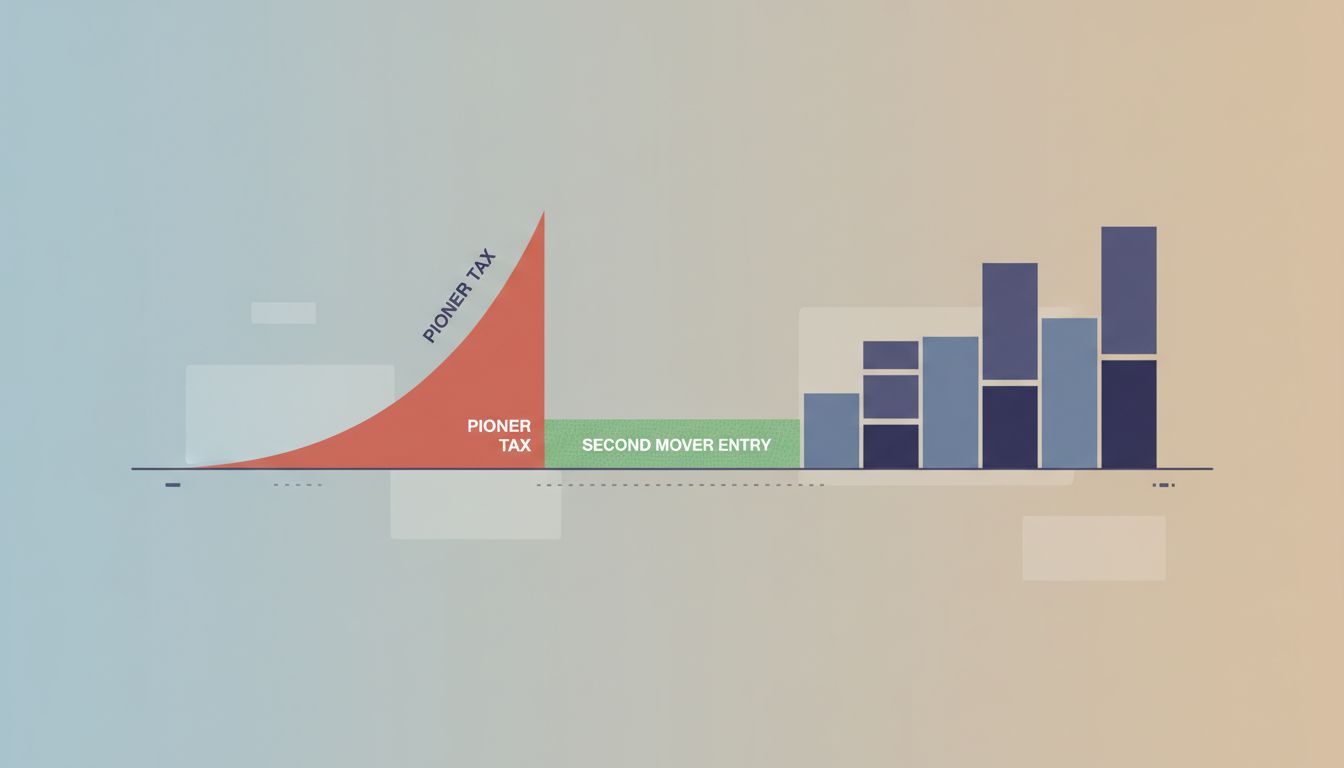
This pattern is common enough to deserve a name. Call it the pioneer tax: the cost paid by first movers in the form of educating a skeptical market, building infrastructure that didn’t exist, and iterating through product assumptions that had no data behind them. These costs are real, measurable, and often fatal. The second entrant inherits the benefits without paying most of the bill.
The conventional view is that arriving first creates durable advantages: brand recognition, customer lock-in, talent recruitment. These advantages exist, but they’re frequently overwhelmed by the structural disadvantages that come with true pioneering. The question worth examining is why, and under what conditions, the second mover wins.
What the Pioneer Actually Builds
The first company into a market does work that is genuinely valuable but not captured entirely in their own balance sheet. They prove the market exists. They run the regulatory experiments. They train a customer base that, once educated, is now available to everyone.
Search engines before Google had spent years teaching users what a search engine was and what it was supposed to do. When Google arrived in 1998, AltaVista and Excite had already absorbed years of user confusion, complaints, and low expectations. Google entered a market of reasonably fluent users and simply needed to be better on the dimensions that now mattered: relevance and speed.
Similarly, MySpace normalized the concept of the social profile, the friends list, and the news feed. Facebook didn’t need to explain what a social network was when it expanded beyond college campuses in 2006. It only needed to execute the concept more cleanly.
This is the core mechanism: pioneers build a shared mental model in the market, and that model becomes a public good. Every subsequent entrant inherits it for free.
The Advantage of Watching Someone Else Fail
Beyond market education, the second mover benefits from a specific form of competitive intelligence that money can’t buy: watching what didn’t work.
Netflix didn’t invent DVD rental by mail. A company called CafeDVD and others had explored the idea before Reed Hastings formalized it. What Netflix had was the ability to observe early failures, understand why subscription models outperformed per-rental pricing for customers who watched frequently, and build the logistics operation with that knowledge already in hand.
This extends to technical architecture. When a new category forms, the pioneer often builds on whatever infrastructure exists at the time. By the time a well-funded second entrant arrives, the infrastructure has usually matured. Amazon Web Services launched in 2006; companies building on cloud infrastructure after 2010 benefited from years of AWS hardening its reliability and expanding its services. The pioneer who built their own data centers in 2005 is now competing against companies with lower fixed costs and more flexible scaling.
There’s a meaningful difference between being fast and being ready. First movers are often fast into a market that isn’t ready. Second movers arrive when both the market and the underlying tools have matured enough to support durable growth.
Timing Is a Skill, Not an Accident
The companies that successfully execute second-mover strategy aren’t just lucky latecomers. They’re reading signals that pioneers are generating and making deliberate timing decisions based on those signals.
The relevant signals are specific. Is the pioneer growing but unprofitably? That suggests the unit economics of the business model haven’t been solved, which means the second mover needs to solve them before entering, not after. Is the pioneer churning customers at high rates? That reveals product-market fit problems that a better product can address. Is the pioneer’s customer acquisition cost rising quarter over quarter? That suggests the easiest customers have been acquired and the second mover faces the same difficult market.
When these signals point favorably, the timing window is open. The market exists, customers are frustrated or underserved, and the pioneer’s structural advantages haven’t hardened into genuine lock-in.
This is distinct from the analysis in why the second-best product often makes more money, which is primarily about distribution and pricing power. Second-mover advantage is upstream of that: it’s about entering a market at the moment when someone else’s groundwork becomes your foundation.
When First-Mover Advantages Hold
This argument has real limits, and ignoring them produces bad strategy.
First-mover advantages are durable when switching costs are high and accumulate over time. Enterprise software is the clearest example. Once a company has trained its workforce on a system, integrated it into core workflows, and stored years of data in its schema, the cost of switching is enormous. This is why SAP and Oracle have maintained positions for decades despite products that consistently draw complaints. The pioneer in enterprise resource planning didn’t just win customers; it embedded itself into operations in ways that compound over time.
Network effects create a similar dynamic. The value of a communication network is proportional to its users, which means the first network to reach scale becomes almost impossible to displace through product quality alone. This is why messaging apps with large installed bases survive despite inferior interfaces. WhatsApp’s product decisions are frequently criticized; its 2 billion users are largely unmoved.
The strategic implication is that second-mover advantage is most powerful in markets where switching costs are low, where customer relationships reset frequently (consumer apps, subscription services, advertising platforms), or where the underlying infrastructure is shifting in ways that nullify the pioneer’s technical investment.
The Real Lesson for Founders
The business press rewards origin stories. The company that invented a category gets the keynote, the magazine cover, and the mythology. What it often doesn’t get is the market.
For founders evaluating a space, the presence of a struggling pioneer is frequently a better signal than a completely empty market. An empty market either means the idea is genuinely new or that many people have already tried and found no customers. A market with a pioneer who is growing but messy means the demand is proven, the product-market fit is approximated but not optimized, and the timing for a better-executed version may be exactly right.
The risk in this framing is complacency. Second-mover advantage is not a license to copy slowly. It’s a structural head start that still requires faster execution, clearer positioning, and a genuine improvement on what already exists. The companies that have exploited this advantage most successfully (Google over AltaVista, Facebook over MySpace, Slack over HipChat) didn’t just arrive second. They arrived with a sharper answer to questions the pioneer had already forced the market to ask.