
The Simple Version
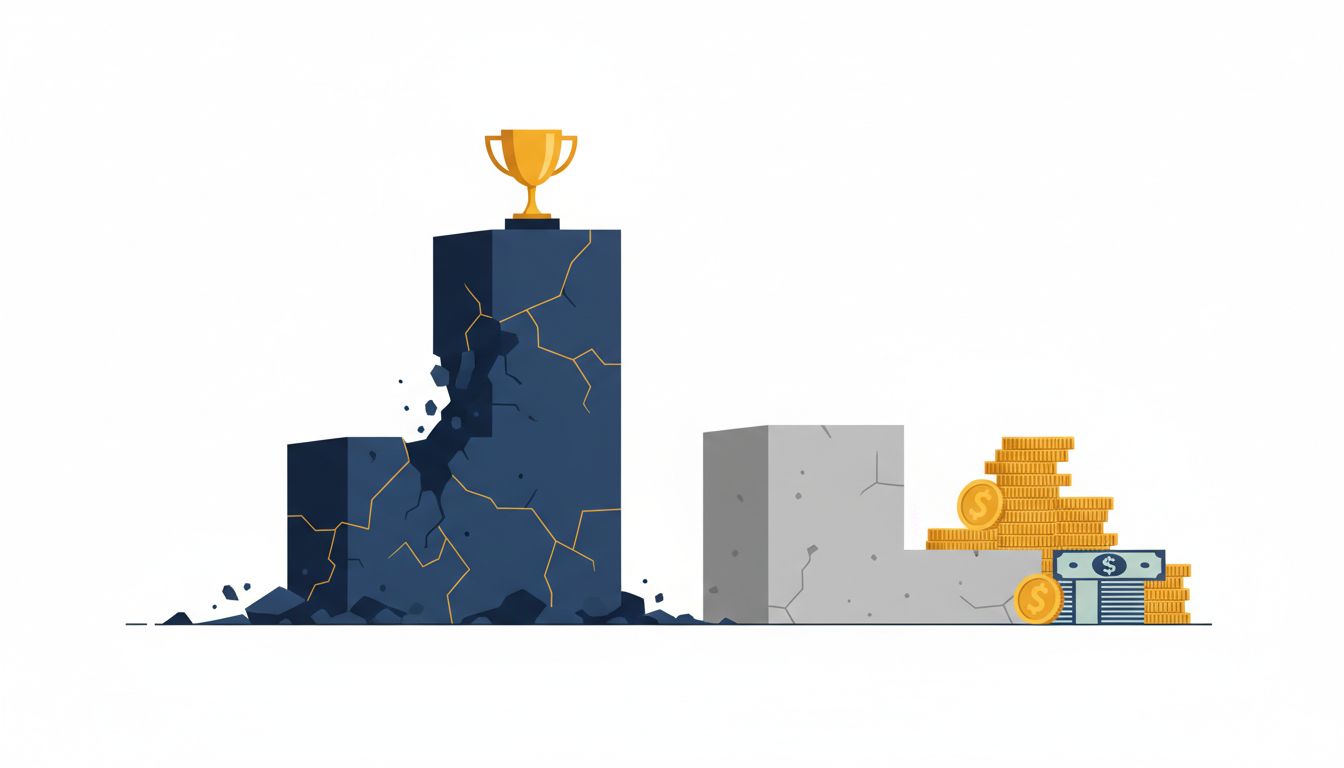
The company that wins a tech market usually wins by spending more than everyone else, which leaves the second-place player to collect better margins on a smaller but more sustainable business. Winning is expensive. Being a close second is not.
Why Market Leadership Costs So Much
The counterintuitive finding buried in most industry analyses is this: the market share leader in a technology category frequently earns lower operating margins than the runner-up. This seems wrong. More customers should mean more pricing power. More volume should mean lower unit costs. Scale should win.
Sometimes it does. But in technology specifically, market leadership carries costs that scale cannot always offset.
Consider what it takes to hold the top position. You defend the entire market. Every enterprise customer who might defect is your problem. Every new entrant who might take a slice of the low end is your problem. You fund the sales force to cover accounts your competitor would never bother with. You maintain the broadest product surface, because your largest customers demand features that no rational product manager would prioritize on their own. You run the most expensive marketing operation, because your brand has to mean something to buyers who have never considered the category before.
The second-place company does almost none of this. It shows up after the category is established, pitches against the leader’s known weaknesses, and wins the customers it actually wants.
The Salesforce-Oracle Dynamic Illustrates This Well
Look at the CRM market over the past decade. Salesforce built and dominates it. The company spent years investing in category creation, building an ecosystem of partners and developers, and acquiring adjacent businesses to defend its position. Those investments paid off in market share. They also produced operating margins that, for most of Salesforce’s history, lagged what you would expect from a company of its scale and pricing power.
Meanwhile, competitors like HubSpot carved out defensible positions by targeting the mid-market that Salesforce underserved, charged less, ran leaner organizations, and for several years posted better operating margin ratios despite being a fraction of the size. HubSpot’s sales and marketing efficiency, measured as a percentage of revenue, was notably better than Salesforce’s for extended periods precisely because it did not have to defend the whole market.
This pattern repeats across categories. The leader spends to maintain. The runner-up spends to acquire.

The Mechanism: Where the Money Actually Goes
Three cost centers explain most of the gap.
Research and development breadth. The market leader has to build for everyone. Enterprise customers who represent large contracts can demand custom integrations, compliance features for obscure jurisdictions, and accessibility requirements that serve a tiny fraction of the user base. The runner-up builds for its target customer and says no to the rest. That selective focus is not just a product strategy. It is a cost strategy.
Customer acquisition costs at the margin. The easiest customers to win are the ones who are already looking for a solution and already know your category exists. The market leader, having created the category, already has those customers. To grow, it has to reach harder-to-convince buyers. The runner-up inherits a market the leader educated and then finds the pockets the leader ignored or underserved. Selling into dissatisfaction is cheaper than selling into ignorance.
Retention costs at scale. When you have the most customers, you have the most customers to lose. The leader’s support organization, customer success teams, and account management layers all scale with the installed base. The runner-up’s churn problem is smaller in absolute terms, even when retention rates are similar.
When Scale Does Win
This is not a universal law, and it is worth being precise about where it breaks down.
In businesses with genuinely high fixed costs and low marginal costs, scale advantages can be decisive. Cloud infrastructure is the clearest example. Amazon Web Services spent years building data centers, network capacity, and operational tooling that smaller competitors could not replicate. The result is that AWS earns operating margins that exceed its nearest competitors in part because its cost per unit of compute is lower. Microsoft Azure has closed that gap substantially, but it did so by matching AWS in capital expenditure, not by avoiding it.
The distinction matters. In cloud infrastructure, the product is largely a commodity and price is a central competitive variable. In software categories where differentiation is high and switching costs are real, the leader’s scale advantages are weaker and the runner-up’s focus advantages are stronger.
The software-as-a-service world tends to reward the focused challenger. The infrastructure world tends to reward the scaled incumbent. Know which one you are actually in.
What This Means for Strategy
For companies competing in established tech markets, the strategic implication is underappreciated. Chasing market leadership is not obviously the right goal. Chasing the most profitable market position often means staying in second place intentionally, selecting customers carefully, and resisting the pressure to match the leader’s product breadth.
This connects to a broader point about customer selection. The instinct to serve every possible buyer, particularly the biggest and most visible ones, frequently destroys the unit economics that made a business attractive in the first place. Firing your biggest customer is sometimes an act of financial discipline, not commercial failure.
For investors, the lesson is to look past revenue and market share rankings when evaluating tech businesses. A company holding 18% of a market with 28% operating margins deserves more credit than a leader holding 40% of the same market with 12% operating margins, particularly if the smaller company is growing efficiently.
Market share charts tell you who won the land grab. Margin analysis tells you who is actually building something worth owning.