
The AI industry has a size obsession. Bigger parameter counts, larger context windows, more compute. The implicit assumption is that intelligence scales with mass. It mostly doesn’t, and the evidence has been piling up for years.
My position is simple: for most real-world tasks, a well-compressed smaller model outperforms a bloated larger one. Not just in speed or cost, but in the quality of its outputs. Shrinking a neural network, done correctly, is an act of refinement, not sacrifice.
Compression forces the model to keep what matters
When you prune a neural network, you’re forcing it to decide what knowledge is load-bearing and what is noise. Techniques like weight pruning, quantization, and knowledge distillation don’t randomly delete capability. They selectively remove redundancy.
Research on lottery ticket hypothesis work, pioneered by Frankle and Carlin at MIT, showed that large networks contain smaller “winning ticket” sub-networks that can match the full network’s performance when trained in isolation. The large network was never doing more work; it was doing the same work with enormous redundancy. Compression finds the signal inside the noise.
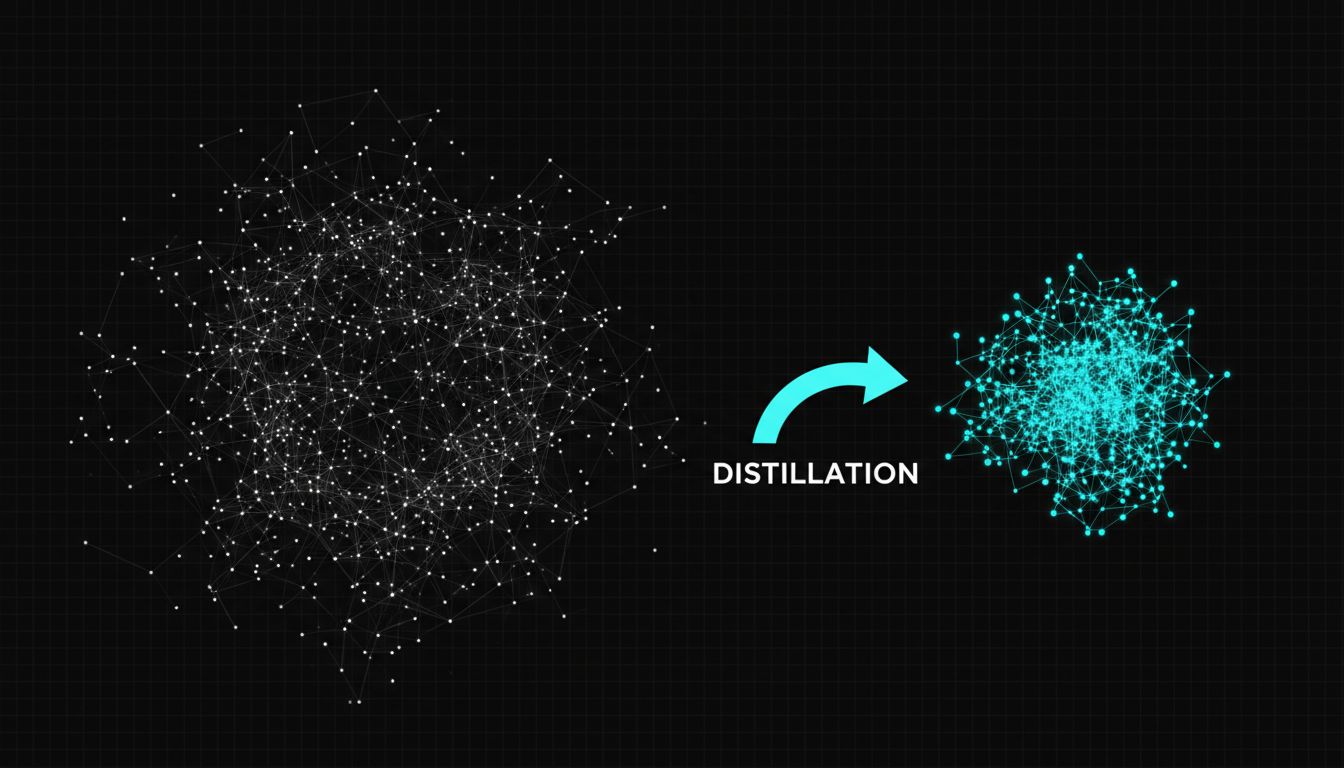
Knowledge distillation takes this further. You train a small “student” model to mimic a large “teacher” model, and frequently the student generalizes better on held-out data than the teacher did. It’s learned the underlying pattern rather than memorizing the training distribution. That’s not a consolation prize. That’s better generalization by definition.
Smaller models are forced to be less confidently wrong
Large models are prone to a specific failure mode: they generate fluent, confident nonsense. The sheer capacity to interpolate between training examples means they can produce plausible-sounding outputs for almost any input, including inputs where the correct answer is “I don’t know.”
A well-trained smaller model operating within a defined domain behaves more like a specialist. It has less capacity to confabulate, which means it fails more visibly and more honestly. You’d rather have a model that says nothing than one that confidently fabricates an answer. Smaller models, counterintuitively, can be safer to deploy in production because their failure modes are more predictable.
Constraints improve focus and reduce interference
Neural networks trained on everything tend to be mediocre at specific things. This is the multi-task learning tradeoff: general capability comes at the cost of specialized depth. When you compress a model and fine-tune it for a specific task, you’re not just making it faster. You’re removing the interference from unrelated knowledge.
Meta’s LLaMA models demonstrated this clearly. Smaller, carefully curated, instruction-tuned versions consistently outperformed larger general-purpose models on specific benchmarks. The same pattern appeared with Mistral 7B, which outperformed larger Llama 2 variants on many reasoning tasks despite having fewer parameters. The focused model beats the distracted one.
This mirrors something true about human expertise. A surgeon who has done ten thousand knee replacements will outperform a generalist who has done a hundred of everything. Depth beats breadth when the task is specific.
Smaller models actually get used
There’s a practical argument that matters as much as the technical one. A model that runs on a consumer GPU, or on-device, or without a $50,000 monthly API bill, gets deployed, iterated on, and improved. A model that requires a data center stays theoretical.
The models making the biggest difference in production software right now are not the largest ones. They’re the models that fit inside a reasonable inference budget and can be fine-tuned without requiring a research team. Phi-2 from Microsoft, at 2.7 billion parameters, achieves performance on many benchmarks that requires 25 billion parameter models to match when those models haven’t been carefully trained. The practical wins here compound quickly.
The counterargument
The obvious pushback is that some tasks genuinely require scale. Broad scientific reasoning, complex multi-step planning, tasks requiring synthesis across enormous knowledge domains; these do seem to benefit from larger models. GPT-4 class models do things that smaller models simply cannot, and pretending otherwise would be dishonest.
But notice how narrow that category is. Most software applications don’t need a model that can reason about novel organic chemistry. They need a model that can classify support tickets, extract structured data from documents, or generate consistent product descriptions. For those tasks, a 7 billion parameter model that’s been fine-tuned correctly will beat a 70 billion parameter general-purpose model while costing a fraction as much to run.
Scale is a tool, not a strategy. Reaching for the largest available model because it feels safer is an expensive habit that usually produces worse results for specific tasks.
The takeaway
If you’re building with AI right now, the instinct to use the most powerful available model is understandable but often wrong. Start by defining the narrowest possible version of your task. Then find the smallest model that can be fine-tuned or prompted to handle it well. You’ll get faster inference, lower costs, more predictable behavior, and, frequently, better outputs.
Bigger isn’t smarter. More focused is smarter. The models that will matter most over the next few years won’t be the ones with the most parameters. They’ll be the ones that do one thing extremely well and are cheap enough to run everywhere.