

The Inversion at the Heart of Engineering Retention
The most dangerous resignation letter you’ll ever receive won’t come from a mediocre performer. It will come from the person who ships the most, breaks things the least, and holds more institutional knowledge in their head than your entire wiki. And the reason they’re leaving is almost certainly not the reason you think.
This is the central inversion of engineering retention: the qualities that make someone irreplaceable are precisely the qualities that accelerate their departure. Competence, ambition, and market awareness move together. The engineer who is genuinely excellent knows it, knows what the market will pay for it, and has the confidence to act on that knowledge. The engineer who is comfortable staying put is often, though not always, the one who has stopped growing.
Most companies build retention programs designed for the median employee. The result is a system that holds average performers in place while creating a conveyor belt for the exceptional ones.
Why High Performers Are the Easiest to Recruit
Recruiters don’t cold-message the people who are hard to place. They message the people with strong GitHub histories, visible conference talks, published writing, or referrals from other engineers who’ve already been poached. The signal that makes an engineer valuable to their employer is the same signal that makes them visible to the outside market.
The inverse is also true. An engineer who is difficult to work with, slow to ship, or weak in technical interviews stays put not out of loyalty but out of limited options. Companies often misread this as engagement.
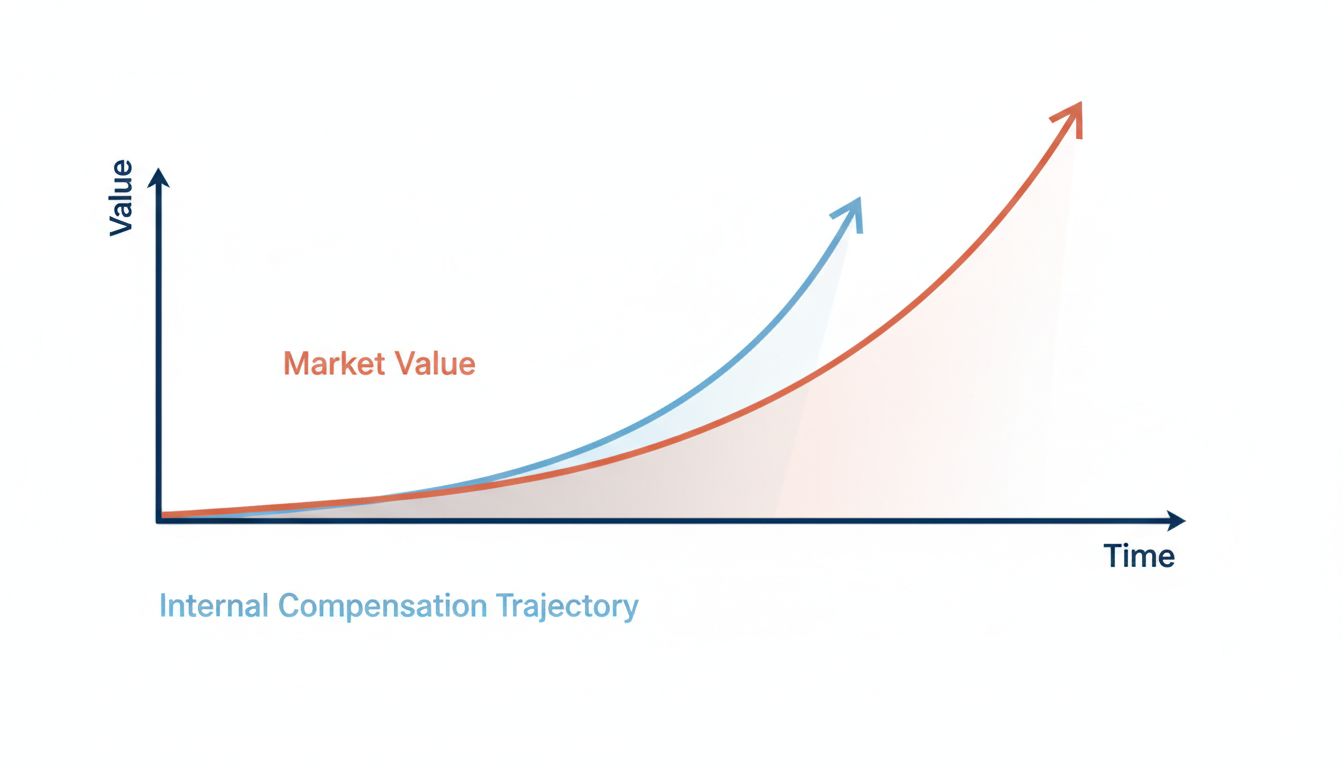
High performers at large tech companies routinely report receiving multiple recruiter contacts per week. The market is constantly repricing their value, often upward, while their employer’s annual review cycle reprices them on a twelve-month delay at a percentage increase determined by a spreadsheet in HR. The gap between market rate and internal rate compounds quietly for years, and then one day someone calls with a number that makes the gap undeniable.
The Knowledge Asymmetry Problem
There is a particular category of engineer whose departure is catastrophic not because of their future output but because of what exists only in their head. This is the person who wrote the authentication layer in 2019, who knows why the payments integration has that one conditional that no one else dares touch, who can explain in thirty seconds why a proposed architectural change will cause a failure mode that won’t manifest for six months.
This knowledge almost never makes it into documentation, because documentation is low-status work. The engineer who holds it is usually too busy shipping to write it down, and the organization rarely creates the conditions or incentives to change that. As the article “The Server That Does Nothing Is Often the Most Critical” illustrates in a different context, the most critical components of a system are frequently the least visible ones. The same principle applies to people.
When this engineer leaves, the organization doesn’t just lose their future contributions. It loses a walking index of decisions made under constraints that no longer exist, workarounds for bugs that were never properly fixed, and context that would take a new hire eighteen months to reconstruct, if they could reconstruct it at all.
The Boredom Problem Nobody Wants to Name
Salary gets blamed for most departures, and salary is often genuinely a factor. But exit interviews, when conducted honestly, reveal something companies are less prepared to address: exceptional engineers leave because the work stops being interesting.
This is not a soft complaint. It is an economic signal. An engineer who has mastered their current domain is operating below their productive capacity. They are, in the language of economists, underemployed. The market offers them problems commensurate with their ability. Their employer offers them the same codebase they’ve been in for three years.
The companies that retain their best people longest tend to share a pattern: they consistently give those people harder problems before they go looking for harder problems elsewhere. This is not complicated in principle. It requires sustained management attention and organizational willingness to put senior talent on genuinely uncertain, high-stakes work rather than using them as a reliability backstop for less capable teammates.
Many organizations do the opposite. They reward their best engineers by making them responsible for the stability of existing systems, which is a path that leads directly to the LinkedIn job search.
What Compensation Surveys Miss
The standard retention playbook says: run a compensation benchmarking exercise, bring salaries to market rate, and add some equity for good measure. This is necessary but not sufficient, and for a specific reason.
Compensation surveys measure the market for the median engineer in a given role and experience band. They are structurally unable to capture the value of the top ten percent. The engineer who would cost your company a year of lost velocity and six months of recovery time is not priced into any Radford survey. Their departure costs are real but they are externalized from the analysis.
The math actually argues for paying your best engineers dramatically above the market midpoint, not at it. If someone’s replacement cost (recruiter fees, interview time, onboarding, reduced productivity for twelve months, lost institutional knowledge) runs to several times their annual salary, paying them twenty or thirty percent above benchmark is cheap insurance. As the analysis in The Engineer Who Costs $300K Is Often the Cheaper Hire makes clear, the sticker price of talent is almost always the wrong number to optimize.
The reason most companies don’t do this is organizational, not analytical. Paying someone dramatically above their peer group creates internal equity problems, requires managers to defend the decision upward, and disrupts the comfortable fiction that compensation bands are about roles rather than people.
The Management Tax
There is a less-discussed reason the best engineers leave, and it is the quality of their direct management. Exceptional engineers have high standards for how decisions get made. They are attuned to organizational dysfunction because dysfunction imposes costs on their work. They notice when roadmap decisions are driven by internal politics rather than customer need. They notice when their manager cannot explain the reasoning behind a priority change. They notice when the organization claims to value technical excellence while systematically promoting people who are good at meetings.
Bad management doesn’t drive out average performers. Average performers have normalized the conditions. Bad management drives out the people with enough self-awareness and market value to recognize that better conditions exist somewhere else.
This is one of the structural reasons why the retention problem is self-reinforcing. As strong engineers leave, the average quality of the remaining team drops, which makes the environment less interesting for the strong engineers who remain, which accelerates their departure. The decay can be gradual enough that it isn’t visible until it’s severe.
What This Means
The retention problem for exceptional engineers is not primarily a benefits problem or a perks problem or even, in the long run, a compensation problem, though compensation matters. It is a problem of organizational design and management quality.
A few things that actually move the needle:
Treat knowledge documentation as real work. Give engineers time and credit for it. The institutional knowledge that walks out the door when someone leaves was almost always available to be captured, and it almost never was.
Benchmark retention risk, not just compensation. Know which engineers carry the most systemic risk if they leave. This is not a difficult analysis. It requires honest conversation about who is covering what, and how replaceable that coverage is.
Pay above market for genuine outliers. The equity tension this creates is a real problem, but it is a smaller problem than losing the person. If your compensation bands prevent you from paying exceptional performers exceptionally, your bands are costing you more than they’re saving you.
Assign harder problems before boredom sets in. The best engineers self-diagnose underemployment accurately. If you wait for them to tell you they’re bored, you’re already behind. By that point, they’ve usually already started taking recruiter calls.
The most important insight here is also the simplest: the people most likely to leave are the people the market most wants to hire. The organizations that hold onto exceptional talent are not the ones with the best ping-pong tables or the most generous PTO. They’re the ones that have built the organizational honesty to recognize what that talent is worth, and the discipline to act accordingly before someone else does.