

The most profitable position in most tech markets is not first place. It is a close, comfortable second — big enough to matter, exempt from the obligations that come with dominance.
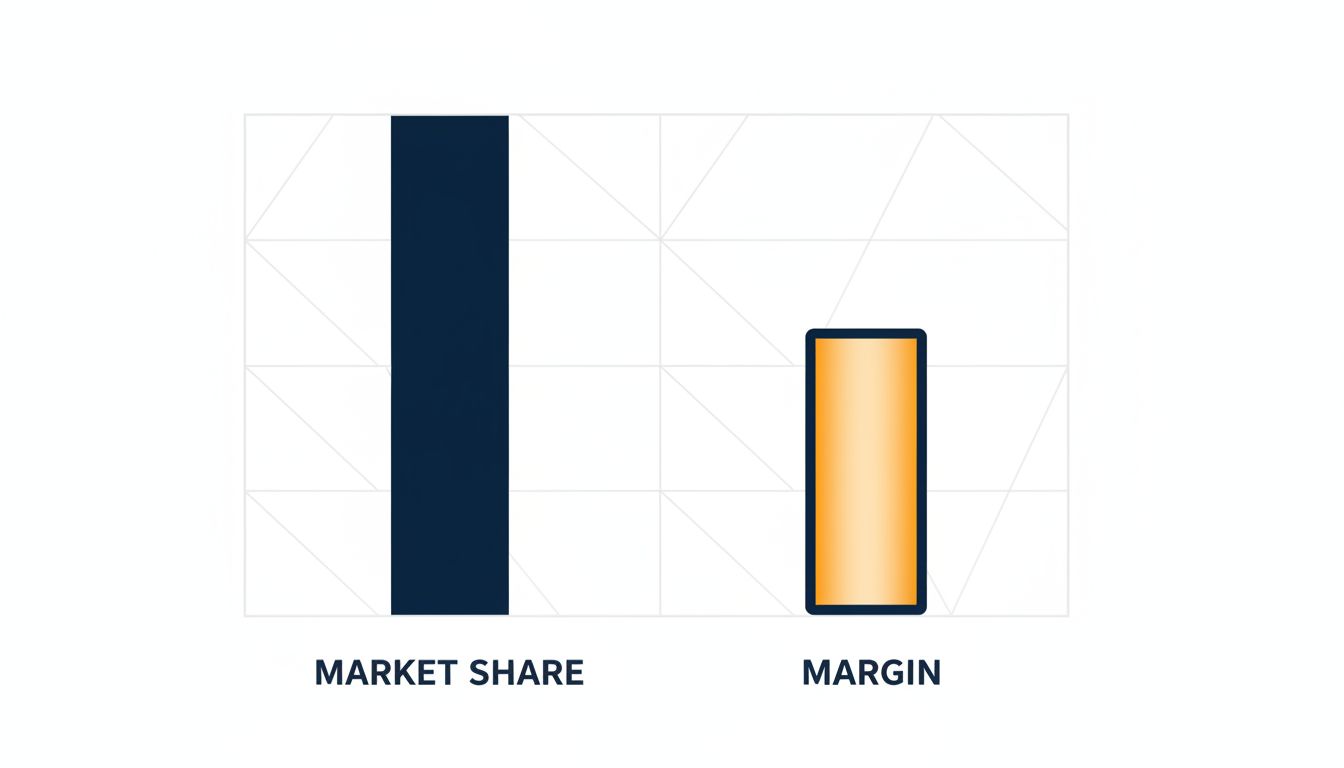
This sounds counterintuitive until you look at the actual financials. Market leadership in technology is a tax. The leader funds the category’s existence. It absorbs the regulatory attention, the talent wars, the expectation of infinite feature expansion, and the pressure to subsidize growth at the expense of margin. The challenger, meanwhile, picks its spots, copies what works, skips what doesn’t, and quietly compounds returns while the leader defends a perimeter that grows larger every year.
The cost of owning a category
Being the defining company in a tech market means you are also its infrastructure. Amazon built AWS, in part, because it had to solve its own scaling problems at a scale no vendor could serve. Google’s search quality requires a continuous, multi-billion-dollar investment in crawling and indexing infrastructure that no competitor needs to match to take meaningful share. The leader does not just compete — it maintains the floor.
Second-place companies inherit a functional market. Bing did not have to convince users that web search was worth doing. Spotify did not have to teach a generation to pay for streaming music. They arrived into proven demand, with a working playbook, and spent their capital on differentiation rather than education.
The regulatory and reputational burden
The company that wins becomes the target. Antitrust scrutiny follows market share, not profitability. Google has faced regulatory action across the EU and the United States for its search dominance. Meta absorbed years of Congressional testimony and billions in fines over privacy. These are not just legal costs — they reshape strategic priorities, slow product decisions, and consume enormous executive attention.
The second-place player operates under a lighter version of this burden almost by definition. It is large enough to be taken seriously by enterprise buyers and regulators alike, but not so large that it becomes the example made of.
Pricing power without price leadership pressure
Market leaders in tech are often expected to set prices low enough to foreclose competition — or to justify their dominance as consumer-friendly. The second-place company has no such obligation. It can price at a premium by positioning as the alternative for buyers who want leverage, or it can undercut selectively without triggering an all-out margin war.
This dynamic shows up clearly in cloud infrastructure. AWS has long carried pricing pressure from its own customers, who use its scale as a negotiating floor. Azure and Google Cloud have both used targeted enterprise pricing deals to win workloads at margins AWS could not politically afford to match across the board. The challenger prices strategically. The leader prices defensively.
The same logic applies to enterprise software. SAP spent decades as the undisputed category leader in ERP, and with that came the expectation of continuous investment, certification ecosystems, and the full cost of category stewardship. Oracle, operating in a similar market at a different scale, extracted famously aggressive margins precisely because it never needed to subsidize the category’s legitimacy — SAP already had.
The talent and culture advantage
Dominant companies attract talent through brand, then lose it through scale. The internal experience of working at a market leader often degrades as the company grows: more process, more politics, more time spent on coordination rather than building. The second-place company can credibly offer mission and urgency without the chaos of a true underdog.
This matters because the best engineers and product people are not simply chasing salary — they want to work on problems that are still being solved. The engineers most likely to leave are precisely the ones who can read when an organization has shifted from building to maintaining. Market leaders tend to cross that threshold earlier and more completely than challengers.
The counterargument
The obvious objection is that winner-take-all network effects make second place unsustainable. In markets where the product genuinely gets better as more people use it — social networks being the canonical case — second place is just slow first place, and the economics collapse before the profitability advantage can compound.
This is real, and it applies to a meaningful slice of tech. Facebook did not give Myspace time to enjoy comfortable margins in its shadow. WhatsApp did not coexist profitably with BBM.
But true winner-take-all markets are rarer than the conventional wisdom suggests. Most tech markets are winner-take-most, which is a different thing. Enterprise software, cloud infrastructure, developer tooling, payments, and hardware all sustain durable second-place businesses with strong unit economics. The markets that most resemble winner-take-all tend to be consumer social — a specific and somewhat unusual category, not a template for the whole industry.
The position worth wanting
First place in a tech market is a prestigious and often grueling job. It means carrying the weight of a category, absorbing its political costs, and justifying your existence to regulators, customers, and the press simultaneously. Second place means arriving into a built market, choosing your battles, and collecting margin the leader cannot.
The company worth envying is usually not the one on top. It is the one that is close enough to benefit from the category’s success and far enough from the center to avoid its obligations. That is not a consolation prize. It is frequently the better business.