

In the spring of 2003, Reid Hoffman sat in a meeting and listened to someone pitch him on a professional networking site. Hoffman, who would go on to co-found LinkedIn, had actually been thinking about the same idea. But the pitch came from a company called Ryze, which had launched two years earlier and already had a few hundred thousand users. Hoffman passed on investing in Ryze. Then he went and built LinkedIn anyway.
Ryze is gone. LinkedIn sold to Microsoft for $26 billion.
This pattern shows up so often in tech that it almost feels like a law. The first company into a market does the hard, expensive work of proving the idea is real. The second company reads the report and builds something better. First-mover advantage, the concept every business school professor loves, is real in exactly one narrow case: when network effects or switching costs lock users in before the second player can arrive. Outside that narrow case, being first is often a disadvantage dressed up as a head start.
The Setup: What Ryze Got Right (and What It Left on the Table)
Ryze wasn’t a bad product. It solved a genuine problem, it got press, and it attracted real users. What it couldn’t do was solve the problem well enough to make switching costly. Professional networking on Ryze was functional but clunky. The value proposition was clear; the execution was thin.
When LinkedIn launched in May 2003, it didn’t need to convince anyone that professional networking on the internet was a good idea. Ryze had already done that. LinkedIn just needed to do it better, and it had the advantage of watching where Ryze stumbled.
This is the real first-mover tax. You spend capital, time, and organizational energy educating the market. You learn painful lessons about what users actually want versus what you thought they wanted. You build infrastructure for a problem you don’t fully understand yet. And then someone with cleaner eyes and a cleaner slate shows up and builds the thing you were trying to build, informed by your failures.
What Actually Happened with Search
Google is the canonical example, though people misremember the story. Google wasn’t the first search engine. It wasn’t even close. By the time Larry Page and Sergey Brin launched in 1998, the market had AltaVista, Excite, Lycos, Infoseek, and Yahoo, all with meaningful user bases and real venture backing. AltaVista in particular was technically impressive for its time.
What Google had was a better algorithm (PageRank) and the benefit of studying exactly where the incumbents failed. AltaVista’s results were degrading because spammers had learned to game keyword density. Google’s link-based ranking was harder to game and produced demonstrably better results. The first movers proved that people would use a search engine millions of times per day. Google proved that those people would switch if the results were better.
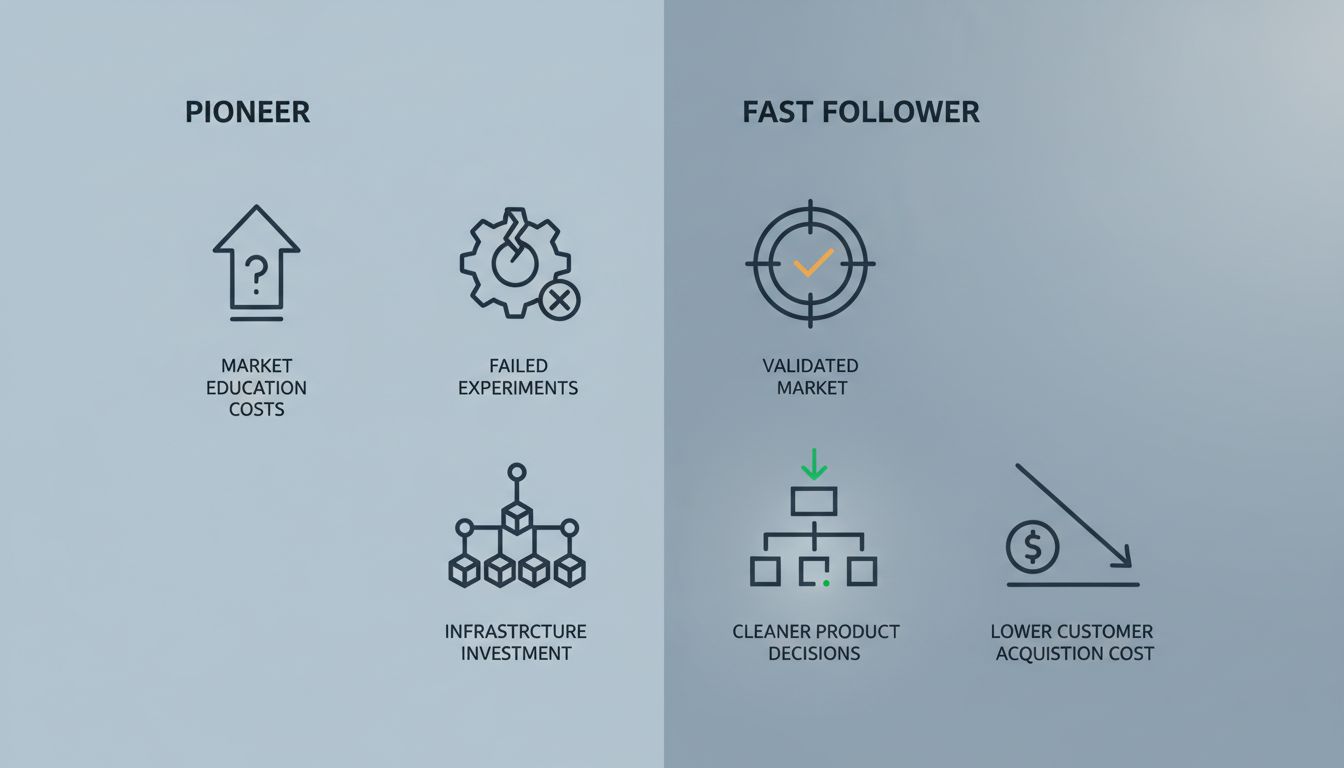
The lesson isn’t that being second is automatically good. It’s that the second entrant can solve a validated problem with better information than the first entrant had. The market research is free because the pioneer paid for it.
The Pattern Holds in SaaS
Salesforce is often credited with inventing the CRM-as-a-service model, and the credit is mostly deserved. But Salesforce didn’t invent cloud software. Companies like Employease and Employwise were running HR software over the web before Salesforce existed. What Salesforce did was apply the model to sales teams, at the right moment, with better design and better sales instincts than anyone who had tried it before.
The second-mover dynamic shows up again inside the CRM market itself. When HubSpot launched in 2006, Salesforce had already spent years convincing enterprise buyers that CRM software delivered real ROI. HubSpot targeted the companies that couldn’t afford Salesforce, with a simpler product and an inbound marketing angle Salesforce hadn’t developed. HubSpot went public in 2014. Its market cap has regularly exceeded $20 billion.
HubSpot didn’t beat Salesforce. It didn’t need to. It used Salesforce’s market development work as a foundation and built something adjacent.
Why This Matters More Than It Should
Founders and investors spend enormous energy on the question of whether a market exists. “Is this real? Will people pay for it? Does anyone care?” These are legitimate questions, but they’re questions the second entrant often gets to skip.
The more important question, the one that actually determines outcomes, is whether you can build something meaningfully better than what’s already there, and whether switching costs are low enough that users will move. If the answer to both is yes, being second is a genuine advantage.
This is why so many successful companies sound boring when you first hear about them. “It’s like Salesforce but for small businesses.” “It’s like LinkedIn but for healthcare workers.” The founder isn’t being unimaginative. They’re being strategic. They’re saying: someone already proved this problem is real. I’m going to solve it better for a segment the incumbent ignored.
The risk is overcorrecting and thinking second always beats first. It doesn’t. In markets where network effects compound quickly, the first mover can build a moat before the second player finishes their seed round. Facebook is the obvious example. By the time Google launched Google+ in 2011, Facebook had over 750 million users and switching costs that were basically social. You don’t leave Facebook because your entire social graph is there.
But most markets aren’t Facebook. Most markets are more like search in 1998 or professional networking in 2003: the first mover has traction but not lock-in, which means the second mover has a real shot.
What We Can Learn
If you’re building a company, the honest advice is this: treat the first movers in your category as unpaid researchers. Study what they got right (the problem is real, people pay for solutions) and study what they got wrong (where users churn, what features they keep requesting that never get built, what complaints show up in their reviews).
The pioneer’s failures are a roadmap. The pioneer’s success is validation that you’re working on something worth doing.
And if you’re the pioneer, this should change how you think about your defensibility. Proving the market exists is necessary but not sufficient. The companies that stay hard to displace are the ones that build genuine switching costs early, not the ones that got there first. Getting there first buys you time. It doesn’t buy you the market.
Ryze got there first. LinkedIn got there better. The scoreboard is pretty clear on which one mattered.