

The received wisdom in tech holds that the first mover wins. Get there early, lock in users, build the network effects, and make yourself impossible to displace. It is a compelling story. It is also wrong often enough that treating it as law has destroyed serious capital.
The more interesting pattern is this: the company that enters second, or even third, into a clearly defined market tends to outperform the pioneer on the metrics that actually matter to a business. Not market share always, but margins, customer lifetime value, and long-run profitability. Understanding why requires looking at what “being first” actually costs.
The Pioneer Tax Is Real and Rarely Discussed
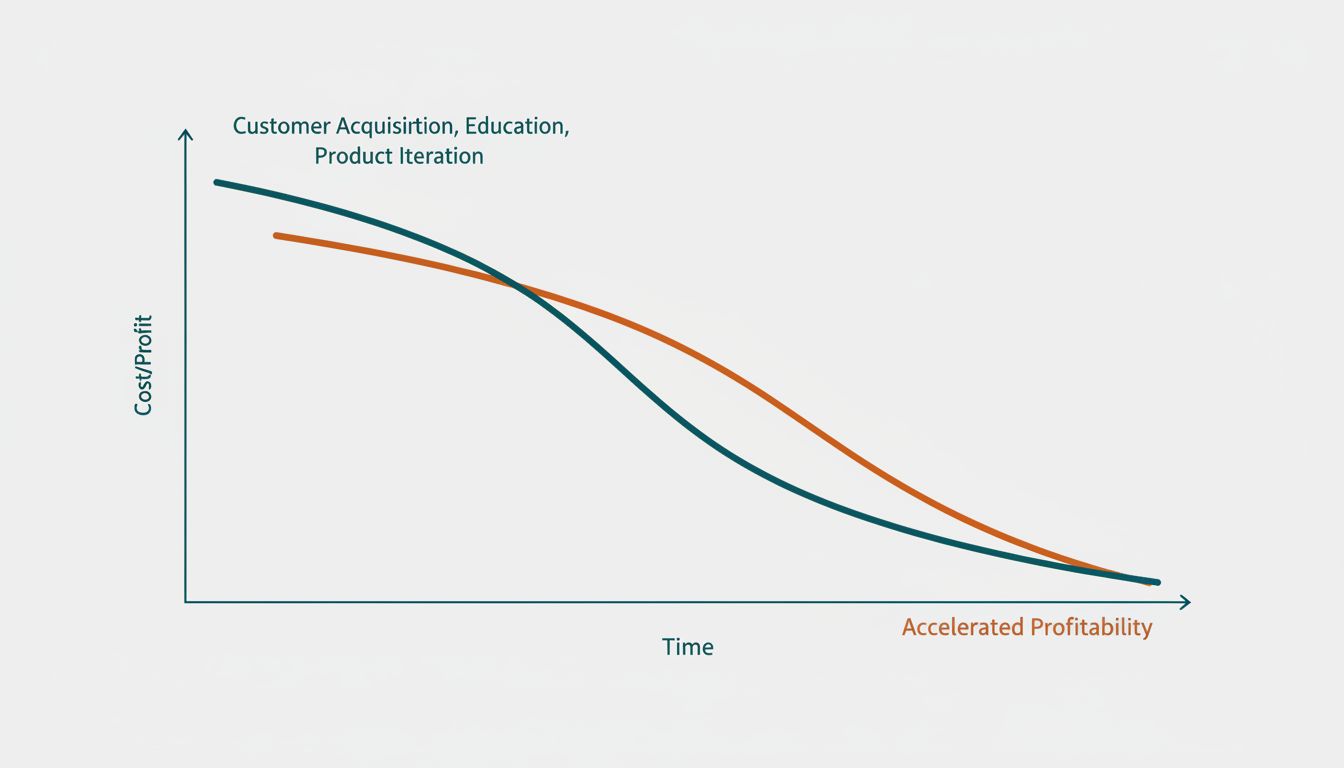
When a company creates a genuinely new category, it takes on a burden that gets almost no attention in startup folklore: it has to pay to make the market exist. This includes educating potential customers about the problem they have, convincing them that a solution is worth paying for, and absorbing every early product failure in public.
This is not a minor line item. Category creation spending can consume enormous portions of early revenue in sales, marketing, and customer success, because every prospect starts from zero. The pioneer is essentially funding a curriculum that all future competitors will get to use for free.
Personal computers illustrate this precisely. MITS shipped the Altair 8800 in 1975 and is largely forgotten outside hardware history. Apple arrived later into a market the Altair had begun legitimizing, built on lessons the pioneer paid to learn, and eventually became the most valuable consumer electronics company ever created. The Altair did the expensive work of demonstrating that personal computing was a real category. Apple collected much of the reward.
What the Second Mover Actually Inherits
When a second company enters a market, several things have already happened on someone else’s budget. Customers have been taught what the product does. Early adopters have identified what they actually want versus what they thought they wanted. The first company has made its pricing mistakes in public, revealing where customers push back on price and where they do not. A pool of trained engineers, salespeople, and operators who understand this specific domain now exists and can be recruited.
This is sometimes called the “fast follower” advantage, but that framing undersells the mechanism. It is not simply that the second mover copies the first. It is that the second mover enters with dramatically lower customer acquisition costs, a more accurate product specification, and the ability to hire people who already understand the market. The asymmetry in starting conditions is significant.
Google was not the first search engine. AltaVista, Lycos, Excite, and Yahoo all preceded it. By the time Google launched in 1998, internet users had already been trained to expect search as a primary navigation tool, and the market had demonstrated what good search was worth. Google did not have to convince anyone that search mattered. It only had to demonstrate that its version was better.
The Cost Structure Advantage Compounds
The second mover’s advantage is not a one-time benefit at entry. It compounds through the business model in ways that show up in margins for years.
Starting with a more accurate product specification means less engineering waste. Less engineering waste means faster iteration cycles. Faster iteration means the second mover closes the product gap to the pioneer quickly while spending less. Meanwhile, lower customer acquisition costs improve unit economics from the first sale. The second mover often reaches profitability on a cohort faster than the pioneer reached any profitability at all.
This dynamic shows up particularly clearly in enterprise software, where the pioneer often spends years in “land and expand” mode at discounted prices to build case studies, while the second mover can walk into a conversation with a prospect who already has a budget line for this category and reference customers willing to take calls. As we’ve noted in Why the Product That Invented a Category Rarely Wins It, the inventor and the monetizer are often different companies.
Salesforce did not invent CRM. Siebel Systems did the painful work of establishing that sales force automation was a real enterprise software category worth significant budget. Salesforce arrived with a delivery model (SaaS) that suited a market already convinced it needed CRM, and collected the rewards of Siebel’s education spending at a fraction of the acquisition cost Siebel had incurred.
Network Effects Protect Pioneers Less Than Advertised
The standard counter-argument is network effects. If the pioneer builds a network, the argument goes, the switching cost becomes prohibitive and the second mover can never catch up regardless of cost structure advantages.
Network effects are real in a narrow set of cases. They are not universal, and the tech industry has a persistent habit of overclaiming them. A product has genuine network effects when its value to each user increases as total users increase. Marketplaces and communications platforms fit this model. Most SaaS products do not. A project management tool, an analytics platform, or a payroll system does not become more useful to you because more people use it.
Even in cases where network effects are real, second movers have defeated them repeatedly by segmenting the market rather than competing head-on. Facebook did not beat MySpace by being a better general social network for everyone. It started at Harvard, then spread to colleges, then to everyone else, building dense local networks that were more valuable to members than MySpace’s diffuse global one. By the time MySpace understood what was happening, it had already lost.
When Being First Is Actually an Advantage
This analysis is not an argument that first movers never win. They do, under specific conditions.
First movers hold durable advantages when they can lock in supply rather than demand. If the pioneer signs exclusive distribution deals, acquires key raw materials, or patents a foundational process, it can prevent the second mover from competing on equal terms regardless of accumulated market knowledge. Intel’s early processor architecture agreements with IBM created a standard that made competitive entry extremely costly for years. That advantage was structural, not educational.
First movers also hold advantages when the category is so narrow that the pioneer can capture most of the economically viable market before a second entrant arrives, leaving insufficient margin for a competitor to build a sustainable business. But these categories are smaller and less common than the first-mover narrative implies.
In large, growing markets, with broad customer bases and no structural supply-side lock-in, the second mover’s advantage in cost structure and product accuracy is usually more valuable than the pioneer’s head start.
The Danger of Winning the Market Too Early
There is a subtler problem for pioneers. Winning early in a large, developing market can be actively harmful. A company that dominates too soon often optimizes for the current version of the market rather than the next one. Its organizational structure, incentive systems, and product roadmap all become oriented toward defending what exists rather than building what comes next.
This is the innovator’s dilemma in its most basic form, but it manifests economically as well as strategically. The pioneer’s early customers shape its product in ways that serve early adopters, who are often different from the mainstream market that eventually shows up. A second mover, building a product specification informed by watching the pioneer’s struggles, can arrive with a product that fits the mainstream customer better from day one.
This pattern is visible in streaming. Netflix pioneered streaming video as a standalone service, but its early product was shaped by customers who would tolerate significant catalog limitations in exchange for convenience. When larger competitors arrived with better catalogs and competing streaming services, they entered a market full of trained streaming customers with clearer preferences than Netflix had faced at launch.
What This Means
For founders and investors, the implications are direct. Being second into a validated market is not a consolation prize. It is a strategic position worth pursuing deliberately. The right question is not “can we be first?” but “is this market large enough that the pioneer’s education spending will benefit an entrant who follows with a better-specified product?”
For anyone evaluating a market, the pioneer’s burn rate is worth studying as a data point about category-creation costs. A pioneer that has spent heavily to build market awareness has, in effect, subsidized the next entrant’s customer acquisition budget. The steeper the pioneer’s education spending, the larger the potential advantage for the company that arrives with a cleaner cost structure and a more accurate product.
First-mover advantage is real in narrow, specific conditions. In most large technology markets, the pioneer is doing expensive, necessary work that the second mover will collect the returns on. The history of the industry supports this reading far more consistently than the conventional story does.