

The Simple Version
When a larger company acqui-hires your startup, it is buying your team, not your product. Your equity in the company being absorbed is almost certainly worth less than you think, and the structure of the deal is specifically designed to make that math work in the acquirer’s favor.
What an Acqui-hire Actually Is
The term combines “acquisition” and “hiring,” which is a useful hint about priorities. The acquirer wants three to eight engineers with a specific skill set. The startup’s product, its user base, and its revenue (if any exists) are incidental. The goal is to skip the recruiting process for talent that is hard to find.
This matters immediately because the purchase price is calibrated to compensation, not company value. A typical acqui-hire might value a 10-person team at $1 million to $3 million per engineer as a rough ceiling, because that is roughly what it would cost to recruit and retain each person over a multi-year period. The company’s equity capitalization table, the thing that determines who gets paid what in a normal acquisition, often becomes a rounding error in that math.
The Liquidation Preference Problem
Here is where most employees with equity get surprised. In a standard venture-backed startup, investors hold preferred stock. That preferred stock almost always carries a liquidation preference, meaning investors get their money back (or a multiple of it) before common stockholders see a dollar.
In a modest acqui-hire, the purchase price frequently doesn’t clear the total liquidation preferences. If a startup raised $15 million across two funding rounds and the acqui-hire deal values the company at $12 million, preferred shareholders are made whole and common stockholders receive nothing. The founding team’s equity and every employee’s vested options can go to zero in a deal that, on paper, looks like a successful exit.
This is not a hypothetical edge case. Many acqui-hires are specifically structured at a price that satisfies investors (who negotiate the deal) while leaving employees with vested options holding worthless paper. The investors recoup capital. The employees get jobs.
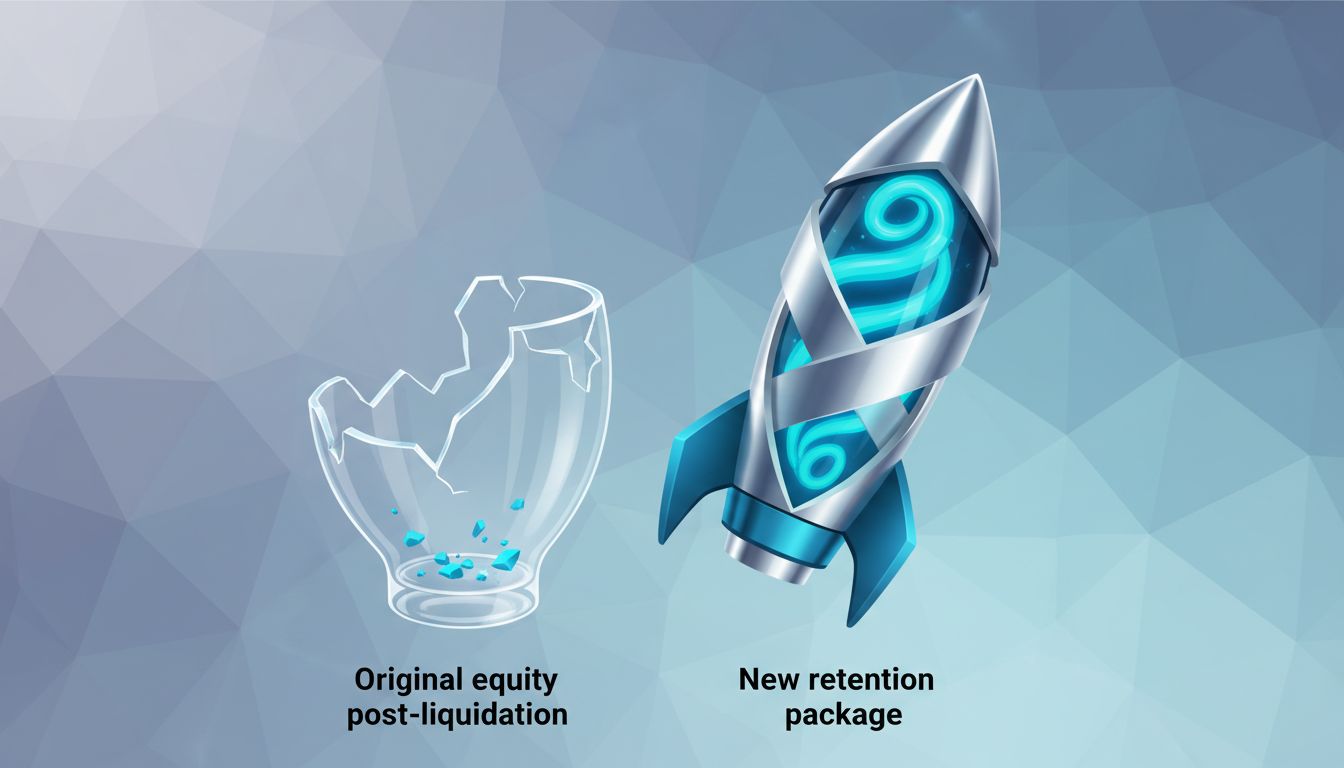
How the Retention Package Replaces Your Equity
The acquirer knows the common stock is underwater. So the deal is constructed around a different instrument: a retention package, usually in the form of new restricted stock units (RSUs) or cash bonuses tied to a vesting schedule at the acquiring company.
This is the actual compensation for most employees in an acqui-hire. A typical package vests over two to four years with a one-year cliff, which means you need to stay employed for at least 12 months before any of it converts. The total value is meaningful, often exceeding what the original equity would have been worth, but it is forward-looking compensation for future work, not a payout for what you already built.
The practical consequence is that your startup equity and your acqui-hire retention package are almost entirely separate conversations. Your original options rewarded historical contribution. The new RSUs buy your next two to four years. The acquirer wants you to conflate them psychologically, because it makes the total number feel larger. You should not.
This structure also explains why founders and early investors often receive different treatment than later employees. Founders may negotiate a small cash component in the purchase price that partially compensates their common stock. Investors negotiate their preferred return directly. Employees hired after the seed round, who hold options that sit behind everyone else in the capital structure, are typically negotiating only their retention package.
What “Acceleration” Does and Doesn’t Fix
Some employee option agreements include an acceleration clause, which triggers vesting of unvested shares upon a change of control. This sounds like protection. It is more limited than it appears.
Single-trigger acceleration vests your shares automatically upon acquisition. Double-trigger acceleration requires both the acquisition and a second event (usually termination without cause) before unvested shares accelerate. Acquirers strongly prefer double-trigger because it preserves the retention incentive. Many acqui-hires are structured so that the acquirer explicitly requires double-trigger terms as a condition of the deal.
More importantly, acceleration only matters if your vested shares are worth something after liquidation preferences. Accelerating your options when the purchase price doesn’t clear preferred shareholders gives you more worthless paper faster.
What You Can Actually Negotiate
If your startup is being acqui-hired and you have any leverage, the retention package is the real negotiation. Specifically, the vesting schedule, the cliff period, what constitutes termination without cause, and whether the package has single-trigger or double-trigger provisions for its own acceleration.
The purchase price for the company is largely out of your hands unless you are a founder with a significant ownership stake. The preference stack is set by documents that were signed years before this conversation. But the retention package is written specifically for you and negotiated fresh.
Foungers in particular should ask directly whether any portion of the purchase price will be allocated to common stock, and if not, why not. Investors have already negotiated their terms with the acquirer before most employees know a deal is happening. You are usually the last to the table, which means the relevant numbers are set. Asking early, while the deal is still being structured, is when asking has any effect.
The broader lesson is that what investors are actually buying at the pre-revenue stage shapes the very capital structure that will determine your payout years later. Preferred shares with aggressive liquidation multiples are a reasonable trade when they help you raise capital, and a painful one when the exit is smaller than anyone hoped.