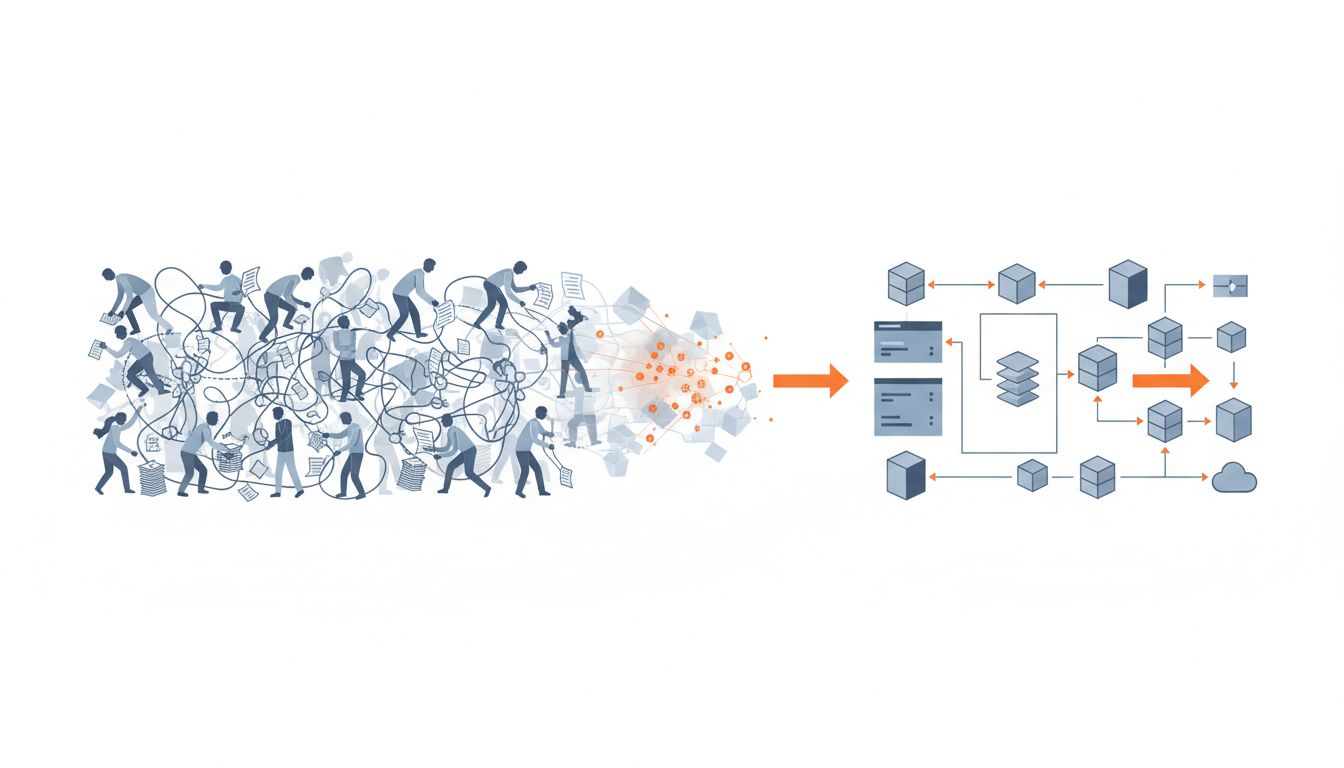

A friend of mine spent eight months building before he talked to a single paying customer. By the time he had something to show, the market had shifted slightly, his assumptions had calcified into architecture, and the first three prospects all said some version of “interesting, but not quite what we need.” He’d been so focused on making the product real that he never figured out what he was actually selling in the meantime.
Every startup goes through a pre-product phase where the pitch deck is more real than the software. What you’re transacting during that window matters enormously. Get it right and you build with momentum. Get it wrong and you build alone, then wonder why no one cares when you launch.
Here’s what’s actually on the table before the product ships.
1. A Specific, Named Problem
Before you have a solution, you can sell the diagnosis. This sounds abstract until you see it in practice. A founder who walks into a room and says “your sales team is losing deals because follow-up timing is inconsistent and nobody knows it” has already created value, even if the software to fix it doesn’t exist yet. They’ve named something the buyer felt but couldn’t articulate.
This is what earns a second meeting. Not a demo, not a roadmap, not a vision slide. The ability to describe someone’s problem better than they can describe it themselves is a credibility signal that no prototype can replicate early on. It tells the buyer you’ve done the work. It tells them you understand their world.
The mistake is skipping straight to the solution. “We’re building AI-powered follow-up automation” lands flat without the setup. “You’re losing deals in the silence between the second and third touch, and here’s exactly why” lands hard.
2. A Credible Point of View on What’s Changing
The strongest early-stage pitches aren’t product pitches. They’re market theses. Sequoia’s famous “why now” slide exists because investors (and early customers) are betting on a worldview before they’re betting on software. They want to know that you see something others don’t, and that you’re right.
This is why founders with genuine domain expertise close early customers that founders without it can’t touch. When a former logistics operations manager starts a freight software company and explains exactly why current dispatch tools are structurally broken, the buyer isn’t evaluating a product. They’re evaluating whether this person understands the problem deeply enough to be worth following.
Your point of view has to be specific and arguable. “Supply chains are getting more complex” is not a thesis. “The shift to nearshoring is creating a documentation mismatch that existing TMS software wasn’t designed to handle” is a thesis. One invites nodding, the other invites a real conversation.
3. The Feeling of Being Understood
This one makes engineers uncomfortable because it can’t be architected. But it’s real and it closes deals.
Early adopters aren’t buying a product. They’re buying the feeling that finally, someone gets it. They’ve sat through vendor pitches where the salesperson clearly had no idea what their day-to-day looked like. They’ve bought software that solved the wrong problem elegantly. When a founder sits across from them and demonstrates genuine understanding of their specific frustration, something shifts. That founder becomes a trusted insider rather than another vendor.
Stripe’s early growth leaned heavily on this. The founders talked to developers the way developers talked to each other, understood the actual pain of Authorize.net integration in a way that felt personal, and that recognition drove word-of-mouth before the product was anywhere near polished. You were buying into people who understood your world.
The tactical implication: spend more time in customer conversations doing active listening than talking. The goal of the first several meetings isn’t to explain your product. It’s to make the other person feel genuinely understood. Everything else flows from that.
4. Access to Your Brain
Many pre-product startups sell consulting and call it something else. That’s not inherently bad. Done intentionally, it’s a legitimate way to fund development, stay close to real problems, and build relationships that convert to paying customers later.
The risk is losing the thread. Consulting money can become a drug that keeps you comfortable while distracting you from building something scalable. The founders who navigate this well treat the early advisory or consulting relationships as paid discovery. Every dollar they earn from a customer’s problem is buying them information about what the product needs to become.
The founders who navigate it poorly end up running a services business with a product roadmap that never gets prioritized. Know which one you’re doing. As Seed Rounds Don’t Fund Companies, They Fund Stories argues, investors are funding a narrative trajectory, not just a current state. If your current state looks like a consultancy, you need a clear story about how you flip.
5. Social Proof Futures
Early customers aren’t just revenue. They’re evidence. And you can sell the evidence before it exists by making explicit what you’re asking for in exchange for your early pricing.
The deal, stated plainly: “We’re going to charge you less than this will cost when it’s fully built. In exchange, we’re going to ask you to be referenceable, participate in a case study, and give us candid feedback during development.” Most early adopters who genuinely believe in what you’re building will take that deal.
What this means is that your first ten customers are really buying a co-development partnership with delayed reciprocity. They get pricing and access. You get capital, feedback loops, and the social proof that makes customers eleven through one hundred easier to close. The transaction is mutual, it’s just asymmetric in time.
6. A Vision Worth Belonging To
The most underrated thing a pre-product startup sells is the ability to say “we were there early.” First employees, first investors, first customers all share this. There’s status in being early to something that matters, and for a certain kind of buyer or candidate, that status is genuinely valuable.
This doesn’t work unless the vision is real and the founder can articulate it without sounding like they’re performing. Authenticity is load-bearing here. People are good at detecting founders who have convinced themselves of a vision versus founders who actually see something.
The test: can you explain, in plain language, what the world looks like in five years if you win? Not market size numbers, not TAM slides. A concrete, specific, human description of how things will be different. If you can do that in a way that makes someone lean forward, you’re selling something real. If you can’t, no product launch will fix it.