

The Paradox That Shows Up Across Every Category
Microsoft’s Bing loses money. Google Search prints it. That much is obvious. Less obvious is what happens one level down from the top across dozens of product categories: the runner-up tends to generate better profit margins than the dominant player, even when it generates less revenue.
This isn’t a quirk. It’s structural. And once you see the mechanism, you’ll recognize it everywhere.
The pattern holds in enterprise software, cloud infrastructure, consumer devices, and streaming. AMD spent years losing money while Intel dominated semiconductors, then quietly rebuilt its margin profile as it took share from roughly 10% to above 30% without ever needing to win outright. Spotify carries thin margins while Apple Music, its closest serious rival in Western markets, operates as a near-zero-cost adjunct to hardware that Apple was already selling. The challenger position, it turns out, is often the most economically desirable place to sit.
The Cost of Owning the Market
Leading a category is expensive in ways that accounting statements capture poorly.
The market leader owns the expectations. When search goes down, users blame Google. When a cloud region fails, the story is about AWS. The leader absorbs the regulatory attention, the antitrust scrutiny, the congressional hearings. Google has spent over a billion dollars on antitrust defense in Europe alone over the past decade, with the DOJ cases in the United States adding further legal cost that no challenger in search faces at anything close to that scale.
Beyond legal exposure, the leader must maintain market-wide infrastructure. AWS prices storage and compute at rates that have to work for customers ranging from startups to the federal government, which means pricing decisions that optimize for retention across an enormous, heterogeneous base. The second-place player (historically Microsoft Azure, now genuinely competitive) can price selectively, target the segments where it has an advantage, and walk away from deals that don’t make sense.
There’s also the support cost of ubiquity. When you have 65% market share, roughly 65% of every strange edge case, every unusual configuration, every legacy integration problem is your problem to solve. The challenger handles fewer of those by default.
Challenger Economics: Lower Acquisition, Higher Selectivity
The second-most-popular product in a category competes for the same customers in a fundamentally different way than the leader. It doesn’t have to be the safe choice. It has to be the better choice for a specific kind of buyer.
This selectivity is a margin gift. Sales cycles for challengers tend to involve buyers who have already decided they don’t want the default option. They’ve already done the work of ruling out the market leader for some reason, whether that’s price, a specific feature gap, a contract dispute, or a philosophical preference for not concentrating vendor risk. The challenger’s sales team is often closing, not convincing. That distinction compresses sales cycle length and reduces the cost to acquire each customer.
In enterprise software, this shows up clearly in how companies like ServiceNow and Salesforce have operated in categories where they’re not the incumbent. When Salesforce entered the CRM space against Siebel, it didn’t compete everywhere. It targeted mid-market buyers who found Siebel too expensive and too complex. The customers it acquired in that period were pre-qualified by their own dissatisfaction with the leader, which made the unit economics of customer acquisition dramatically better than what Siebel faced defending its installed base.
The Investment Trap at the Top
Market leaders face a capital allocation problem that challengers don’t. They must invest to stay ahead across the entire product surface, even in areas that generate little differentiation.
Consider what it costs to be the leading smartphone operating system. Google invests in Android across hundreds of device manufacturers, thousands of app developers, and dozens of country-specific regulatory and carrier relationships. The Android ecosystem requires constant maintenance investment to preserve the conditions that make it dominant. Samsung, which runs Android and builds the second-most-popular smartphone line globally, collects a large portion of the premium smartphone margin without bearing the cost of maintaining the OS itself, without funding the Play Store infrastructure at scale, and without the legal exposure that comes with owning the platform.
This is the second-place structural advantage in its clearest form: Samsung benefits from Android’s dominance while Google pays to sustain it.
Apple is a more complex case because it owns the full stack, but even there, the pattern appears. Apple Music operates at minimal marginal cost because it runs on infrastructure Apple built for other reasons. Spotify, as the market leader in music streaming, must fund the negotiating position, the licensing infrastructure, the podcast acquisition strategy, and the international expansion that comes with trying to own the category globally. The result is a company that has struggled to convert strong revenue growth into consistent operating profit despite being the clear category leader by subscriber count.
Pricing Power Without Pricing Pressure
One of the less appreciated dynamics of the challenger position is the ability to price without defending a brand promise.
The market leader’s price becomes the reference price for the entire category. If Microsoft raises Office 365 prices, every business publication writes about it, enterprise IT departments reconsider their contracts, and the move becomes a news event. When a serious competitor raises prices, it’s barely noticed outside specialist circles.
This asymmetry matters because the leader’s price ceiling is lower than its market position might suggest. Google can’t charge enterprise search customers ten times what they currently pay, not because the value isn’t there, but because the political and reputational cost of that move would be enormous. A challenger with a strong offering in a specific segment faces none of that constraint. It can price at a significant premium to the market rate in the niches where it genuinely outperforms, because its customers have already self-selected as people who value something specific about what it offers.
Zoom is a reasonable example here. Before its dominance of video conferencing during 2020, it was a well-regarded challenger to Cisco WebEx and Microsoft Skype for Business in certain enterprise segments. In those segments, it charged premium prices and maintained good margins. Webex, as the market leader for most of the previous decade, spent significant resources defending its installed base at prices it couldn’t easily move.
The Moat Problem Cuts Both Ways
The standard argument for chasing market leadership is moat construction. Network effects, switching costs, and data advantages compound over time for the leader and make the position progressively harder to dislodge.
This is true. But the moat is also a cage.
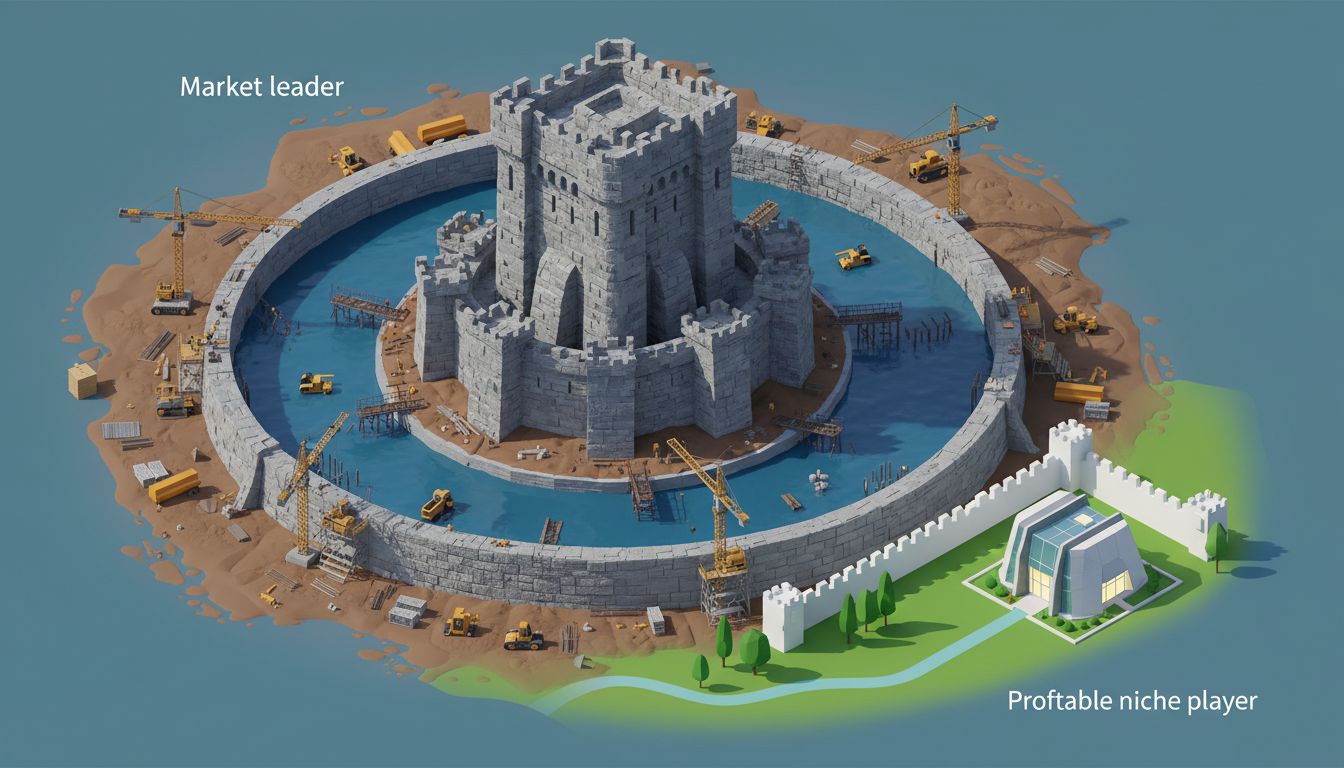
The investments required to build and maintain a moat reduce the return on that moat. Google’s search moat requires continuous investment in crawling infrastructure, quality raters, algorithmic development, and legal defense. The moat generates enormous revenue, but the margin on that revenue is constrained by the cost of the moat itself. A challenger in a category with strong moats faces a different problem: it typically knows the moat will hold, so it doesn’t try to attack it directly. Instead, it carves out adjacent positions where the moat doesn’t extend, serves customers the leader has de-prioritized, and builds a profitable business in the shadow of a market that the leader effectively defines and funds.
This is precisely the second-company dynamic that shows up in market after market. The first company builds the category. The second company builds the business.
When the Pattern Breaks
None of this means the second-place position is always more profitable. The pattern breaks in a few specific conditions.
In winner-take-all markets, where network effects are so strong that the value of the second network is near zero, challengers don’t accumulate profitable niches. They bleed. Myspace after Facebook. Betamax after VHS solidified. The challenger’s margin advantage depends on having real customers who have made a genuine choice to prefer it, not on being the last alternative standing in a dying product.
The pattern also breaks when the challenger is burning cash to maintain its position through subsidized pricing. WeWork was, for a period, the second-most-used flexible office provider in several cities. That position was funded by investor capital at margins well below sustainable. The structural advantages of the challenger position don’t apply when the business model requires indefinite subsidy to hold the position.
And in markets with very high fixed costs, like semiconductor fabrication, the leader’s scale advantages in amortizing capital expenditure can simply overwhelm the challenger’s cost structure. TSMC’s manufacturing economics improve with every additional wafer it produces. A smaller fabrication company can’t necessarily offset that with selectivity.
What This Means
For investors, the implication is that market share rankings are a poor proxy for where profits actually accumulate. The race for category leadership is often a race toward lower margins, higher regulatory risk, and greater capital requirements. The player at position two in a growing market, with a clear segment it owns and improving unit economics, is frequently the better financial bet.
For product teams, this reframes the entire goal of a competitive strategy. Trying to unseat the category leader is usually a mistake not because it’s impossible but because winning would eliminate the structural advantages that made the position profitable. The question isn’t how to take the top spot. It’s how to make the second position as defensible and as specific as possible. Specificity of value proposition is what preserves the pricing power and the customer quality that make the challenger economics work.
For anyone building a business, this pattern suggests that the healthy response to being outgrown by a competitor isn’t always to match them. Sometimes the right move is to get more deliberately smaller, own a real segment completely, and let the market leader pay the costs that come with the crown.