
The AI industry has spent years in a scaling race, chasing the assumption that more parameters mean better performance. GPT-4 has an estimated trillion-plus parameters. Gemini Ultra is similarly massive. The implicit message: bigger is smarter. But for most practical software applications, this framing is backwards. A model that can discuss philosophy, write poetry, and explain tax law is impressive at a demo. It’s often overkill, and sometimes actively worse, for a company that just needs to extract structured data from invoices.
Model compression isn’t a compromise. It’s often the right engineering decision.
What ‘Smaller’ Actually Means
When engineers talk about shrinking a model, they’re usually referring to one of a few techniques. Quantization reduces the numerical precision of the weights (the learned parameters) from 32-bit floating point numbers down to 8-bit or even 4-bit integers. This cuts memory usage and speeds up inference without retraining from scratch. Pruning removes weights that contribute little to the output, essentially finding and deleting the parts of the network that aren’t pulling their weight. Distillation is the more elegant approach: you train a smaller “student” model to mimic the behavior of a larger “teacher” model, transferring knowledge rather than just trimming it.
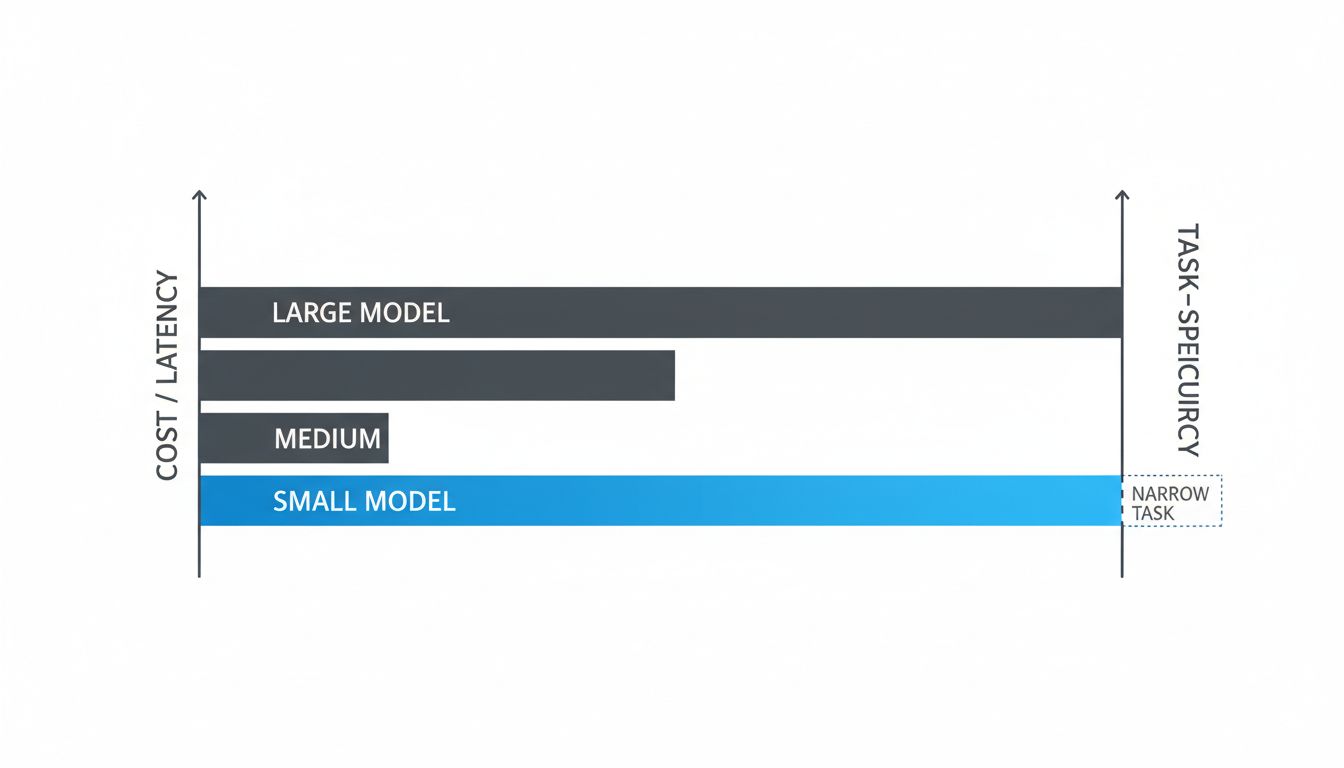
Meta’s LLaMA 3 family is a practical example worth understanding. The 8-billion parameter version runs comfortably on a single consumer GPU. The 70-billion parameter version requires serious hardware. The 8B model doesn’t do everything the 70B does, but for many tasks, particularly classification, summarization, and structured extraction, the gap in quality is small while the gap in cost and latency is enormous.
The Latency Problem Nobody Talks About Enough
Here’s a scenario that plays out constantly in production systems. A team integrates a large language model into a customer support workflow. The model is genuinely impressive. It handles nuanced queries well. But response time is 4-6 seconds. Users, it turns out, will tolerate a slow human but not a slow chatbot. The product feels broken even when it’s working correctly.
Latency isn’t just a user experience issue. It compounds. If your model is part of a pipeline where you’re running multiple inference calls (say, extracting information, then classifying it, then generating a response), each step’s latency multiplies the problem. A smaller model that responds in 400 milliseconds instead of 4 seconds doesn’t just feel faster. It changes what architectures are even feasible.
This connects to a broader truth about software that good engineers internalize early: the theoretical best solution and the deployable best solution are different things. A model that’s 3% more accurate but 10x slower will lose to the faster one in most real-world contexts.
Specialization Beats Generalization for Defined Tasks
General-purpose large models are trained on enormous, diverse datasets to perform well across as many tasks as possible. This is genuinely useful when you don’t know what you need. But when you do know what you need, that generality becomes overhead.
Fine-tuning a smaller model on domain-specific data consistently outperforms larger general models on narrow tasks. Microsoft’s research into fine-tuning smaller models for code-specific tasks showed this clearly: Phi-2, a 2.7-billion parameter model, was outperforming much larger general models on coding benchmarks when evaluated on the specific types of code tasks it was tuned for. The reason isn’t magic. A smaller model trained heavily on medical records learns the vocabulary, formatting patterns, and common structures of that domain. It develops a strong prior for what it’s likely to see. A massive general model has to reason through the same problems with much weaker domain-specific signal.
This is the same intuition behind why specialized tools beat general ones at specific jobs. A chef’s knife and a Swiss Army knife are both useful. You wouldn’t butcher a chicken with the latter.
The Cost Argument Is More Serious Than It Looks
Running inference on a large frontier model is expensive in a way that doesn’t always show up clearly in early prototypes. During development, you’re making hundreds of calls. In production, you might be making millions. The economics change completely.
OpenAI’s pricing for GPT-4 class models versus smaller models like GPT-3.5 or the more recent GPT-4o-mini reflects roughly a 10-20x cost difference per token depending on the use case. At prototype scale, this is invisible. At production scale, it’s the difference between a feature being profitable or not.
Beyond direct API costs, there’s the infrastructure angle. If you’re self-hosting (which many companies choose for data privacy reasons), a model that fits in 16GB of VRAM runs on hardware that’s orders of magnitude cheaper than a model requiring multiple high-end GPUs. This matters especially for companies that want to keep sensitive data on-premises rather than sending it to an external API.
When Bigger Models Genuinely Win
It’s worth being honest about the cases where large models are the right call. Complex multi-step reasoning, creative tasks with high ambiguity, and situations where the cost of a wrong answer is very high (medical diagnosis assistance, legal analysis) often benefit from the additional capacity of larger models. When you need a model to handle genuinely open-ended tasks across wildly varying inputs without fine-tuning, size provides robustness.
The failure mode to avoid is defaulting to the largest available model because it feels safer. It feels safer the same way building on top of a complex framework feels safer than writing targeted code. Sometimes it is. Often it’s just more. The engineering judgment is figuring out which situation you’re actually in, not which one sounds more impressive in a technical design document.
Smaller models also require more upfront investment in data curation and fine-tuning. If you don’t have clean, domain-specific training data, or the engineering capacity to build that pipeline, a larger general model with good prompting might genuinely be the more practical path. This is a real tradeoff, not an excuse to avoid thinking.
The Practical Takeaway
The question to ask when reaching for a large model isn’t “is this the most capable model available?” It’s “what’s the smallest model that handles this task reliably, given my latency, cost, and accuracy constraints?”
Start with that framing and work outward. Benchmark smaller models against your actual task first. Fine-tune on your domain data before concluding that a tiny model can’t do the job. Profile latency under realistic load before assuming the cost of a bigger model is worth it. Most engineers who do this are surprised by how much capability lives in a well-tuned small model.
The best tool is the one that solves the problem in front of you. In AI right now, that tool is smaller than most people reach for.