

There’s a moment in every tech market where a clear winner emerges, and the business press declares the race over. Google beat Yahoo. Facebook buried MySpace. AWS lapped everyone in cloud. The narrative writes itself: the winner takes all, the losers go home.
Except the losers often go home with more cash.
This isn’t a contrarian take for its own sake. It’s a pattern that keeps showing up in the economics of technology companies, and it’s worth understanding why, especially if you’re building something or deciding where to compete.
1. The Winner Spent Everything Getting There
Being first, or fighting hardest to be first, is expensive in ways that compound long after the battle is won. The company that wins a market through aggressive expansion has usually burned through capital on sales teams, infrastructure buildout, below-cost pricing to kill competitors, and marketing designed to establish dominance rather than generate return.
Uber is the clearest modern example. Uber won. Nobody seriously disputes that. And for years after winning, Uber was still losing billions annually on subsidized rides, driver incentives, and geographic expansion into markets that may never be profitable. Meanwhile, Lyft, smaller and definitively second, was operating a tighter business with less geographic exposure and clearer unit economics per market. Being number two gave Lyft permission to be selective.
The winner often has to defend every front. The second-place player gets to choose which battles to take seriously.
2. R&D Costs Get Socialized, and Second Place Pays Less
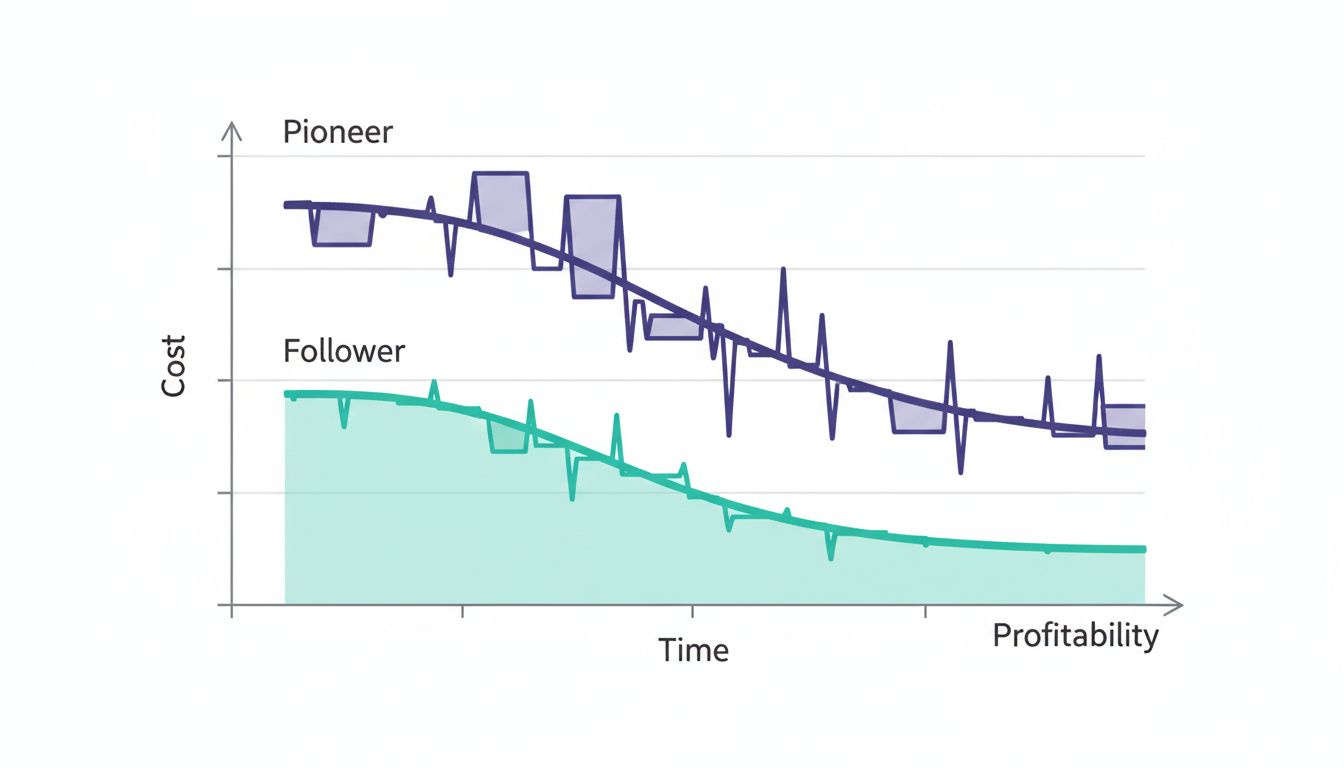
The company that pioneers a technology pays to figure out what works. The one that follows pays only for what they’ve decided to build, informed by watching someone else’s expensive mistakes.
This is why Bing, despite being a punchline for years, has actually been a reasonable business for Microsoft. Google built the search infrastructure, established user expectations, trained the ad market. Microsoft arrived with a working template and competed on the margin. They didn’t have to invent web search; they had to be good enough at it while cross-selling into enterprise relationships where they already had leverage.
The R&D logic applies at every level. Second-place companies hire engineers who learned their craft at the pioneer. They adopt infrastructure patterns the leader validated. They enter a market where customer education has already happened. The pioneer paid for all of that.
3. Second Place Gets to Be Boring, and Boring Scales
There is a particular kind of pressure on the market leader that has nothing to do with competition. It’s the pressure to keep being interesting. Investors, press, and customers expect the category-defining company to keep defining the category. That pressure pushes leaders into product sprawl, premature platform plays, and acquisitions that look strategic in a deck and turn into integration nightmares.
The second-place company doesn’t have to do any of that. It can focus. It can say no to adjacent markets. It can serve a specific customer segment better than the leader ever will, because the leader is trying to serve everyone.
This is exactly what happened with Salesforce and its smaller CRM competitors in the early years. Salesforce had to be the platform, the AppExchange, the enterprise standard. Companies like SugarCRM or later Pipedrive could ignore all of that and just build a better sales tool for a specific kind of team. Many of them had better margins doing it.
4. The Talent Equation Flips After Year One
Winning companies attract talent during the sprint. They can recruit aggressively, offer big packages, and make compelling pitches about being part of history. Then they win, and something changes.
The people who joined to be at a scrappy company fighting for something are now at a large, successful company maintaining something. A different kind of person is motivated by that. The best engineers, the ones who want to be building rather than defending, start looking sideways at the second-place company, which still has problems worth solving.
This talent drift is subtle and underreported, but it’s real. Netflix benefited from this when blockbuster-era video rental won and then stagnated. Second-place players in cloud infrastructure regularly pull engineers who built the thing at AWS and found the internal bureaucracy stifling. You can sometimes recruit the people who know the most about the market precisely because they built the market and found winning it disappointing.
5. Second Place Attracts the Customers the Leader Ignores
Every dominant tech company eventually starts optimizing for its most lucrative customer segment, which means everyone else becomes an afterthought. Enterprise software is full of this. Salesforce got expensive and complex, which handed a generation of SMB customers to HubSpot. Oracle’s database pricing became aggressive enough to make PostgreSQL and then a wave of cloud databases commercially viable.
The second-place company often finds a natural customer base in the people the leader has priced out, underserved, or actively annoyed. These customers tend to be loyal, because they’ve already been burned once and don’t want to go through an evaluation process again. That loyalty translates into lower churn and better lifetime value.
This is a better foundation than it sounds. You’re not scraping for customers the leader didn’t want. You’re building a business out of the people who were actively pushed out of the winner’s ecosystem, and they come with a grudge that keeps them from leaving.
6. Profitability Was Never the Metric That Won the War
The final piece is the most important one. The companies that win tech markets are almost never optimizing for profit during the winning phase. They’re optimizing for market share, user growth, network effects, whatever metric makes the case that they’ll deserve the profits later.
This is rational behavior for a market capture strategy. It is not the same thing as building a profitable business. The company that finishes second often got there because it wasn’t willing to burn money at the same rate, which means it was building sustainable unit economics while the winner was deferring that problem indefinitely.
The winner then has to figure out how to extract profit from the empire it built. That transition is genuinely hard, and many companies never fully make it. The second-place company is already there, with a smaller and more defensible business that actually makes money.
This is not an argument for losing on purpose. It’s an argument that in technology, the definition of winning deserves more scrutiny than it usually gets.