
The simple version
When an AI model tells you it’s 94% confident in an answer, that number describes something about its internal probability distribution, not whether the answer is correct. Treating it as a reliability score will get you into trouble.
What confidence scores actually measure
Most AI systems, when they surface a confidence score, are reporting something derived from the model’s output probabilities. At a basic level, the model is choosing between possible next tokens (words, characters, or chunks of text), and it assigns probability weights to each option. A high confidence score usually means the model committed strongly to one option rather than spreading probability across many alternatives.
This is a measure of decisiveness, not accuracy.
A model can be completely, decisively wrong. If it has learned incorrect information, or if it’s pattern-matching to something that looks superficially similar to the question you asked, it will often do so with high confidence. The model doesn’t know what it doesn’t know. It’s not reasoning about its own reliability the way a careful human expert might say “I’m pretty sure about the framework, but you should double-check the specific statute numbers.”
The calibration problem
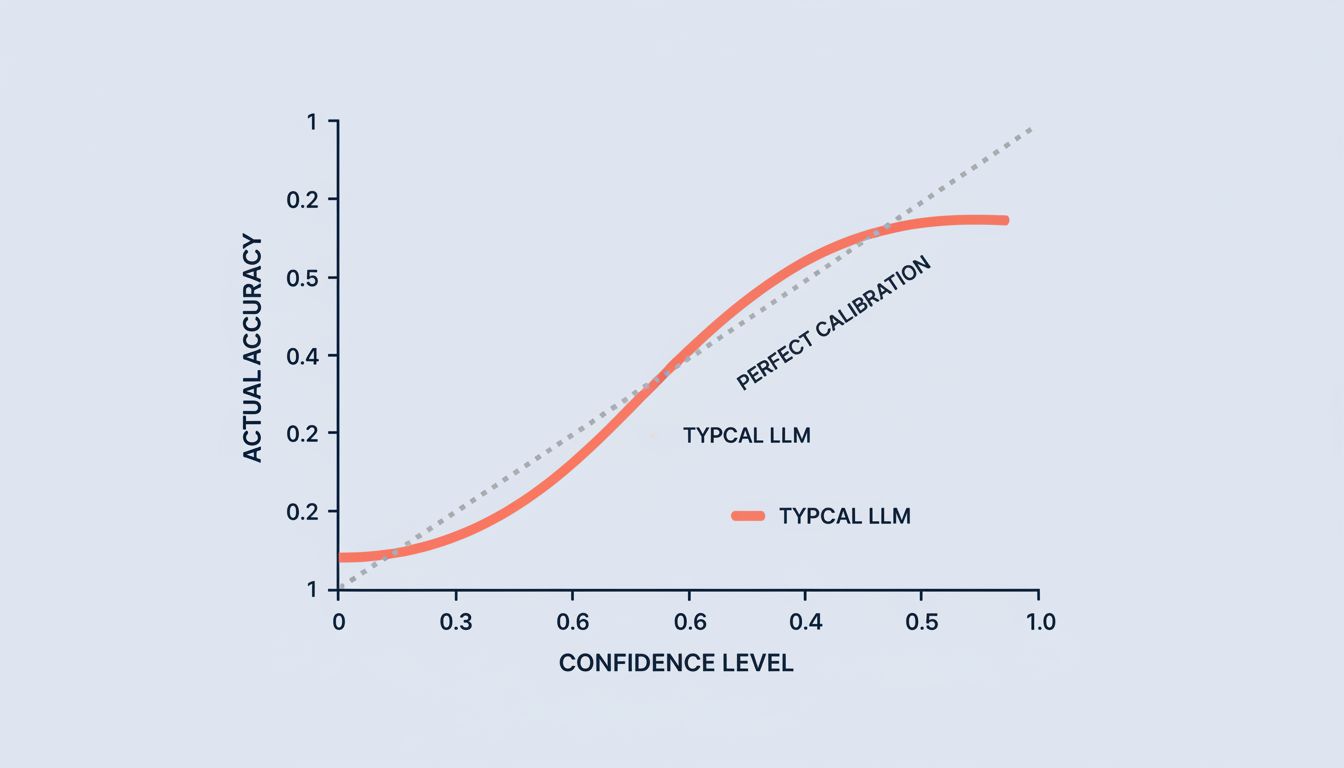
There’s a technical concept called calibration that describes how well a model’s confidence scores correspond to actual accuracy rates. A perfectly calibrated model that says “I’m 70% confident” would be correct exactly 70% of the time when it expresses that level of confidence. In practice, most large language models are poorly calibrated, and the direction of the error matters.
Research on large language models has consistently found that they tend to be overconfident, particularly on questions that fall outside their training distribution or that require precise factual recall. The model generates fluent, authoritative-sounding text because that’s what it was trained to do, and the confidence score often reflects that fluency rather than underlying correctness.
Making things more complicated: different tasks have wildly different accuracy profiles at the same confidence level. A model might be genuinely reliable at 90% confidence for common coding patterns and completely unreliable at 90% confidence for obscure legal questions, but the score won’t tell you which situation you’re in.
Where it breaks down in practice
Consider code generation. When an AI writes code confidently, the confidence score captures how predictable that code was to generate given the training data, not whether it will actually run correctly or handle edge cases. As we’ve covered before, the AI writing your code has never run it, and its confidence reflects pattern completion, not execution testing.
The same dynamic applies to factual questions. Ask a model about a well-documented historical event and a high confidence score is somewhat meaningful, because lots of correct information about that event existed in the training data. Ask it about something recent, niche, or requiring precise numerical recall, and you’ve changed the underlying reliability completely while the confidence score stays in the same range.
The failure mode that hurts people most in practice is the confidently wrong edge case. A model might handle 95% of questions in a domain correctly, and for the other 5%, it produces answers that are wrong but stated with the same assured tone and similar confidence scores. There’s often no signal in the output to tell you you’ve hit one of those cases.
What to use instead
You can’t fix the underlying problem, but you can route around it.
Cross-check on anything that matters. If the answer is consequential, verify it through a separate source. Not a second AI query to the same model (which will often reproduce the same error with equal confidence), but an external reference. The model’s confidence score is not a substitute for this step.
Pay attention to the shape of the answer, not the score. A model that hedges, surfaces multiple interpretations, or notes where it’s less certain is often being more honest than one that delivers a clean, confident summary. Counterintuitively, expressed uncertainty in the text is sometimes a better reliability signal than a high confidence number.
Learn the failure modes of your specific use case. If you’re using a model for a particular domain repeatedly, invest time in understanding where it tends to go wrong. That knowledge is worth more than any confidence score the interface surfaces. Test it on questions you already know the answer to, specifically in the categories where errors would matter most to you.
Use confidence scores comparatively, not absolutely. If you ask the same model the same type of question repeatedly, a notably lower confidence score on one response is a meaningful signal to dig deeper, even if you can’t treat the absolute numbers as reliable. The relative drop tells you something even when the baseline doesn’t.
Ask the model to explain its reasoning. This isn’t foolproof, but a model that can walk through a coherent chain of reasoning is somewhat more trustworthy than one that delivers a bare answer. It also surfaces the assumptions, giving you places to check.
The right frame
Think of AI confidence scores the way you’d think about a very fast, very well-read colleague who has never had to be accountable for being wrong. They’re often right, frequently useful, and almost always sound sure of themselves. The confidence in their voice doesn’t tell you how carefully they’re reasoning. You still need your own judgment about when to verify.
The score isn’t useless. Extremely low confidence is a real signal worth taking seriously. But the high end of the range gives you less than it appears to. Use it as one weak data point, not as permission to stop thinking.