

A founder I know spent six months agonizing over his first hire. He had a working product, a handful of paying customers, and a co-founder who handled design. The question wasn’t whether he needed help. It was what kind. He made a list of everything that felt hard, ranked the items by pain, and hired for the top item on the list: customer support.
Two years later, he told me it was the worst decision he ever made. Not because the person was bad. She was excellent. But hiring for support first told the rest of the team, the early employees who came after, that this company’s primary concern was managing existing customers rather than acquiring new ones. The culture that formed around that belief nearly killed the growth phase before it started.
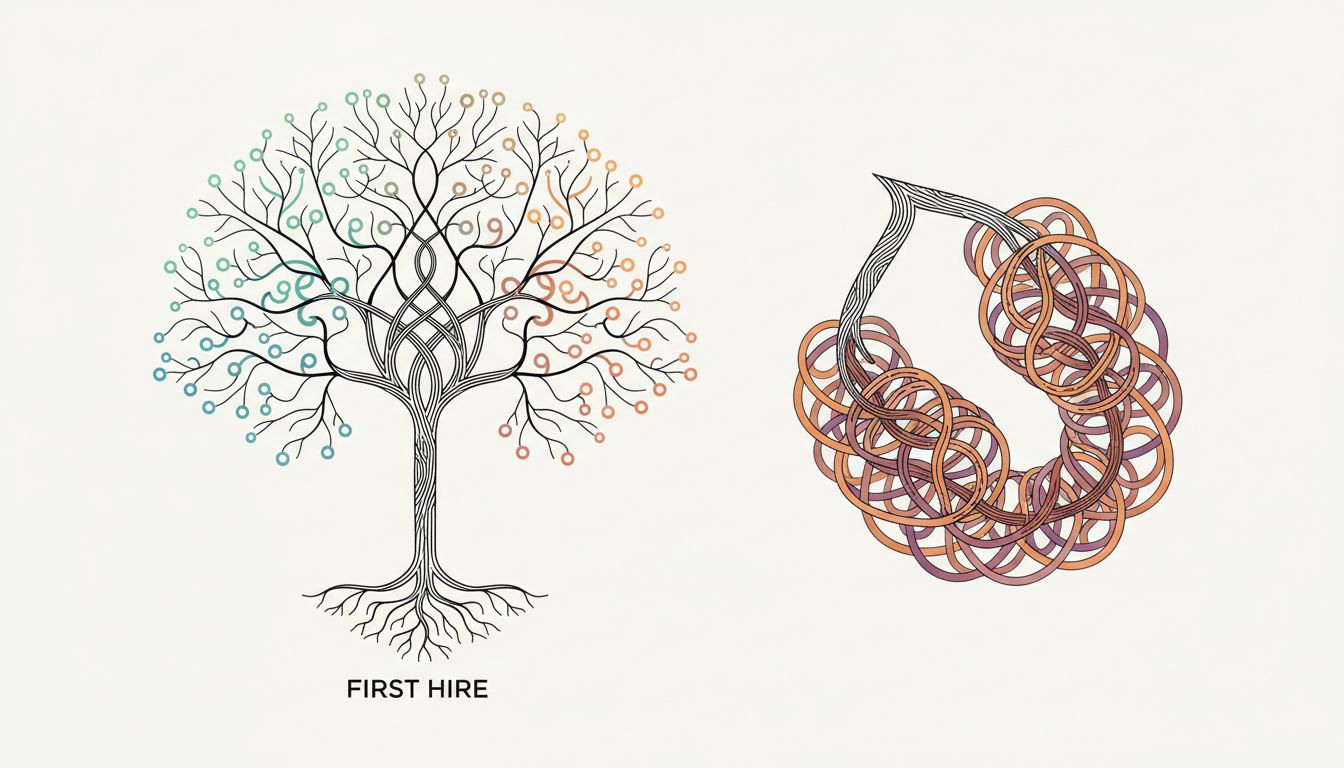
Your first hire is not a staffing decision. It is a thesis statement. It tells the world, and more importantly your next ten hires, what you believe the hard problem actually is.
The Org Chart Is a Theory of the Business
Every hiring decision encodes a belief about where value gets created. When a two-person startup hires a salesperson first, they’re saying: we have something worth selling and the constraint is distribution. When they hire an engineer first, they’re saying: the product isn’t ready and building is the constraint. When they hire an office manager first, they’re saying something that probably doesn’t end well.
The problem is that most founders don’t make this explicit. They experience a pain, they hire to relieve it, and they never articulate the underlying theory. That theory gets baked into the culture anyway, just without anyone examining it. You’ve written a thesis you’ve never read.
The org chart that emerges from your first three to five hires is a map of what the founders believed the company needed to become. Teams organize around problems. The problems you staffed first are the problems the company learns to see. Everything else becomes, subtly, someone else’s concern.
Why Early Hires Compound Differently Than Later Hires
The reason this matters more at the start than at, say, hire number fifty, is compounding. Your first three employees don’t just do work. They build the informal norms, the communication patterns, the unstated values that persist long after they’ve left or grown into different roles. They are the culture’s founding document.
When Stripe was early, the Collison brothers were famously obsessive about developer experience. Their first technical hires came from that same belief system. That wasn’t an accident of who applied. It was a filter built on a thesis: the hard problem in payments is not fraud or compliance, it’s that building with payment infrastructure is miserable. Hire to solve the hard problem as you actually understand it.
The inverse is equally instructive. Startups that hire their first VP of Sales before they have repeatable revenue often spend years mistaking a distribution problem for a product problem. They hired a closer when they needed a discoverer. The thesis was wrong, and the team that formed around it kept solving for the wrong constraint.
The Question You’re Actually Answering
Before you post a job description, answer this question out loud: what is the one thing that, if we don’t get right in the next twelve months, makes everything else irrelevant?
Not what’s painful. Not what’s annoying. What’s existential.
If the answer is that your product works but nobody knows it exists, your thesis should be that growth and distribution are the constraint, and your first hire should embody that belief. If the answer is that people try the product and leave, your thesis is that retention and product quality are the constraint, and you hire accordingly. If the answer is that you’re about to close three large enterprise deals and can’t staff the implementation, your thesis might be that operational credibility is the constraint.
These sound obvious when stated plainly. The problem is that founders rarely state them plainly. They reach for the job title that sounds most like what successful startups have (a Head of Growth, a VP of Engineering, a Product Manager) rather than reasoning from first principles about what their specific company actually needs right now.
The job title is the last thing you should choose. The thesis comes first.
What Gets Baked In That You Can’t Unbake
Here’s the part that makes this consequential beyond just the hire itself: early employees shape your next round of hiring in ways that are almost impossible to undo.
They write the job descriptions. They do the initial screens. They decide what questions to ask in interviews. They onboard new hires and pass on what they believe the company values. If your first engineer cared deeply about code quality and test coverage, the engineers who join after her will be filtered and socialized toward that standard. If your first salesperson believed in high-volume outbound, the sales culture that forms will optimize for activity over relationship.
This is not a reason to be paralyzed. It’s a reason to be intentional. You’re not hiring a person. You’re instantiating a set of values and a problem-solving orientation that will recruit in its own image for years.
The founders who get this right don’t have better judgment about individual candidates. They’ve done harder work before the search begins. They’ve written the thesis out, argued with it, revised it, and stress-tested it against what they actually believe is true about their market and their moment. The hire is the easy part once the thesis is honest.
Getting It Wrong Is Survivable. Not Knowing You Got It Wrong Isn’t.
You will probably make at least one early hiring mistake. Almost everyone does. Wrong role, wrong timing, right person for a company that doesn’t exist yet. That’s recoverable.
What’s harder to recover from is not knowing why the mistake happened. If you hired because something felt urgent and you never interrogated the thesis underneath that urgency, you’ll make the same mistake again with the next hire. The pattern becomes structural.
Before you open the search, write a paragraph. Not a job description, not a list of requirements. A paragraph that answers: what do I believe is the primary constraint on this company right now, and why does this hire address that constraint directly? If you can’t write it cleanly in a hundred words, you don’t have a thesis yet. You have anxiety. Hire from a thesis, not from anxiety, and you’ll be surprised how much clarity it creates for everything that comes after.