A B2B SaaS founder I know spent six months grinding through a pricing problem. Signups were decent but conversions to paid were stuck around 2%. He tried longer trials. He simplified onboarding. He added a cheaper tier. Nothing moved the number. Finally, on the advice of a mentor who’d seen this before, he did the opposite of everything his gut was telling him: he tripled the price of his core plan.
Conversion rate went to 7% in the following quarter. Same product. Same marketing. Just a different number on the checkout page.
This isn’t a fluke. It’s a pattern that shows up repeatedly in SaaS, in professional services, in consumer products. And the reason it works cuts against almost everything founders are told about growth.
Low Prices Attract the Wrong Buyers
When you price too low, you pull in tire-kickers. You attract people who are mildly curious, not people who have a real problem. You optimize for volume over fit, and that mismatch shows up everywhere: in support tickets, in churn, in users who sign up and never log back in.
High-intent buyers, the kind who actually implement your product and stick around, are often willing to pay significantly more. They’re not hunting for the cheapest option. They have a problem that costs them time or money, and they need it solved. For them, a low price raises questions rather than lowering barriers. They wonder what’s missing. They wonder if it’ll hold up at scale. They wonder why it’s so cheap when the competition charges more.
This is the signal function of price. A number on a pricing page doesn’t just describe value, it asserts it. Price is, among other things, a credibility claim. When you charge $15/month for something your competitor charges $150/month for, a reasonable buyer’s first thought isn’t “great deal.” It’s “what’s wrong with it.”
The Conversion Math Nobody Does
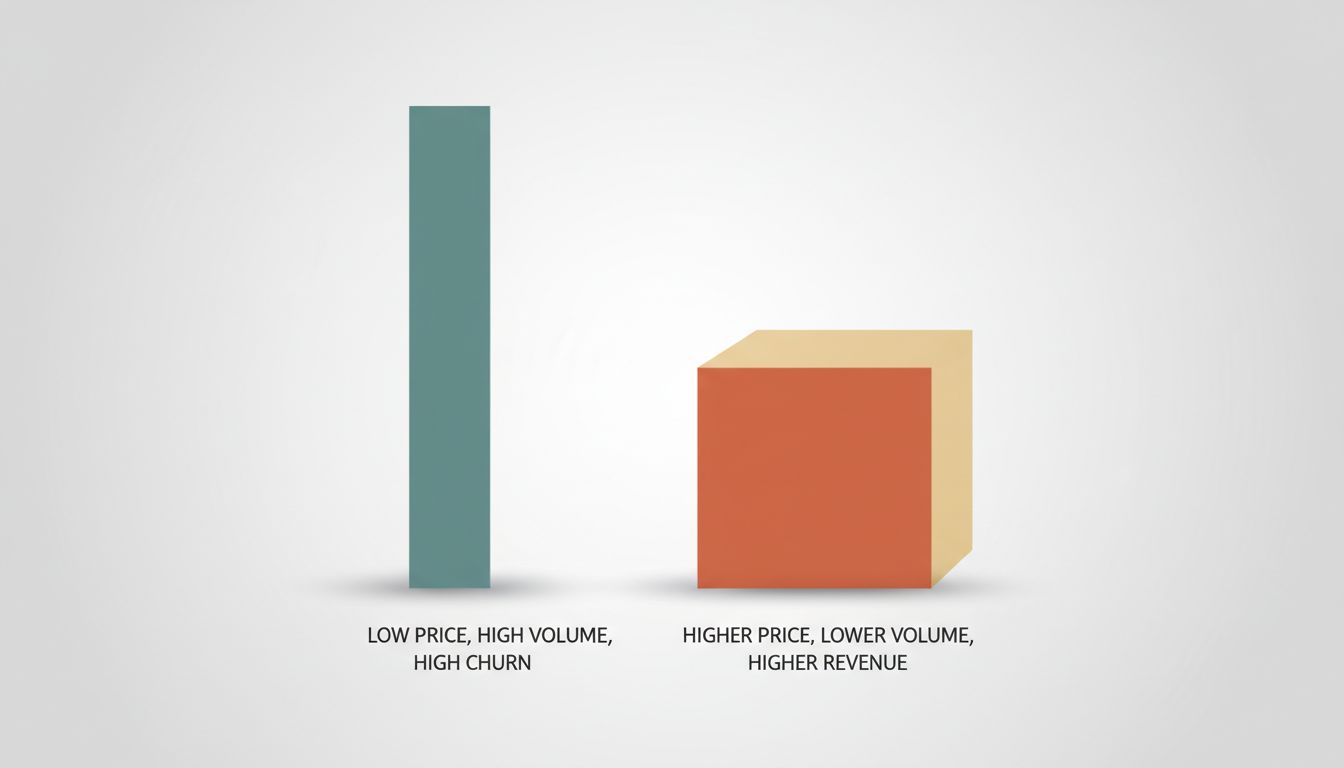
Founders talk about conversion rates like they’re independent of price, and they almost never are. A 2% conversion rate at $15/month and a 7% conversion rate at $50/month aren’t even close to equivalent, and that’s before you factor in that the higher-priced customers tend to churn less.
The obsession with raw conversion rate is a trap. What you actually care about is revenue converted and customers retained. Cheap plans that convert well but churn at 10% monthly are destroying you. You’re running fast to stay in place. As the piece on why the second-best product often makes more money gets at, pricing and positioning decisions often matter more than product quality in determining who actually wins commercially.
When you raise prices and conversion actually improves (which doesn’t always happen, but happens more than people expect), the math compounds quickly. You’re not just making more per customer. You’re acquiring customers who were genuinely sold, who wanted the thing, who integrated it into their workflow because it felt like a real purchase, not an experiment.
What Raising Prices Actually Tests
Here’s what I’ve seen happen when companies raise prices thoughtfully: the process forces a clarity they didn’t have before.
You can’t charge $500/month and mumble through your value proposition. You can’t charge enterprise rates and have a homepage that reads like a generic SaaS template. Raising prices creates pressure to articulate why. That pressure produces better copy, better sales conversations, better onboarding sequences. The price increase is the forcing function; the product and messaging improvement are the real driver of the better conversion.
There’s also a selection effect on your own team. When you’re charging real money, support and customer success start taking a different posture. You invest differently in onboarding. You pay more attention to whether customers are actually getting value. The internal culture around customer success shifts when a churned account means $18,000 a year lost instead of $180.
When This Doesn’t Work
This is a real phenomenon, not a universal law. Raising prices doesn’t fix a product that doesn’t work. It doesn’t fix a category where buyers genuinely are price-sensitive and the value prop is thin. And it doesn’t fix a situation where you haven’t earned the right to charge more yet, where your product is genuinely early and rough and you’re still figuring out what problem you actually solve.
The price increase that improves conversion is almost always happening in a context where the founder was systematically underpricing a real value. They knew the product was good. Customers who used it loved it. Churn among engaged users was low. The problem was that the price was sending the wrong signal before the customer ever got started.
If your product is half-finished, your retention is poor, and your NPS is underwater, raising prices will not save you. It’ll just surface your real problems faster. Which, honestly, might not be the worst thing.
The Ceiling Is Almost Always Higher Than You Think
Most founders set prices by looking at competitors, finding the median, and shading down a little to be “competitive.” This logic feels safe. It is not. It’s a race to the bottom dressed up as market research.
The customers you most want are rarely choosing on price. They’re choosing on trust, fit, and evidence that your product will do what you say. Your price tag, as I’d argue elsewhere on this site, is writing your product roadmap whether you intend it to or not. It defines who shows up, what they expect, and what you’re obligated to deliver.
The founder who tripled his prices wasn’t being aggressive. He was finally aligning his price with what the product was actually worth to the customers it was designed for. Sometimes the most tactical thing you can do is stop apologizing for your price.