
In 2009, Airbnb was keeping the lights on by renting air mattresses to conference attendees in San Francisco. The people booking those mattresses were a very specific kind of traveler: broke, adventurous, willing to sleep on a stranger’s floor because every hotel in a ten-mile radius was sold out. They loved Airbnb. They were also almost nobody’s idea of a mainstream customer.
Here is the thesis: the customer who saves your startup in year one is often structurally incompatible with the company you need to build by year three. Not because they’re bad people or bad customers. Because early adopters, anchor clients, and desperate-use-case users optimize your product for themselves, and that optimization can quietly foreclose the future you actually want.
The Anchor Client Problem
Slack did not start as Slack. It started as Glitch, a massively multiplayer online game that was failing in slow motion. The internal chat tool the team built to coordinate game development was, in retrospect, more interesting than the game. So Stewart Butterfield pivoted.
But Slack’s first real traction came from technical teams, specifically developers who already had strong opinions about workflows, integrations, and APIs. That audience shaped the product deeply. Slack became extraordinarily good at things developers care about and noticeably awkward for the non-technical teams that would eventually represent most of its market. The product’s early DNA, its integration-first architecture, its keyboard-heavy UX, reflected the people who adopted it first. Onboarding a 60-person marketing agency in 2015 felt like asking someone to use a product that had been designed for someone else. Because it had been.
The Power User Trap
Spotify’s early free tier attracted a user type that no streaming service can actually build a business on: people who wanted unlimited music and were philosophically opposed to paying for it. These users were vocal, technically sophisticated, and extremely good at finding workarounds. They flooded forums, wrote browser extensions to skip ads, and treated the free tier as a permanent lifestyle rather than a conversion funnel.
The problem wasn’t just revenue. It was that this cohort provided enormous amounts of feedback, filed bug reports, joined betas, and generally made themselves heard. Product teams, rationally, respond to the people talking to them. So Spotify spent real engineering cycles optimizing an experience for users who were never going to convert. The ad-supported tier got better. The value proposition for paying got fuzzier. It took years of deliberate constraint, including limiting free mobile listening, to start fixing the conversion math.
The Enterprise Anchor
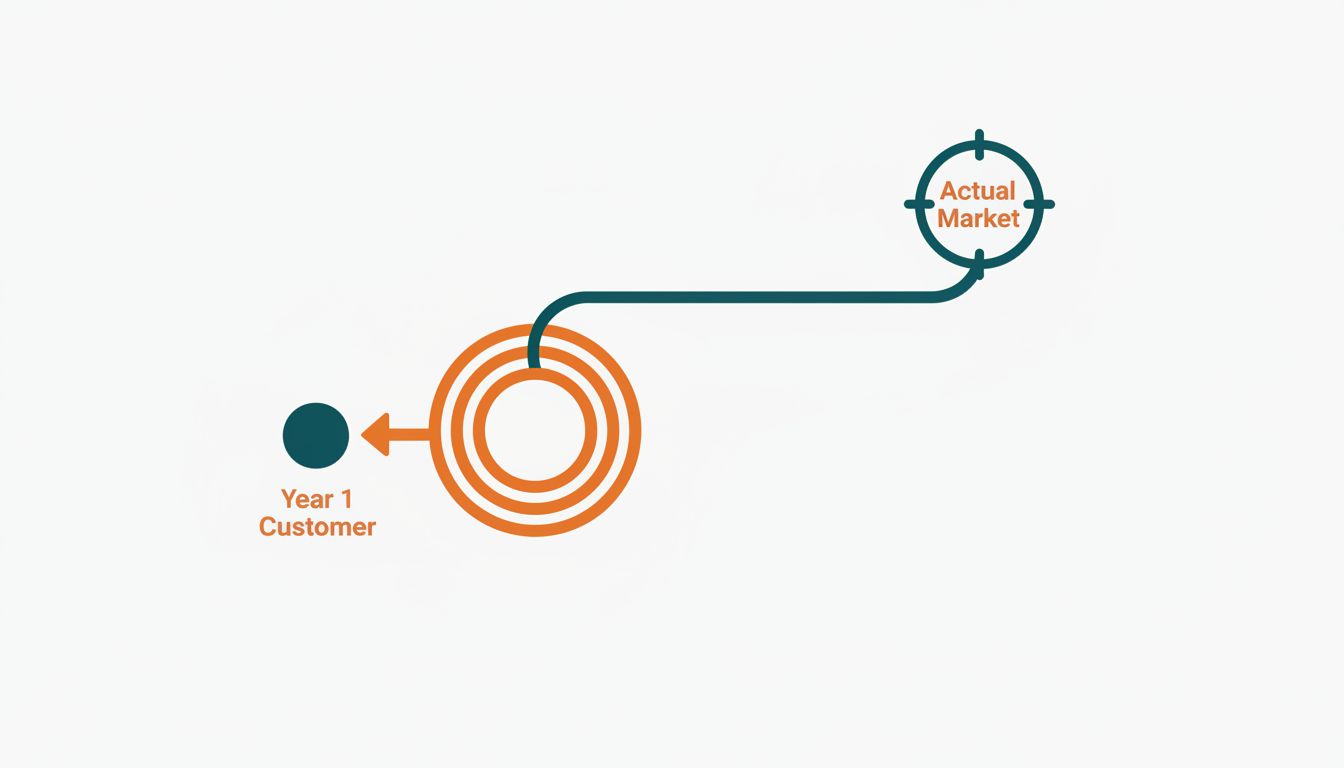
This problem runs in both directions. Early-stage B2B startups often land one large customer who accounts for 60 or 70 percent of revenue in year one. That customer becomes the de facto product manager. Their feature requests jump the queue. Their integration requirements shape the architecture. Their security review defines the compliance posture.
Then the startup tries to sell to customer number two, who has completely different requirements, and discovers that the product has been custom-built for an audience of one. The code is full of undocumented special cases. The pricing model was negotiated to fit one company’s procurement process. The roadmap is a monument to one customer’s organizational chart. As the piece on what happens when your only customer decides to compete with you makes clear, concentration risk isn’t just financial. It’s architectural.
The Counterargument
The obvious pushback: without these early customers, there is no company to worry about. Airbnb needed conference attendees to prove the concept. Slack needed developers to build something worth using. Spotify needed free users to establish critical mass before labels would negotiate. You do not get to be selective about your customer base when you have twelve users and $40,000 in the bank.
That is completely correct, and I am not arguing you should turn away revenue in year one. The mistake is not having these customers. The mistake is mistaking them for your real customer. Founders who survive early traction often do something subtle but important: they stay curious about why their early adopters are different from the customer they actually want, rather than just being grateful the early adopters showed up. There is a difference between “this customer is funding our survival” and “this customer is showing us what to build.”
Know Who You’re Building For
The companies that navigated this well did it by maintaining a clear picture of their eventual target customer even while serving their current one. Airbnb’s founders did not let the air-mattress use case define their product vision. They were already thinking about the traveler who wanted something better than a hotel, not just cheaper than one. That mental separation, keeping the survival customer and the target customer as distinct categories, is what let them expand rather than calcify.
If you are running a startup right now and one customer type is disproportionately loud, disproportionately satisfied, or disproportionately responsible for your growth metrics, it is worth asking whether they represent where you are going or just where you are. The metrics that worked at Series A can actively mislead you at Series B, and a lot of that slippage traces back to optimizing for the wrong customer for too long.
Your earliest customers are a gift. They are also a trap. The founders who built lasting companies understood both things simultaneously.