
A founder I know raised a Series A at a $40 million valuation. The company had no revenue, a clever pitch deck, and two engineers. Eighteen months later, they had $1.2 million in ARR, a real product, and paying customers. They went out to raise a Series B and got term sheets valuing them at $35 million. Their revenue had gone up. Their valuation had gone down. They were confused. They shouldn’t have been.
The relationship between revenue and startup valuation is one of the most misunderstood dynamics in early-stage investing, and it trips up founders constantly. The confusion usually comes from assuming valuation tracks progress in a linear way. It doesn’t. Valuation tracks narrative, and revenue changes the narrative in ways that aren’t always flattering.
The Valuation You Get Before Revenue Is Mostly Fiction
Pre-revenue valuations are a bet on a story. Investors are pricing in a theoretical future where the company captures a large market, grows fast, and becomes very valuable. Because there’s no evidence to contradict that story, it can be told in its most optimistic form. A pre-revenue B2B SaaS company in a large market can credibly claim it will grow to $100 million in ARR in five years because nothing has happened yet to prove otherwise.
This is why pre-revenue seed rounds can carry surprisingly high valuations relative to any objective measure of the business. Investors are pricing optionality. The startup is a lottery ticket with a narrative attached, and the narrative is unconstrained by data.
The moment you start making money, the fiction becomes fact, and facts are less flexible than stories.
Revenue Reveals What the Story Was Hiding
Once you have customers and revenue, investors can see things they couldn’t see before. Sales cycle length. Churn rate. Average contract value. Net revenue retention. How hard it is to close a deal. How fast the product actually spreads within an organization.
A lot of startups discover that their real economics are uglier than their projected economics. Maybe the market that was supposed to be $10 billion is behaving more like a $500 million market because most companies in it won’t pay for the product. Maybe sales cycles are nine months, not three. Maybe the customers who signed are churning at 15% annually. None of this was visible before revenue. Now all of it is.
This is the core tension: early investors priced a dream, and now the dream has contact with reality. If the reality is worse than the dream (and it often is, in at least some dimensions), the valuation corrects.
The Multiple Compression Problem
There’s also a mechanical problem that many founders don’t anticipate. Pre-revenue companies are often valued on potential, which means the implied revenue multiple is essentially infinite. Once you have revenue, investors start applying multiples to that revenue, and those multiples might be lower than the implied multiple you were carrying before.
Here’s what that looks like in practice. Say a startup raises at a $30 million valuation pre-revenue. Twelve months later they have $800,000 in ARR. Even if an investor is willing to pay a generous 20x ARR multiple for a fast-growing early-stage SaaS company, that math produces a $16 million valuation. The company made real progress. The valuation went backward.
The multiple itself can also shift based on growth rate. A company growing at 200% year-over-year commands a very different multiple than one growing at 40%, even if both have the same absolute ARR. If your early revenue growth is slower than the narrative implied, you get hit twice: smaller revenue number, lower multiple on that number.
This is why some investors talk about the “valley of death” in valuations, the period where a company has enough revenue to be measured against multiples but not enough to look impressive under that measurement.
When Revenue Actually Inflates Valuation Further
Not all revenue data works against you. When the numbers validate the story, they can push valuation significantly higher than pure narrative would support.
The companies that come out of their first revenue phase with higher valuations tend to share a few characteristics. Net revenue retention above 120% is a powerful signal, meaning customers are expanding their spend over time and the business grows even without new customers. Short sales cycles combined with high close rates suggest real product-market fit rather than heroic selling effort. Low churn relative to category benchmarks signals that customers are getting genuine value.
When a company hits that early revenue phase and produces numbers like these, it can actually compress the narrative risk that investors were previously discounting for. The story becomes more credible, not less. Investors who would have applied a heavy discount for execution risk before now feel safer, and a lower discount rate means a higher present value.
Salesforce in its early years is the textbook case. Revenue data consistently validated the narrative, which let each funding round build on a more credible foundation than the last. That kind of compounding credibility is rare, but it’s what founders are actually aiming for when they talk about wanting to “hit milestones before raising.”
The Mechanics of the Down Round
If your revenue data comes in weaker than expected, you may face a down round, and founders consistently underestimate how damaging these are beyond the headline number. Understanding what investors mean when they push for more traction matters here, because a lot of what they’re really evaluating is whether your early revenue data confirms or undermines your original pitch.
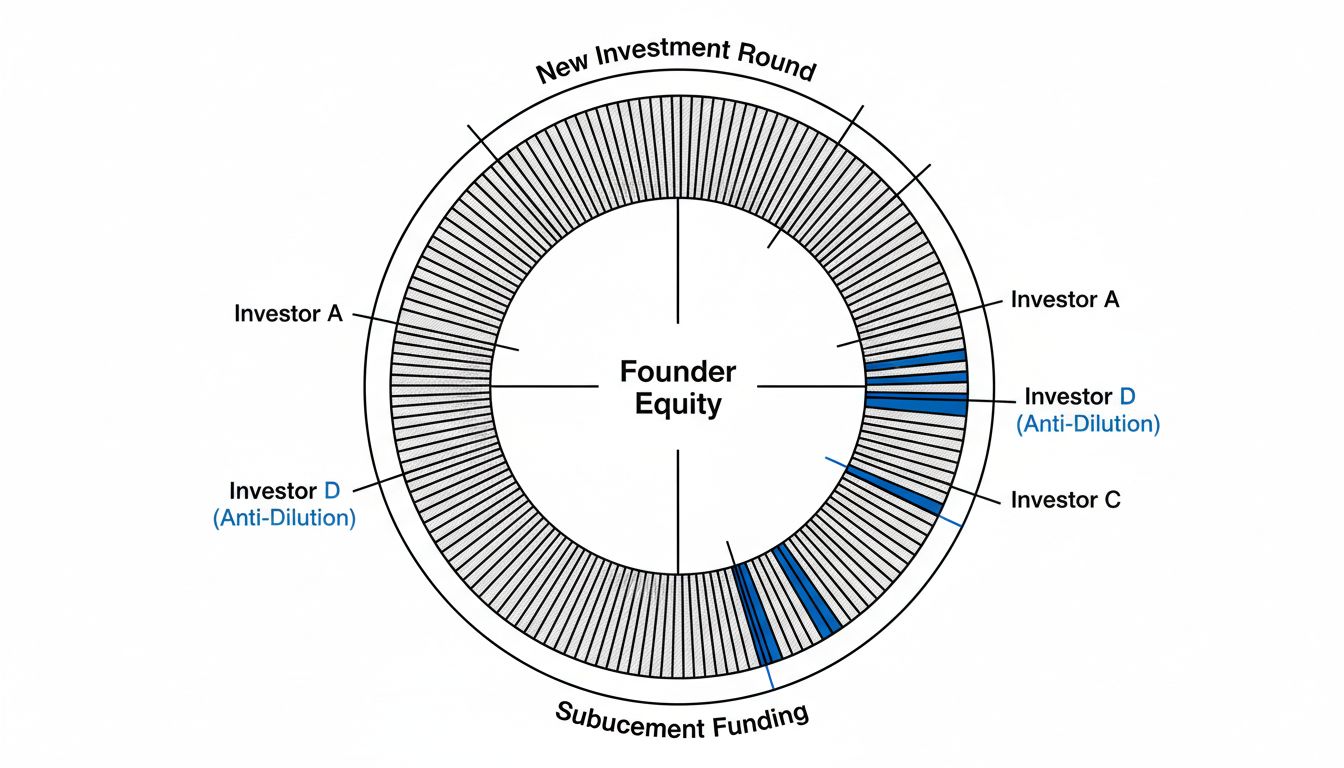
The financial mechanics of a down round are painful. Anti-dilution provisions that earlier investors negotiated, typically broad-based weighted average or full ratchet, kick in and protect them by issuing them additional shares. This dilutes founders and employees who don’t have the same protection. A single down round can materially damage the equity stakes of the people doing the most work on the company.
Beyond dilution, down rounds carry a signaling cost. They make future fundraising harder because they suggest the prior investors got the valuation wrong, which raises questions about what else they might have gotten wrong. They can trigger morale problems as employees watch their options go underwater. Some will leave, which is often exactly when you can least afford to lose people.
The founders who avoid down rounds aren’t just the lucky ones. They’re usually the ones who either priced their early rounds conservatively (leaving room to grow into the valuation) or grew fast enough that the data consistently beat the original narrative. Both require discipline that the fundraising environment doesn’t always reward.
Valuation Strategy Before You Have Revenue
All of this points to something founders should be thinking about before they have a single dollar of revenue: the valuation you take in your pre-revenue rounds sets the bar you’ll have to clear with real data.
Taking a higher pre-revenue valuation feels like winning. More money for less dilution, strong signal to the market. But it builds in pressure. Every dollar of ARR you generate will be compared against the story that valuation implied. If you raised at $50 million pre-revenue but your first year of revenue is $600,000 growing at 60% annually, you have a problem that money can’t straightforwardly fix.
This is also why underpricing your startup is harder to fix than overpricing specifically in the context of revenue multiples: if you come in low, good data produces a nice step-up. If you come in too high, good-but-not-exceptional data produces a flat round or a down round, and there’s very little you can do at that point except grow faster.
The founders who navigate this best tend to be the ones who think about their pre-revenue valuation not as “what can I get” but as “what can I credibly grow into.” That framing requires honest forecasting about sales cycles, market size, and growth rates, which is genuinely hard when everything is speculative. But it’s the right discipline to build early.
What This Means
Revenue doesn’t automatically make your startup more valuable. It changes the framework investors use to value you, and whether that change helps or hurts depends almost entirely on how your actual numbers compare to the implied story in your prior valuation.
Before revenue, you’re priced on narrative optionality. After revenue, you’re priced on multiples applied to real data, with adjustments for growth rate, retention, and unit economics. The transition can produce a step-up in valuation if your numbers validate the story, or a painful compression if they don’t.
The practical implication is that founders should think about valuation and growth trajectory together, not separately. The goal isn’t to maximize the valuation you raise at. It’s to raise at a valuation your actual business can grow into, so that each round of data you produce moves the story forward instead of requiring a rewrite.