
The Simple Version
An LLM’s context window is the maximum amount of text it can receive. How well it actually uses that text is a separate question, and the answer is often: not very well.
Context Windows Are Marketing, Utilization Is Engineering
When Anthropic announced Claude’s 100,000-token context window, and later its 200,000-token window, the tech press treated it as a straightforward capability upgrade. Feed in an entire codebase. Summarize a book. Ask questions about a lengthy legal contract. The implication was that more tokens in means more information processed, linearly, reliably.
That’s not quite how it works.
A context window is best understood as a desk surface. Making the desk bigger means you can spread more papers across it. It doesn’t mean you’ll read all of them with equal care. LLMs have a similar problem: they can technically receive huge amounts of text, but their ability to retrieve and reason over information buried deep in that text degrades in ways that aren’t obvious from the outside.
The “Lost in the Middle” Problem
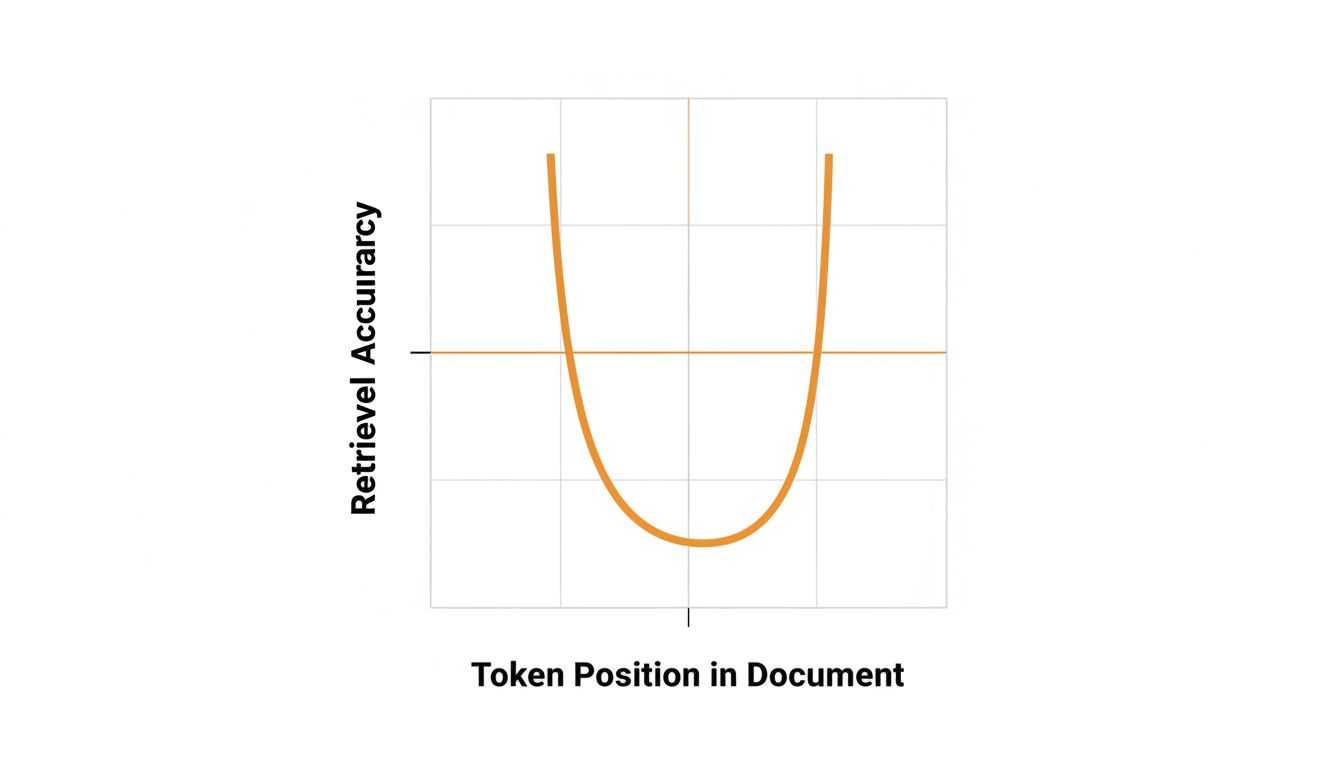
Researchers at Stanford and UC Berkeley published work in 2023 documenting a specific failure pattern they called “lost in the middle.” They gave language models long documents with relevant information placed at different positions, then asked questions that required finding that information. The finding was stark: models performed best when the relevant content appeared at the very beginning or the very end of the context. Information placed in the middle of a long document was retrieved far less reliably.
This isn’t a minor edge case. It’s a structural property of how attention works in transformer models. Attention mechanisms don’t process tokens with equal weight across an entire sequence. They tend to anchor on early tokens (the system prompt, the beginning of a document) and recent tokens (the end of the input). Everything in between competes for attention in a way that disadvantages it.
So if you paste a 50,000-word contract into an LLM and the critical clause is on page 30, you’re not guaranteed the model will surface it correctly, even if it technically “read” every word.
Needle-in-a-Haystack Tests Reveal the Gap
The AI research community has developed a useful benchmark for this: the needle-in-a-haystack test. You hide a specific piece of information (the needle) somewhere in a long document (the haystack) and ask the model to retrieve it. By varying where the needle is placed and how long the haystack is, you get a map of where a model’s retrieval actually degrades.
The results differ significantly across models and context lengths. A model might score near-perfectly at 10,000 tokens and substantially worse at 100,000, even if both are well within its advertised context window. Some models show clean degradation curves. Others have strange gaps, performing fine at 80,000 tokens but poorly at 60,000 for reasons that aren’t publicly explained.
This matters practically. If you’re building a product that relies on an LLM analyzing long documents, the context window size tells you almost nothing about whether your specific use case will work. You need to know where in the context your critical information lives, and test accordingly.
Why Bigger Windows Are Still Worth Building
None of this means longer context windows are useless. A few things are genuinely better with more context, even with imperfect utilization.
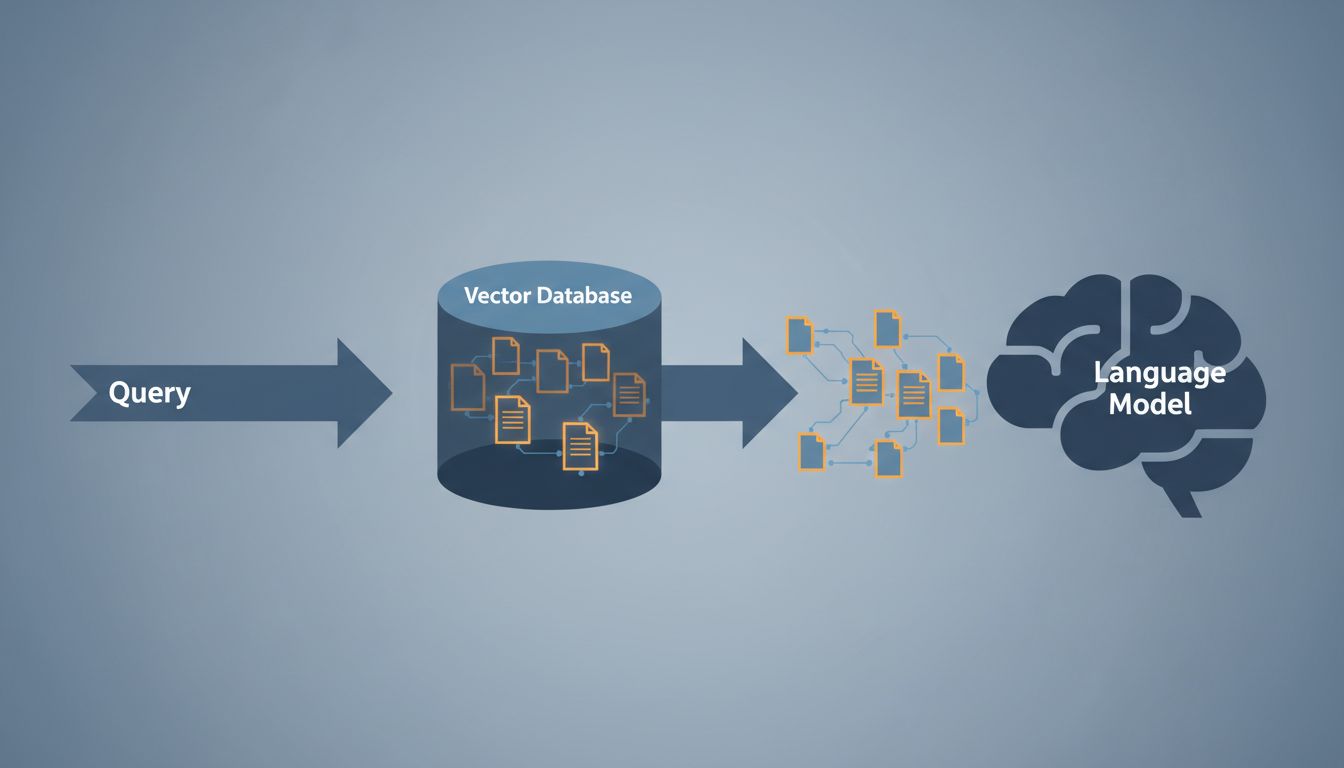
First, more context reduces the need for chunking. Retrieval-augmented generation (RAG) systems work by breaking documents into chunks, embedding them, and retrieving the most relevant pieces to insert into a shorter prompt. This works well for many tasks but introduces its own failure modes: you might retrieve the wrong chunks, miss context that spans multiple chunks, or lose track of document structure. A long context window lets you sometimes skip this complexity entirely.
Second, some tasks benefit from breadth over precision. Summarization, for example, doesn’t require the model to precisely locate a specific fact. It benefits from seeing more of the document, even if attention is unevenly distributed. The same applies to tasks like style analysis or generating text consistent with a long reference document.
Third, models are genuinely improving. The lost-in-the-middle problem is well-known, and labs are actively working on it through training modifications and architectural changes. The gap between advertised context size and reliable utilization is smaller than it was two years ago. It’s just not zero.
What This Means If You’re Building Something
If you’re evaluating LLMs for a product that depends on long-context reasoning, test the specific failure mode you care about. Don’t benchmark on haystack tests with needles at the end of the document. Put the critical information in the middle, because that’s where real contracts, real codebases, and real conversations tend to hide the important parts.
If your use case requires reliable retrieval from very long documents, a well-designed RAG system often still outperforms raw long-context prompting, even with models that nominally support the full document length. This is counterintuitive but worth testing empirically for your specific task.
And be skeptical of context window size as a headline comparison metric. It’s the processor clock speed of the LLM era: technically meaningful, frequently misleading, and often used to obscure more relevant differences. The question isn’t how much text a model can receive. It’s how reliably it reasons over what you gave it.
As the AI confidence score article on this site notes, the numbers LLMs surface about their own capabilities are often poor guides to actual performance. Context window size is just a more legible version of the same problem.