Microsoft’s outage took out the consoles admins use to manage things, and Nvidia lost its founder-CEO with no succession plan. Elsewhere: an AI inference vendor was holding Uber drivers’ licenses, and Google put its fast model, not its best one, in front of everyone.
1. Microsoft’s outage also hit Defender and Intune, the tools admins would reach for
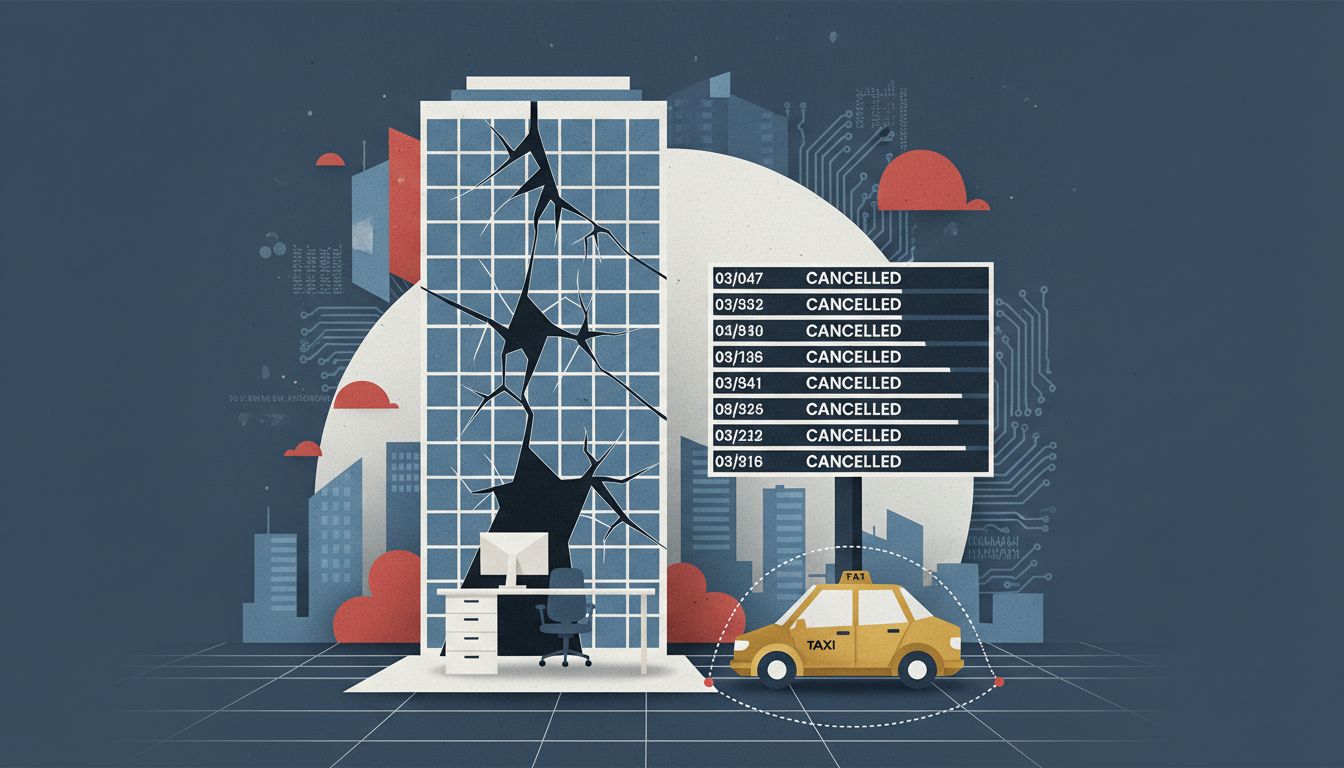
What began Thursday as an Outlook and Teams problem became a meltdown across Microsoft’s cloud. TechCrunch reports it hit consumer and business email, files, Copilot, Defender, and the Intune dashboards administrators use to manage devices. Kentik’s Doug Madory put downtime at about 18 hours before traffic returned. The Register had it past 20 hours, with Microsoft’s fixes failing along the way.
Microsoft’s explanation so far is thin: “a large number of servers being unexpectedly unavailable.” It says there is no evidence of malicious activity, but it didn’t tell TechCrunch whether it has the logs to check. Engineers reportedly struggled at first to find the cause at all. Ars Technica’s headline quotes an expert saying this may be worse than Amazon’s or CrowdStrike’s outages. We only have the headline, not the reasoning.
My read: when the productivity suite, the security tooling, and the management console share one failure domain, a customer has no neutral place to stand during an outage. This is also the second multi-service Microsoft outage since September, when it blamed a core authentication configuration issue. A real post-mortem should say why recovery took this long.
Ars Technica · TechCrunch · The Register
2. Nvidia’s interim CEO is the CFO Huang reportedly doubted
The scandal is personal, but the governance problem is structural. By TechCrunch’s timeline, Jensen Huang admitted infidelity, resigned this week, and was followed by reports, from the New York Times and Reuters, of further affairs with Nvidia employees. U.S. officials also reportedly believe a Megaspeed executive he was close to is a Chinese spy. Huang has about 60 direct reports and, per the timeline, the company had no obvious successor.
The Wall Street Journal’s reporting is the revealing part. Huang reportedly called CFO Colette Kress, now interim CEO, “a deer in the headlights” in a meeting about guaranteeing billions for data center operators who couldn’t afford chips upfront. Kress had reportedly questioned how to value those guarantees and pushed back on credit-based deals involving Huang’s son-in-law. She also helped cut Nvidia’s OpenAI data center commitment from a discussed $250 billion to $105 billion.
So the person now running Nvidia is the one who asked hard questions about its financing. Whether the board lets her keep asking is unclear. Huang is due to testify to Congress before Thanksgiving, and Democrats are probing why chip sales to China were approved after the administration was briefed.
TechCrunch · TechCrunch · TechCrunch
3. Another Linux kernel developer steps back, and AI is the likely culprit
Linux maintainers are quietly running out of hours. The Register reports that another kernel developer is stepping back from some duties because of overload. Its subhead, “you can probably guess what he blames,” points to AI-generated contributions. We only have that headline and subhead, so the developer’s own words and any numbers are missing.
The signal is still the word “another.” Kernel maintainers are volunteers and employees doing unglamorous review work, and every patch needs a human to judge it. If tools make submissions cheap while review stays expensive, the cost lands on the few people willing to read them. Whether the flood is easing, as some maintainers have suggested, is not something this source establishes.
4. Uber drivers’ licenses were sitting at an AI vendor that got breached
Fireworks AI sells developers access to open models. So why did it have Uber drivers’ license data? Uber’s notices don’t say. TechCrunch reports that hackers stole internal credentials from Fireworks and used them to reach Uber’s data, and that Uber learned of it on October 9.
State filings show 2,567 affected people in Massachusetts, 3,430 in South Carolina, and 1,873 in Rhode Island, over 7,800 in those three states alone. Illinois and California counts are pending or unstated, and Uber has given no total. It deferred questions to Fireworks, which confirmed unauthorized access but didn’t answer TechCrunch’s questions. Notion also confirmed its data was taken.
Fireworks blames a financially motivated group that wants to sell stolen LLM access tokens. My inference is that the license data was collateral damage from a hunt for compute credentials. For the drivers, the motive doesn’t matter. Founders choosing AI vendors should ask what data actually goes to them, and whether they need it there at all.
5. Google put its fast model, not its smartest, in front of all Search users
Google’s biggest Search model upgrade yet is not its top model. Gemini 4 Hydrogen is the fast one, which Google says runs 2.5 times faster than Gemini 3.8 Flash. Google’s frontier models, Carbon and Argon, handle the deep reasoning. Google says Hydrogen even beats Argon on the Artificial Analysis Intelligence Index at its default setting. That is one benchmark and Google’s own claim.
The rollout is global, to all Search users. Ars Technica’s feed excerpt says it skipped the slow, security-conscious release that Carbon and Argon got. Google promises better handling of multi-part questions and typos, richer answers across AI Mode languages, and more tables, images, and custom tools in responses.
The line to watch is query fan-out. Google says Hydrogen splits questions into more subqueries and surfaces sites people might have missed, which could change who gets traffic. More visual answers could also keep users on Google longer. Google’s post doesn’t say which will win, and publishers should watch their referral data.