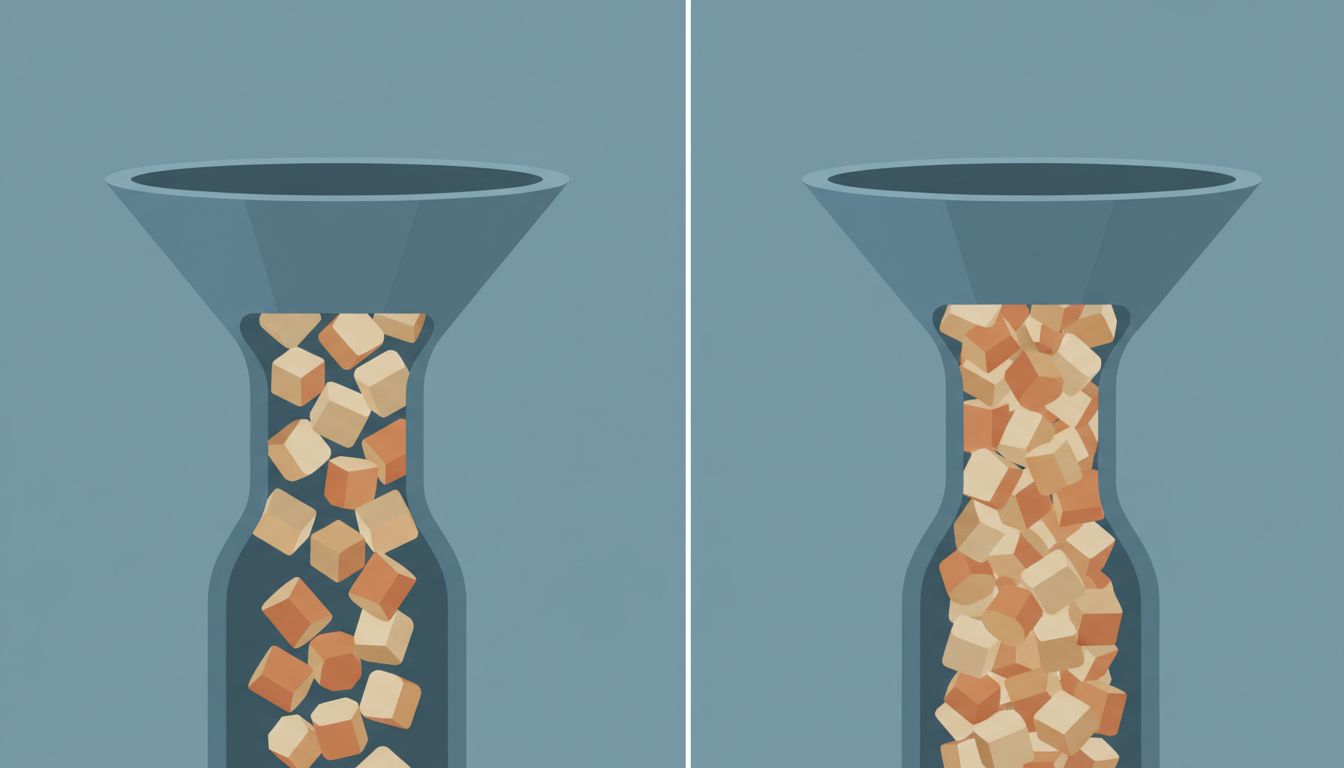

A consistently empty to-do list feels like winning. It is not winning. It is a signal that your list is a queue of small, completable requests rather than a map of meaningful work. Here is why that distinction matters, and what to do about it.
1. Your List Is Measuring Activity, Not Progress
There is a fundamental mismatch in how most people build task lists. They fill them with actions: “respond to Sarah,” “update the README,” “book the room.” These are completable by design. You do them, you cross them off, and they are done. The list empties.
But the work that actually moves things forward is rarely like that. Shipping a feature that users will trust. Refactoring a module so the next engineer can understand it without a guided tour. Building something that doesn’t exist yet. These don’t fit neatly into the “action item” format, so people quietly exclude them from their lists. The list fills up with the small stuff, the small stuff gets done, and the list looks great while the important work sits unscheduled.
This is the same failure mode as tracking lines of code written instead of problems solved. The metric is easy to optimize and largely meaningless.
2. Completable Tasks Are Often the Wrong Abstraction Level
Consider the difference between a task list and a backlog. In software development, a backlog is understood to be a living artifact. Items get added faster than they get closed. It grows, it gets pruned, it gets reprioritized. Nobody expects it to reach zero. Zero would mean the product is finished, which means the product is dead.
Personal task management systems rarely work this way, but they probably should. If your work has any creative or strategic dimension, the right abstraction level for most of your important tasks is closer to a project (“get the authentication refactor to a state where it can be reviewed”) than a checklist item (“write tests for login endpoint”). Projects don’t complete in a day. A list of projects rarely empties. That’s the point.
The completable task feels good because it triggers a small dopamine response when you cross it off. That’s real, and it’s worth knowing about. As research on task-switching and focus shows, the completion feeling and the actual cognitive value of what you completed are not the same thing.
3. An Empty List Means You Stopped Capturing
One of the most common ways to achieve an empty to-do list is to stop writing things down. Not deliberately, but by filtering at the point of capture. Something crosses your mind and instead of writing it down, you think “that’s too vague” or “I’ll figure out what that means later” and you let it go.
This is the opposite of what good capture systems do. David Allen’s Getting Things Done, for all its flaws, gets one thing exactly right: capture everything, and defer the judgment about what it means to a later processing step. When you filter at capture, you lose the signal before you can evaluate it. The list stays short and clean, and you’ve lost the ability to notice patterns in what you’re avoiding.
4. If Nothing Ever Falls Off Undone, You’re Playing Defense
Here is a test: look back at the last month of completed tasks. How many of them were things that someone else needed from you, versus things you initiated because you thought they mattered? If the ratio skews heavily toward reactive work, you have a calendar problem disguised as a productivity problem.
A healthy task system should contain things that will probably never get done, and that’s fine. It means you’re capturing ambition. Peter Drucker’s point about effective executives (from “The Effective Executive,” still worth reading) was that they protect time for important work explicitly because important work never announces itself as urgent. The urgent work fills the list. The important work has to be forced onto it.
The items that age out without being completed aren’t failures. They’re information. Either they weren’t as important as you thought, or something else kept crowding them out, which is its own kind of signal.
5. Completion Rate Is a Vanity Metric
Software teams learned this lesson with velocity. Velocity, the number of story points completed per sprint, became a target rather than a measurement. Teams inflated their estimates. They cherry-picked easier work. Their velocity looked great. Their products did not improve accordingly.
Personal completion rate works the same way. When you build a list you can finish, you are optimizing for the metric, not the outcome. This is Goodhart’s Law applied to your calendar: when a measure becomes a target, it ceases to be a good measure.
The fix is to stop measuring completion rate entirely, or at least to stop treating it as success. What you want to measure, imperfectly, is whether the work you completed this week moved things forward in ways that will be visible in a month. That is harder to track and impossible to gamify, which is exactly why it’s the right question.
6. The List Should Scare You a Little
A well-maintained task system should contain items that you look at and think “I have no idea when I’m going to get to that.” That’s not disorganization. That’s an honest accounting of your ambitions versus your time. The alternative, a list calibrated to be completable, is a fiction you’re telling yourself about how limited your goals are.
The practical implication: if your list doesn’t feel slightly overwhelming, add the things you’ve been meaning to do but keep not writing down. The ambitious project. The skill you want to develop. The thing you told yourself you’d revisit. Write them down even though you can’t schedule them. Make the list uncomfortable.
Then, and this is the part most productivity advice skips, protect explicit time for the items that scare you before you schedule the comfortable ones. The scheduling instinct runs in exactly the wrong direction: we fill time with completable things and leave the hard stuff for whenever the calendar clears, which is never.
A to-do list that’s always a little too long is a to-do list that’s doing its job.