

The engineers who maintain legacy systems earn more than those building greenfield projects. This isn’t a market inefficiency. It’s the market working correctly.
The conventional image of a well-compensated engineer involves building something new: a clean repository, modern tooling, a product launch. The reality is that some of the highest-paid technical work in existence involves reading code written before the engineer was born and keeping it from taking down systems that process trillions of dollars annually. COBOL programmers, mainframe specialists, and the people who actually understand thirty-year-old C++ financial systems don’t command premium rates because companies are sentimental. They command them because the economics of irreplaceability are brutal.
Supply shrinks while stakes grow
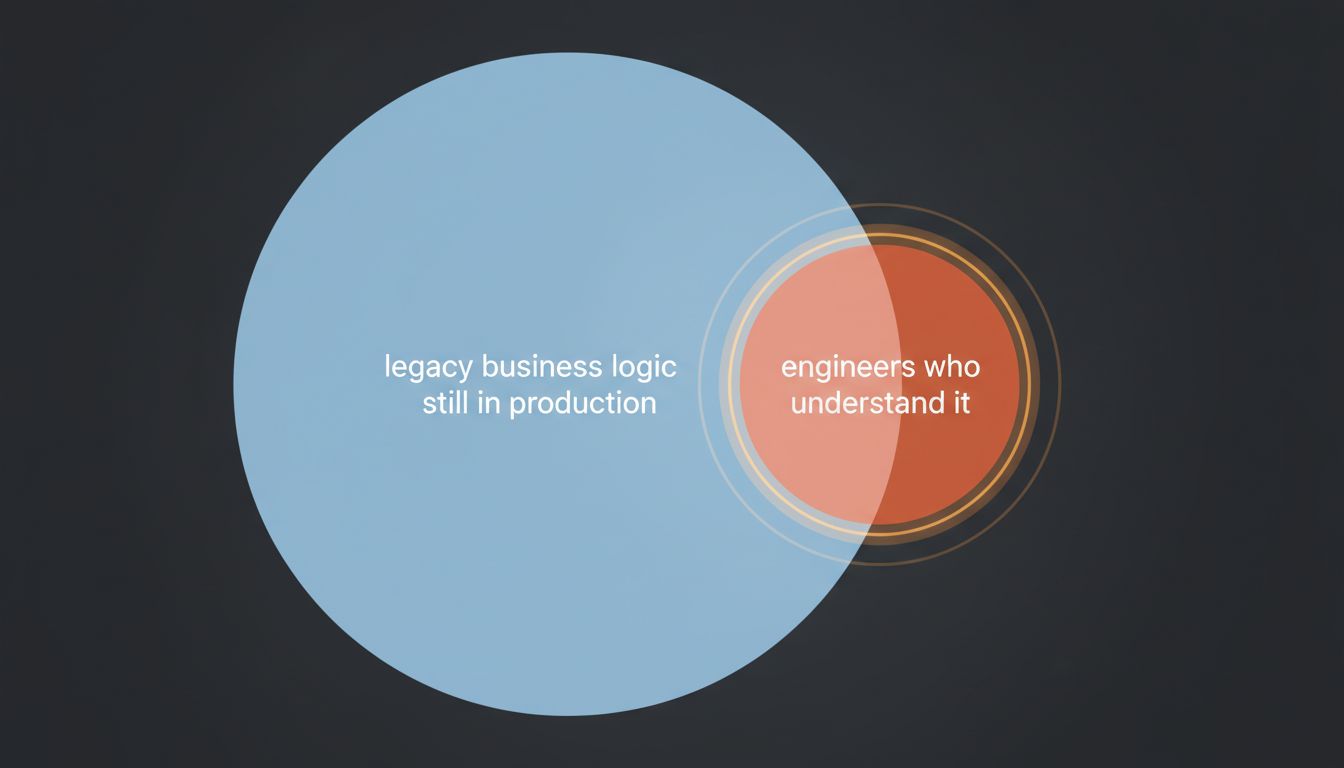
When a technology ages out of fashion, the people who know it stop being trained. Universities stop teaching it. Bootcamps never touch it. The existing practitioners retire or move on. What doesn’t shrink at the same rate is the amount of business logic embedded in that aging code. Banks don’t rebuild their core systems every decade. Airlines don’t rewrite their reservation platforms when a new framework arrives. The code that handles the actual money, the actual transactions, the actual regulatory compliance gets older every year while the pool of people who understand it gets smaller.
This is a straightforward supply-and-demand story, but the demand side is more extreme than it appears. A company can delay launching a new feature. It cannot delay payroll processing because nobody remembers why the batch job runs at 2 a.m. The asymmetry in consequence is what drives the asymmetry in pay.
Replacement risk creates negotiating power
Building new software is competitive. Thousands of engineers can write a React front-end, design a REST API, or deploy a containerized service. The knowledge required is current, well-documented, and actively taught. This is good for software development as a profession and bad for individual negotiating leverage.
Maintaining legacy systems is the opposite. The knowledge is scarce, poorly documented, and often exists only in the heads of a small number of people who accumulated it through years of direct exposure. An engineer who has spent five years understanding why a particular mainframe job fails on the third Tuesday of months with an odd-numbered day count has knowledge that cannot be replicated quickly. That engineer knows it. The employer knows it. The salary reflects it.
This is distinct from seniority in general. Senior engineers who have spent their careers on modern stacks are valuable but not uniquely irreplaceable in the same structural way. The legacy maintainer’s value comes specifically from the narrowness and non-transferability of the knowledge, combined with the severity of what breaks if they leave.
The cognitive difficulty is genuinely higher
Building new code is hard. Maintaining old code, especially code that wasn’t written with any expectation that someone else would read it, is a different and often harder kind of hard.
New code comes with the luxury of context. You know why you made the decisions you made, or at least you can ask someone who does. Old code comes with decisions made by people who are gone, under constraints that no longer exist, to solve problems that are no longer fully understood. The documentation, where it exists, describes what the system was supposed to do, not what it actually does. The tests, where they exist, test the behavior that was anticipated, not the edge cases that accumulated over decades of production use.
The engineer maintaining legacy code has to reconstruct intent from behavior. That requires a combination of systems thinking, historical intuition, and patience that is genuinely rare and genuinely difficult to develop. It also requires being right, because the cost of being wrong is measured in outages, not in failed tests.
As a related piece on this site explored, the highest-value engineering work often looks invisible until something goes wrong. Legacy maintainers live entirely in that space.
The counterargument
The obvious pushback is that this dynamic is temporary. Companies know their legacy systems are a liability and are actively working to modernize them. As those modernization efforts succeed, demand for legacy expertise will decline. Why would companies pay a premium for skills with a shrinking future?
The answer is that modernization timelines are reliably optimistic. Organizations have been planning to replace their COBOL systems since the 1990s. The Y2K remediation effort, which cost an estimated $100 billion globally, was supposed to accelerate that transition. It didn’t. Mainframe usage has not declined the way anyone predicted it would. The modernization project that was supposed to free a company from its legacy dependencies becomes, with regularity, a new system running in parallel with the old one, both of which must now be maintained.
Even when modernization does succeed, it takes years. During those years, the legacy system still runs production. It still needs people who understand it. And those people know that the company’s urgency to replace the system is matched by its urgency to keep it running in the meantime. That’s not a weakening negotiating position. That’s a stronger one.
The market is telling you something
Pay is information. When the market consistently prices a skill above what intuition suggests it should be worth, the question worth asking is what the market knows that the intuition is missing.
In this case, what the market knows is that irreplaceability combined with high stakes is worth more than general competence in a crowded field. The engineer who can build a new service in a modern framework is valuable. The engineer who can keep a thirty-year-old system running while everyone else figures out how to replace it is operating in a different economic category entirely.
This is not an argument that engineers should seek out legacy work as a career strategy. The work is often unglamorous, the systems are often genuinely painful to work with, and the knowledge accumulated doesn’t transfer easily to other contexts. But it is an argument that the compensation premium is rational, earned, and likely to persist longer than most people expect.