
The simple version
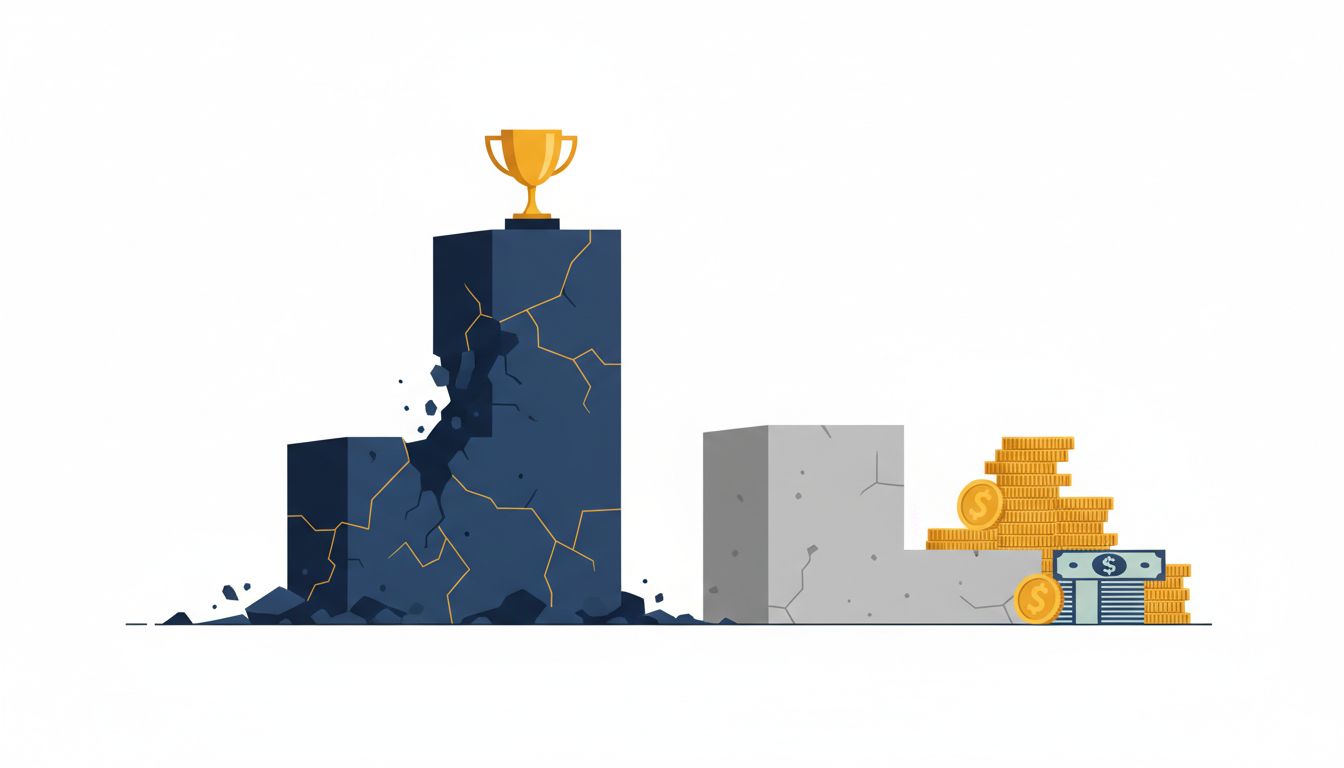
Being number one in a market forces you to spend enormous amounts defending that position. The company just behind you often gets most of the customers without most of the cost.
The burden of the top spot
Consider what a market leader actually has to do. It has to define the category, educate customers about why the product exists at all, fight off regulatory scrutiny that comes with dominance, and match every competitive move from below while also anticipating threats from above. None of that is free.
Intel spent decades as the dominant PC processor maker. It also spent enormous sums on the “Intel Inside” marketing campaign, on building and maintaining fabrication plants, and on lobbying and legal expenses tied to antitrust scrutiny. AMD, sitting reliably in second place for much of that period, ran a leaner operation, spent less on marketing, and in several years posted higher operating margins than Intel despite generating far less revenue. When AMD released Ryzen processors in 2017 and began genuinely competing on performance, its stock rose more than 1,000 percent over the following three years, while Intel spent that same period defending ground it had already won.
This pattern is not a coincidence.

What economists call this
The phenomenon has a name: the second-mover advantage, though that framing slightly misses the point. The classic version of the argument focuses on timing, the idea that the second company into a market can learn from the first mover’s mistakes. (There’s a related case to be made about why the second company into a market usually wins, and the same logic applies here at the product level.)
But the profitability edge for the second-most-popular product operates through a different mechanism. It isn’t mainly about timing or learning. It’s about cost structure.
The leader in any market absorbs what you might call “category overhead.” Advertising that explains the product category, not just the brand. Partnerships that set industry standards. Customer education that benefits every competitor once a buyer enters the market. A customer who spends ten minutes reading about why they need project management software will then comparison-shop across options. The leader paid to bring them into the market. Everyone else benefits from that investment at zero cost.
The pricing trap that traps the leader
There’s a second, subtler force. The market leader almost always sets the reference price for the category. That sounds like power. It is also a trap.
When you are the price setter, you face a choice: raise prices and risk accusations of gouging, or hold prices steady and compress your own margins as costs rise. The second-place company faces no such constraint. It can price just below the leader, capturing price-sensitive customers without doing the work of justifying the category price level to the market.
Salesforce has faced this dynamic consistently. As the dominant CRM platform, it has essentially established what enterprise CRM costs. Competitors like HubSpot were able to enter below that price point, attract buyers who were already sold on the category concept, and build toward profitability without bearing the cost of category creation. HubSpot’s gross margins have run above 80 percent in recent years, comfortably above what Salesforce achieves on comparable business.
This is not an argument that Salesforce made poor decisions. It’s an argument that the math of being first is harder than it looks.
Why this matters for technology markets specifically
Technology markets amplify this dynamic in two ways.
First, network effects raise the cost of leadership. When a platform’s value grows with the number of users, the leader has to maintain that user base aggressively. Customers churn, competitors poach, and every defection slightly degrades the value of the whole network. The leader has to spend to prevent that. The second-place company, without the same network density, faces less pressure and can be selective about which customers it wants. Deciding not to chase every segment can itself be a profit move, as counterintuitive as that sounds.
Second, technology markets require constant reinvestment in R&D just to stay relevant. The leader has to spend on maintaining the current product and building the next one. The challenger can focus resources more narrowly, often copying features once the leader has proven demand for them rather than building into uncertainty. Feature-following is cheaper than feature-leading, and in a market where customers rarely switch for one feature alone, it’s often good enough to retain second place indefinitely.
What this should change about how you read market share numbers
Market share is a proxy metric. It tells you about volume and reach. It says almost nothing about the cost of acquiring and maintaining that share, and therefore almost nothing about how much of that revenue converts to profit.
When analysts celebrate a company’s rise to number one, the right question to ask is: what did they have to promise customers, pay partners, and spend on marketing to get there? And what ongoing cost will they bear to stay there?
In many technology markets, the honest answer is that the number-one company made itself the most expensive billboard in the industry, generating traffic for the whole sector while the number-two company waited to convert it.
The best position in a market is often not the top spot. It’s the spot just below it, visible enough to attract buyers the leader trained, nimble enough to avoid the overhead the leader cannot escape, and profitable enough to wait for the leader to make a mistake.