

The markup isn’t the scandal. Your misreading of it is.
When a consulting firm bills a client $300 per hour for a junior engineer who earns the equivalent of $50 per hour in loaded compensation, the instinct is to call that extraction. Six times markup sounds like someone is getting fleeced. But that math misunderstands what is actually being sold, and who is bearing what risk.
The six-times multiple isn’t a bug in consulting economics. It’s a fairly predictable output of real costs, real risks, and a pricing model that clients tacitly accept because the alternative is more expensive.
What ‘loaded cost’ actually means
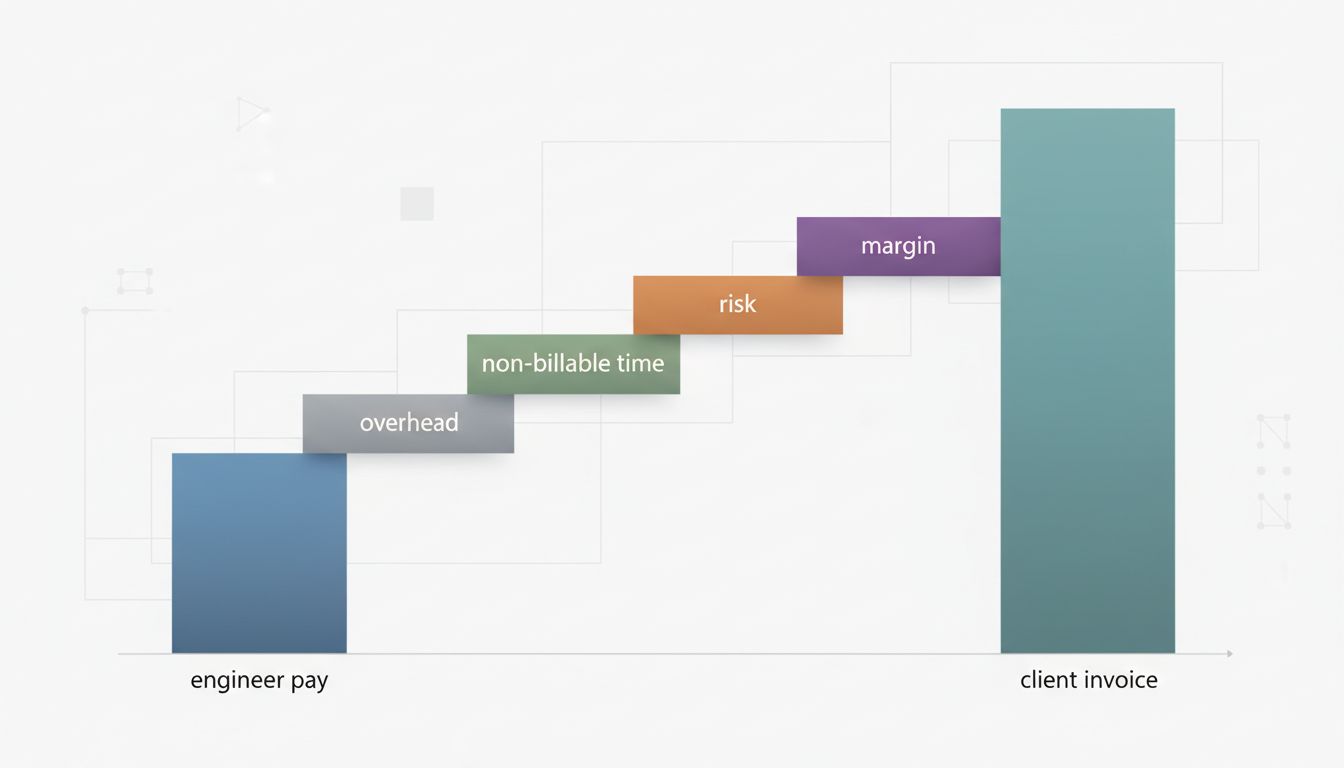
The $50 hourly figure that appears on a pay stub is not what an employee costs. Add payroll taxes (around 7.65% in the US for FICA alone), health insurance, paid time off, equipment, software licenses, office space, HR overhead, and retirement contributions, and a $50-per-hour employee typically costs an employer closer to $75 to $85 per hour in total. That’s before a single dollar of profit.
But consulting firms don’t sell hours the way a manufacturer sells widgets. They sell billable hours against a backdrop of non-billable ones. Internal training, sales cycles, proposal writing, bench time between projects, account management — none of that gets billed to any client. Industry estimates suggest that utilization rates for consultants (the share of hours actually billed) commonly run between 65% and 75%. That means for every hour billed, the firm is paying for roughly 1.4 hours of the employee’s time. The effective cost per billable hour rises accordingly.
Risk is the part the math usually skips
A full-time employee represents a relatively stable cost. A consulting firm carries a different profile: project work ends, clients churn, and the firm still owes salaries. The firm is absorbing demand volatility that the client is offloading. That volatility has a price.
There’s also liability. When a consultant’s code causes a production outage or a data leak, the firm carries professional indemnity insurance and, often, contractual liability. That coverage isn’t free. Neither is the reputational risk the firm absorbs when a junior engineer makes a mistake on a client’s critical system.
This is the core economic transaction that the six-times multiple reflects: the client is paying a premium to not be an employer. No recruiting costs, no severance, no HR overhead, no carrying cost during slow periods. As explored in the case of the $400K engineer who saved a company millions, the true cost of technical talent rarely lives in the salary line alone.
The firm’s margin is smaller than the multiple implies
Net profit margins at large consulting and staffing firms are not generous. Publicly traded IT staffing firms typically operate on net margins in the 3% to 6% range. The gross markup looks dramatic; the bottom line is thin. Most of what sits between the engineer’s pay and the client invoice is real cost: management layers, sales infrastructure, compliance, training programs, and the carrying cost of bench time.
The firms that look like they’re printing money are usually the ones selling specialized expertise at high utilization, not the ones running large pools of generalist junior talent. The margin story at the top of the market looks different from the one in the middle.
The counterargument
The honest version of the critique isn’t that the multiple exists — it’s that clients often don’t know what they’re getting. A junior engineer billed at $300 per hour carries an implicit promise of supervision, quality control, and firm accountability. When that promise is poorly kept (and it often is), the client is overpaying relative to what they’re receiving, not relative to the firm’s cost structure.
There’s also a legitimate question about whether the six-times multiple is sustainable as remote work lowers coordination costs and platforms connecting clients directly to engineers continue to grow. Disintermediation has compressed margins in other professional services. It may do the same here over time.
But that critique is about market evolution, not about whether today’s pricing is irrational. The multiple is, for now, a reasonable reflection of real costs. The firms charging it aren’t uniquely greedy — they’re operating a model with thin margins and significant overhead.
What the number actually tells you
When you see a six-times multiple on a consulting invoice, the right question isn’t “how can they justify that?” It’s “am I buying the right thing, and are they actually delivering it?”
The pricing is defensible. The execution often isn’t. Those are two different problems, and conflating them leads buyers to make bad decisions — either refusing to use outside talent because the markup offends them, or accepting poor quality because they assume the price guarantees something it doesn’t.
The multiple is math. Whether you’re getting what the math promises is a management question.