
Most developers treat the temperature parameter like a volume knob: turn it up for creative writing, turn it down for factual summaries. This mental model is wrong in ways that matter in production.
Temperature doesn’t add randomness on top of the model’s output. It transforms the probability distribution that the model samples from, and that transformation is nonlinear, meaning small changes at the extremes have outsized effects. Understanding what’s actually happening explains a lot of otherwise puzzling behavior: why temperature 0 sometimes still gives you different answers, why very high temperature produces what looks like nonsense, and why the “right” setting for your application probably isn’t where you think it is.
What Temperature Actually Does to the Numbers
At the end of a forward pass through the model, the last layer produces a vector of logits, one for each token in the vocabulary. These are raw scores with no constraint on their range. To convert them into probabilities, the model applies a softmax function. Temperature modifies that process by dividing each logit by the temperature value before the softmax runs.
If temperature is 1.0, the logits pass through unchanged. If temperature is 0.5, each logit is doubled in relative magnitude before softmax, which sharpens the distribution: the highest-probability tokens get disproportionately more of the probability mass, and low-probability tokens get squeezed toward zero. If temperature is 2.0, the logits are halved, which flattens the distribution and gives unlikely tokens a much larger share of the probability mass than the model’s training would suggest they deserve.
This is why a temperature of 0.1 and a temperature of 0.9 are not just “a little less creative” and “a little more creative.” At 0.1, you’re making the model’s top choice almost inevitable on every single token. At 0.9, you’re running something close to the raw distribution. The behavioral difference compounds across every token in a multi-hundred-word response.
The Compounding Problem Nobody Talks About
Consider what happens over a 200-token response. At temperature 1.0, if the model’s top token has a 60% probability at each step, there’s meaningful variance in what path the generation takes. At temperature 0.3, that 60% might become 95%+. The response becomes almost deterministic, but not because the model “knows” the answer better. It’s because you’ve mathematically suppressed its uncertainty rather than resolved it.
This is where things get counterintuitive. High confidence via low temperature can actually mask the places where the model genuinely doesn’t know something. A model generating code at temperature 0.1 will pick the most probable token at each step with near-certainty, but the most probable token for a function it has weak training signal on might still be wrong, just wrong very confidently. You’ve traded output diversity for the illusion of precision.
This connects to a broader point about how model outputs signal uncertainty. Your AI’s confidence score is mostly decoration in many contexts, and low temperature is another version of the same problem: a formatting choice that reads as certainty but doesn’t reflect the model’s actual epistemic state.
Temperature 0 Is Not What You Think It Is
Many developers set temperature to 0 for tasks requiring determinism, such as structured data extraction, function calling, or anywhere they need consistent output across runs. The intuition is reasonable but the behavior is more complicated.
Setting temperature to 0 means dividing logits by zero, which is undefined. In practice, API providers handle this by implementing greedy decoding: always pick the highest-probability token. That does give you more deterministic behavior, but not perfectly deterministic behavior. Most large model deployments are running inference on GPU clusters with floating-point arithmetic, and the order of operations in parallel matrix multiplication is not guaranteed to be identical across runs. Small numerical differences can shift which token is technically “highest probability” in very close cases.
OpenAI has documented that temperature 0 does not guarantee identical outputs, especially across model updates or infrastructure changes. If you need true determinism, you need a fixed random seed along with temperature 0, and you need to accept that a model version change can still invalidate your assumptions.
Finding the Right Temperature for Your Use Case
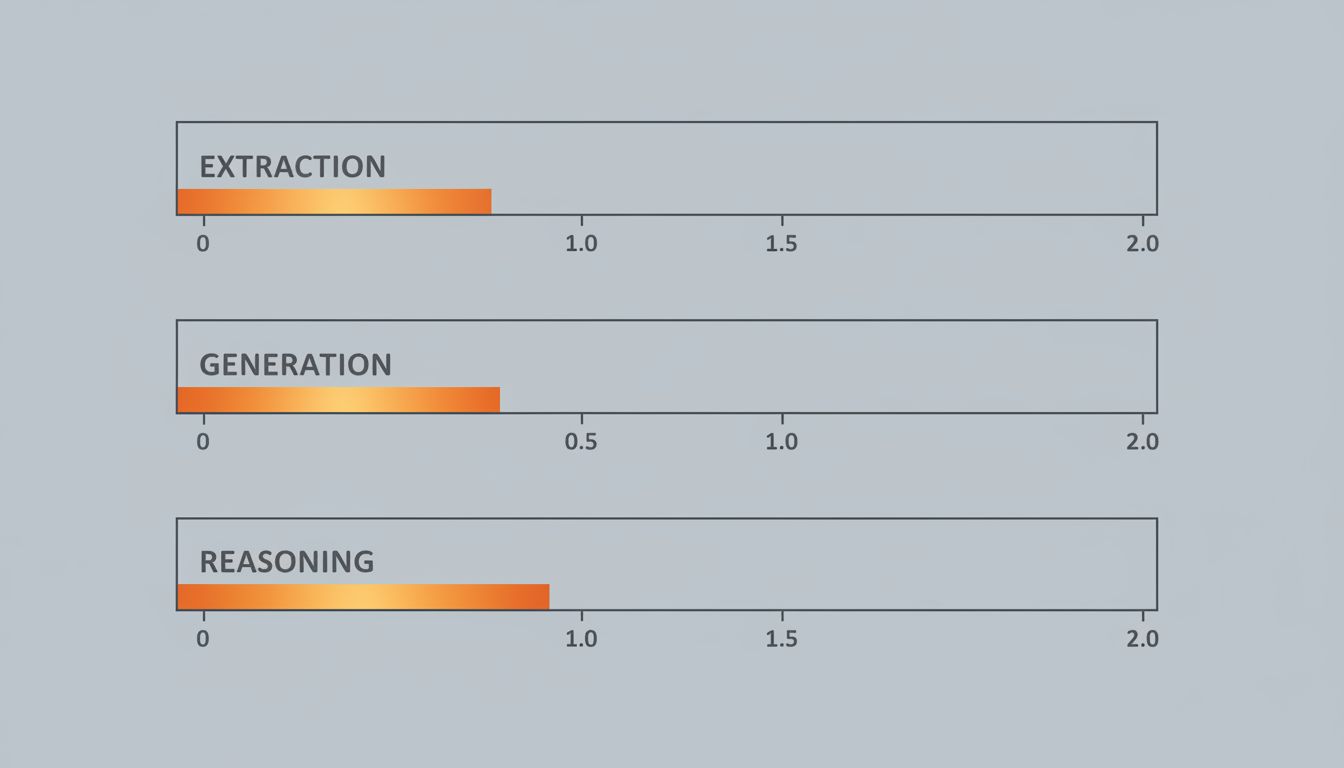
The practical implication is that temperature should be calibrated per task type, not set globally and forgotten. Three rough categories are worth distinguishing.
For extraction and classification tasks (pulling structured data from text, categorizing inputs, answering yes/no questions), low temperatures in the 0.1 to 0.3 range make sense. You want the model to commit to its best interpretation, and diversity of output is a bug, not a feature.
For open-ended generation (marketing copy, brainstorming, dialogue), temperatures between 0.7 and 1.0 give you actual variety. Below that, you’ll get responses that feel locally coherent but globally repetitive if you generate multiple options, because you’re repeatedly sampling near the same high-probability path.
For reasoning-heavy tasks (code generation, multi-step problem solving, analysis), the answer is less obvious than most guides suggest. Low temperature makes the model commit early, which can propagate an early wrong turn with high confidence through the rest of the response. There’s a reasonable argument for moderate temperatures (0.4 to 0.7) combined with techniques like chain-of-thought prompting, where the model’s intermediate steps can self-correct. This is an area where the prompt you write isn’t the prompt the model reads matters as much as temperature setting.
The Parameters You’re Ignoring That Interact With Temperature
Temperature doesn’t operate in isolation. Top-p sampling (also called nucleus sampling) and top-k sampling both apply filters before or after temperature scaling, and their interaction with temperature is often misconfigured.
Top-p sampling cuts the vocabulary to the smallest set of tokens whose cumulative probability exceeds a threshold, then samples from that set. If you set temperature to 0.3 (sharpening the distribution) and top-p to 0.9 (keeping the top 90% of probability mass), the sharpened distribution means your top-p cutoff is hitting almost the entire probability in just a few tokens anyway. The top-p constraint barely does anything. Many practitioners set both parameters thinking they’re adding independent controls, when in practice one is often redundant given the other.
For most production applications, pick one approach and understand what it’s doing. Temperature with top-p at 1.0 is clean and well-understood. Top-p sampling with temperature at 1.0 is also clean. Running both with non-default values for each creates an interaction that’s hard to reason about and harder to debug.
Temperature is the kind of parameter that looks like a detail until something goes wrong in production. Getting it right means understanding that you’re not adjusting creativity. You’re reshaping the probability distribution the model samples from, compounding across every token, with downstream effects on confidence, consistency, and correctness that don’t behave linearly. Treat it like the lever it actually is.