
The deployment succeeded. The pipeline is green. The team posts in Slack and someone adds a party emoji. And then, quietly, reality begins its audit.
This is the thesis: passing deployment is a necessary condition for software to work, not a sufficient one. The bugs that cost companies the most, in money, in users, in engineering time, don’t appear in CI. They appear when real users arrive with real data, doing things no test suite anticipated. Treating deployment as an endpoint is one of the most expensive habits in software.
Tests cover the code you wrote, not the system you built
Unit tests verify that functions behave as specified. Integration tests verify that components talk to each other. What they rarely verify is whether the whole system behaves correctly under the actual load, actual usage patterns, and actual data distributions of production.
Knight Capital Group’s 2012 trading incident is the canonical example. Code was deployed. The deployment succeeded. Within 45 minutes, a dormant code path reactivated by a new feature flag had sent erroneous orders totaling over $440 million in losses. The deployment didn’t fail. The system failed.
The problem isn’t just edge cases. It’s that production is a different environment in kind, not just in scale. Real users have unexpected locale settings, legacy browser configurations, pasted text full of unicode characters your validation never considered, and session states that don’t match any fixture you wrote. Your test data was designed by someone who understood the system. Your users weren’t.
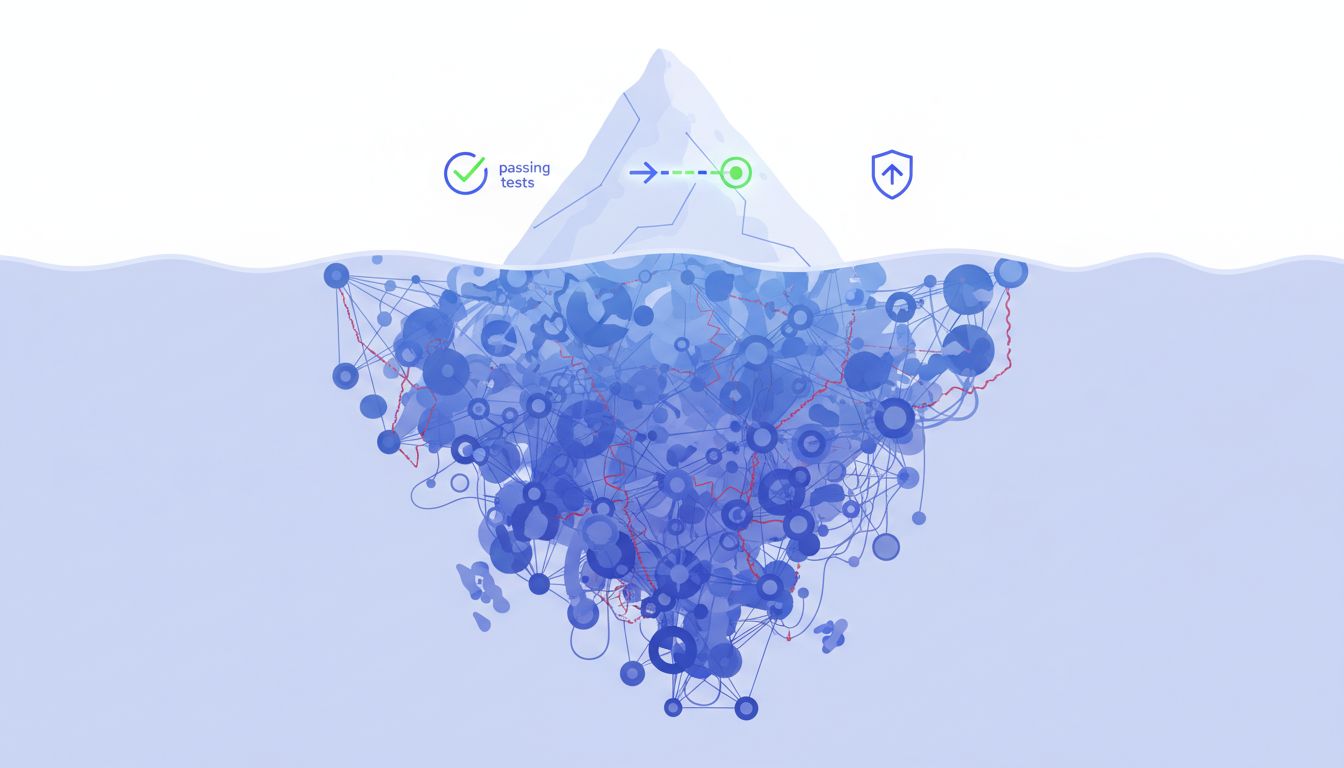
The post-deployment window is where assumptions meet reality
Every piece of software is a collection of assumptions. Assumptions about how the database will perform under real query patterns. Assumptions about which API paths users will actually hit. Assumptions about how often a third-party service will respond slowly, or not at all.
Those assumptions were reasonable when you made them. They were based on the information available before users existed. The first days after deployment are when those assumptions start failing, one by one, in an order nobody predicted.
This is why replication lag becomes a real problem only in production, even when it was technically present in staging. Staging traffic doesn’t expose it. Real concurrent users do. The bug was always there. Production revealed it.
Monitoring catches some of this, but only if you’re watching the right signals. Error rates and p99 latency are obvious. What’s harder to instrument is correctness degradation: the feature that returns stale data under concurrency, the recommendation model that works in accuracy benchmarks but performs badly on the long tail of real user queries, the form that silently drops a field under a specific browser and OS combination.
The incentives push teams toward declaring victory too early
Deployment is legible. It either passes or it fails. Product managers can see it. Executives can see it. There’s a date associated with it and a ticket to close.
Post-deployment quality is harder to measure, which makes it easier to deprioritize. Bugs found after deployment require someone to argue that the feature isn’t actually done yet, which is an uncomfortable conversation when the Jira card is already marked complete.
This incentive structure produces a specific failure pattern: teams invest heavily in the deployment pipeline (which produces clear signals) and underinvest in post-deployment observability (which produces ambiguous ones). The result is software that ships cleanly and degrades quietly. The real cost of keeping a software product alive is substantially post-deployment, in the bugs nobody budgeted for because the deployment succeeded.
The counterargument
The obvious pushback is that this is what QA, staging environments, and load testing are for. If post-deployment surprises keep happening, the argument goes, the answer is more pre-deployment rigor.
This is partially right. Better testing does reduce post-deployment failures. Feature flags and canary releases reduce blast radius. Chaos engineering can surface assumptions before users do.
But the argument runs into a limit. You cannot fully simulate production without production. The data is different. The traffic patterns are different. The combination of user behaviors is effectively infinite. Companies that spend enormous resources on pre-deployment rigor still encounter post-deployment failures, because the environment itself is not reproducible in advance. The goal of pre-deployment work is to reduce the frequency and severity of production failures, not to eliminate them. Anyone who believes otherwise is likely to be surprised.
What actually follows a successful deployment
A successful deployment should trigger a specific kind of attention, not relief. The first 24 to 72 hours are when assumptions fail, when edge cases arrive, when the gap between what you built and what users do becomes visible.
The teams that handle this well have monitoring in place before the deployment, not after. They have runbooks for rollback. They have someone actually watching the dashboards, not assuming the dashboards will alert if something is wrong. They treat the deployment as the beginning of an observation period, not the end of a development period.
A green pipeline means the code is in production. It doesn’t mean the code works in production. Those are different statements, and confusing them is expensive. The party emoji is premature. Save it for the week after, when the real audit comes back clean.