
The Complaint Is Correct and Also Useless
Every knowledge worker has felt it: sitting in a 45-minute meeting where someone reads bullet points off a shared screen, where the “discussion” is mostly nodding, where the outcome could have been conveyed in three sentences. The frustration is legitimate. But the fix that gets prescribed from this frustration, which is “send an email instead,” treats a symptom while leaving the disease untouched.
The reason “this meeting could have been an email” became a mantra is that it gave people a vocabulary for a real problem. The reason it hasn’t fixed anything, after years of being said constantly, is that it frames the problem as a format mismatch. Wrong medium, wrong time. Switch the medium, problem solved.
It isn’t solved. The meetings keep happening.
What the Format Frame Gets Wrong
When you say a meeting should have been an email, you’re making an implicit claim: that the information being shared is the point, and information can travel more efficiently through text. That’s true as far as it goes. But it assumes the meeting was called because someone chose the wrong delivery mechanism for a piece of information. Usually, that’s not what happened.
Meetings get called because someone is uncertain. They’re uncertain whether a decision has been made, whether other people are aligned, whether the work is progressing the right way, whether their own position in the project is secure. Meetings are how organizations make uncertainty feel managed. You sit in a room (or a Zoom call), everyone nods, and for a moment the fog lifts. The problem is that the fog came back before anyone reached their desk.
This is why companies that try to aggressively cut meeting time, without changing anything else, tend to find the uncertainty doesn’t disappear. It migrates. It becomes long Slack threads that go unresolved, or email chains that CC half the company, or informal side conversations that exclude people who needed to be included. The information still doesn’t flow well. It just flows through different pipes.
The Thing Meetings Actually Do (When They Work)
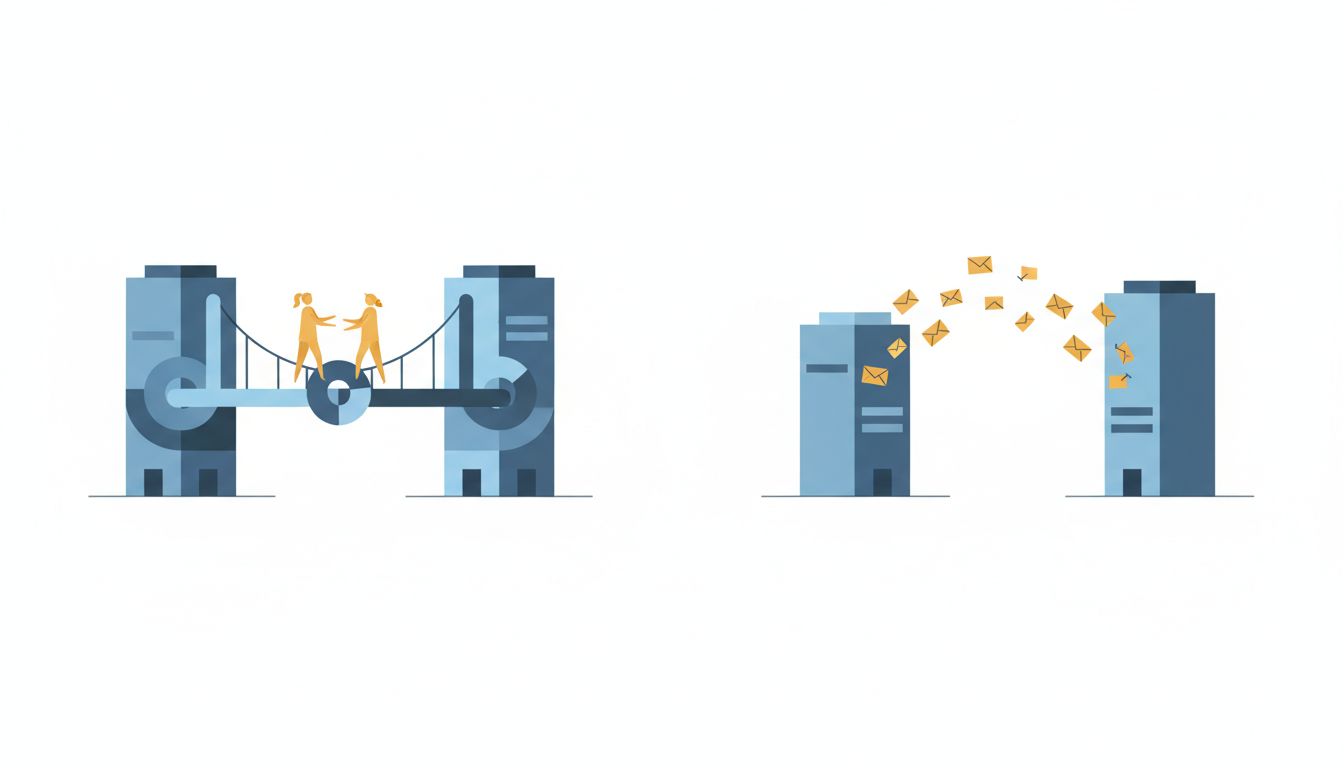
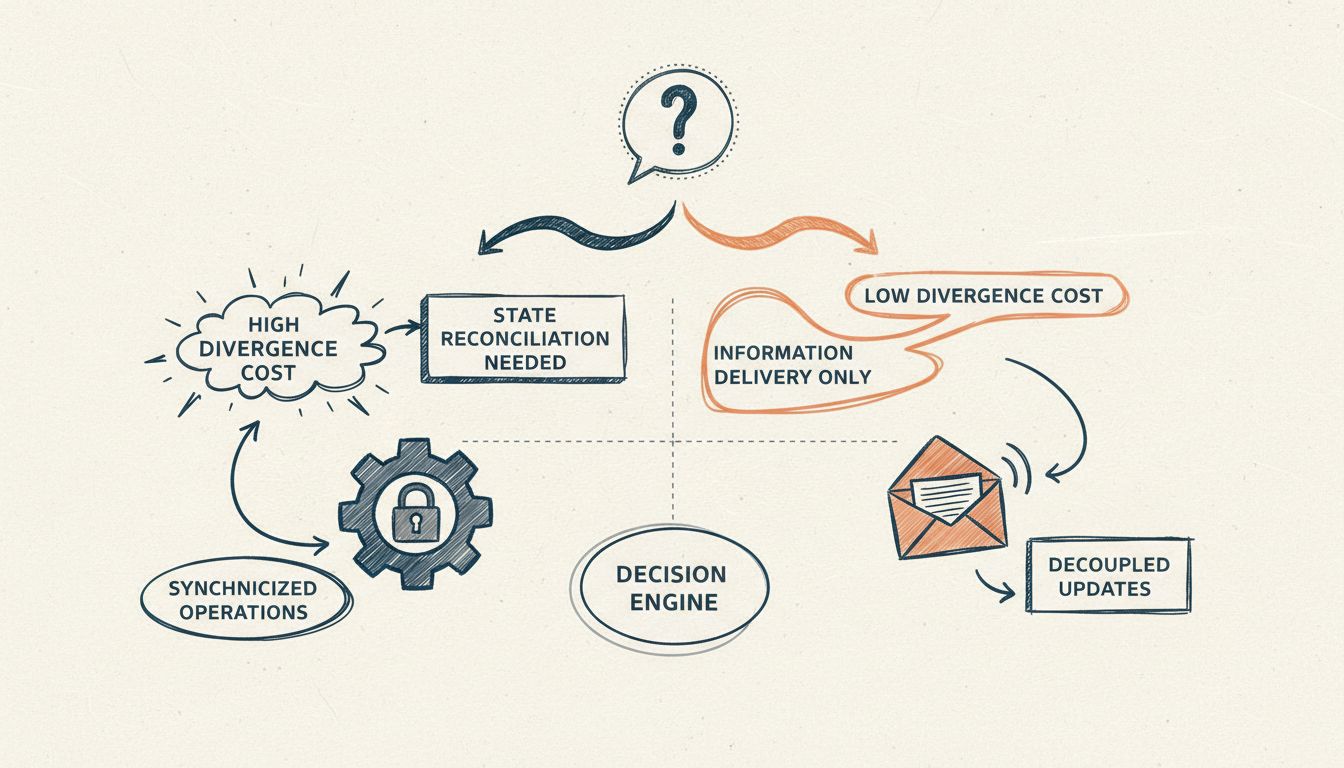
Synchronous communication, meaning communication where people are present together in real time, does something that asynchronous communication genuinely can’t replicate: it allows for rapid state reconciliation. That’s a cumbersome phrase for something you experience constantly. You think you and a colleague agree on the project direction. You get on a call. Thirty seconds in, you realize you were both using the word “launch” to mean completely different things. You fix it on the spot. An email chain would have taken two days and probably wouldn’t have surfaced the misunderstanding at all.
The technical analogy here is instructive. When two distributed systems need to agree on shared state, the synchronous approach (one node blocks until it gets confirmation) is expensive but reliable. The asynchronous approach (fire-and-forget with eventual consistency) is cheap but leaves windows where the systems diverge. Neither is universally better. The choice depends on how costly divergence is.
Meetings are expensive synchronous operations. The question isn’t whether to use them. The question is which state-reconciliation problems are actually expensive enough to pay for synchronous resolution.
Status updates usually aren’t. A human delivering information that everyone will passively receive is almost always async-suitable. Decisions where someone needs to say “yes I own this” out loud, so that social accountability is established, are often not. The distinction matters and most organizations have no vocabulary for making it deliberately.
What Async Communication Actually Demands
Here’s where the email-instead proposal runs into its real failure mode. Async communication doesn’t just mean “write it down instead of talking.” Done well, it’s genuinely harder than calling a meeting, because the burden of clarity shifts entirely to the writer.
In a meeting, you can be half-organized and still succeed. Confusion generates clarifying questions in real time. You get multiple chances to land the point. In an email or a Slack message or a Notion document, you get one shot. If the reader hits an ambiguity, they either send a follow-up (delay), make an assumption (divergence), or do nothing (stall). The entire cost of unclear thinking falls on everyone downstream.
This is why async communication done well is a writing problem, not a tool problem. Switching from Zoom to Loom to a written doc doesn’t help if the person sending the communication hasn’t done the work of thinking clearly first. In fact, it often makes things worse, because now the half-formed thought is preserved in text and can be re-read repeatedly in its confused state.
The uncomfortable implication is that the people who call unnecessary meetings are often doing so because they haven’t fully thought through what they’re trying to accomplish. The meeting is cognitive outsourcing. Gather the stakeholders, let discussion do the thinking work, arrive at clarity together. This isn’t always bad. Collective thinking has real value. But it’s expensive and shouldn’t be the default mode for problems one person could have solved with an hour of focused writing.
The Organizational Layer Nobody Mentions
There’s a layer underneath all of this that individual advice about meetings and emails can’t touch. Meeting culture is usually load-bearing in a way that’s invisible until you try to change it.
In many organizations, being present in meetings is how you demonstrate that you exist and matter. Engineers who skip status meetings find themselves excluded from decisions. Managers who attend fewer calls lose visibility. Meetings aren’t just communication mechanisms. They’re also social infrastructure, political participation, and performance of engagement. Telling someone “that meeting could have been an email” is accurate about the information economics, but it ignores that the person who called the meeting was also doing several other things that email doesn’t accomplish.
This is related to why productivity metrics often mislead. The metrics that look clean on a dashboard frequently miss the informal coordination work that keeps a team coherent. If you measure “meetings reduced by 30%” as a win, you might be measuring the removal of some genuine waste, or you might be measuring the removal of the social glue that was preventing churn and confusion. You often can’t tell without looking harder than most productivity initiatives bother to.
The companies that successfully change their meeting culture usually don’t do it by telling people meetings are bad. They redesign the surrounding conditions. They make written communication high-status. They give people explicit permission to decline meetings without political cost. They create clear decision-making frameworks so people don’t call meetings to figure out who decides things. They invest in onboarding new hires into written communication norms rather than letting those hires default to meetings because meetings feel safer in an unfamiliar environment.
The Right Diagnostic Questions
If the format frame is wrong, what’s the right frame? Here’s what I think the actually useful questions are.
First: what uncertainty is this meeting managing, and is that uncertainty real? If a weekly team meeting exists because a manager is uncomfortable not knowing what everyone is working on, the underlying problem is a trust or visibility problem. No amount of meeting optimization fixes that. The underlying anxiety will regenerate whatever format is killed.
Second: what would it cost if this communication failed? High-cost failure (wrong technical direction, misaligned product decision, legal exposure) probably justifies synchronous resolution. Low-cost failure (someone gets the wrong context about a minor initiative) probably doesn’t. Most organizations apply synchronous resolution indiscriminately across both.
Third: does the person calling this meeting have something to say, or something to figure out? These are different. The first is a communication problem that might well be solved by email. The second is a thinking problem that might need a focused conversation, but probably not a 12-person call.
Fourth: what decision, if any, needs to come out of this, and who can actually make it? If the answer is “no one in this room,” the meeting is a performance of process with no actual function.
What This Means
The “meeting could have been an email” observation is correct in many individual cases, and almost useless as organizational advice. It treats a systemic problem as a format preference.
The actual problem is that most teams have no shared model for which kinds of communication require synchronous presence and which don’t. They also have no model for what quality async communication looks like, which means async fails and people fall back to meetings, which confirms the belief that meetings are necessary.
Fixing this requires three things. First, a genuine investment in writing quality: not as a nicety but as a core professional skill, with feedback loops and standards. Second, explicit norms about meeting types, who can decline them, and what conditions justify calling one. Third, and hardest, changing what visibility and participation look like so that people don’t need meetings for political self-preservation.
The format is almost never the problem. The thinking, the trust, and the incentive structures are the problem. Swapping Zoom for email doesn’t touch any of those.