

The Myth of the First-Mover Advantage
Ask most founders which position they’d prefer, and they’ll say first. Get there before anyone else, establish the brand, lock in customers, build a moat. The first-mover advantage is one of the most repeated ideas in business strategy, and it rests on a reasonable-sounding logic: early customers are loyal customers, early networks are powerful networks, and whoever writes the category name in the consumer’s mind tends to keep it.
The problem is that the historical record doesn’t back this up, at least not consistently. Across tech, the company that invented a market and the company that ultimately won it are frequently not the same company. The pattern is so persistent that it demands a structural explanation, not just a list of exceptions.
Myspace preceded Facebook. Alta Vista preceded Google. Apple’s Newton preceded the Palm Pilot, which preceded the iPhone. Friendster preceded everyone. In each case, the first entrant educated the market, burned capital experimenting, and then watched a later entrant absorb those lessons and execute more precisely. This is not coincidence. There are specific mechanisms at work.
What ‘First’ Actually Means
Before diagnosing why second-movers win, it helps to define terms carefully. “First to market” usually means first to achieve meaningful commercial traction with a product category. It doesn’t mean first to have the idea, or first to file a patent, or first to build a prototype. By that definition, the first company in a market faces a peculiar set of problems that don’t get enough attention.
The first mover has to figure out the product, the business model, the distribution channel, and the customer psychology, all simultaneously, all without reference points. They’re not executing against a known map. They’re drawing the map. That is expensive, slow, and failure-prone in ways that compound.
Amazon Web Services launched in 2006 and built the cloud computing market largely from scratch. The company spent years explaining to enterprise customers what the cloud was and why they should trust their data to it. Google Cloud and Microsoft Azure arrived later and inherited a pre-educated customer base, established pricing benchmarks, and a clearer understanding of what enterprise buyers actually needed from cloud infrastructure. AWS still leads, but the second and third movers have taken substantial share precisely because the foundational market-building work was done for them.
The Pioneer Tax
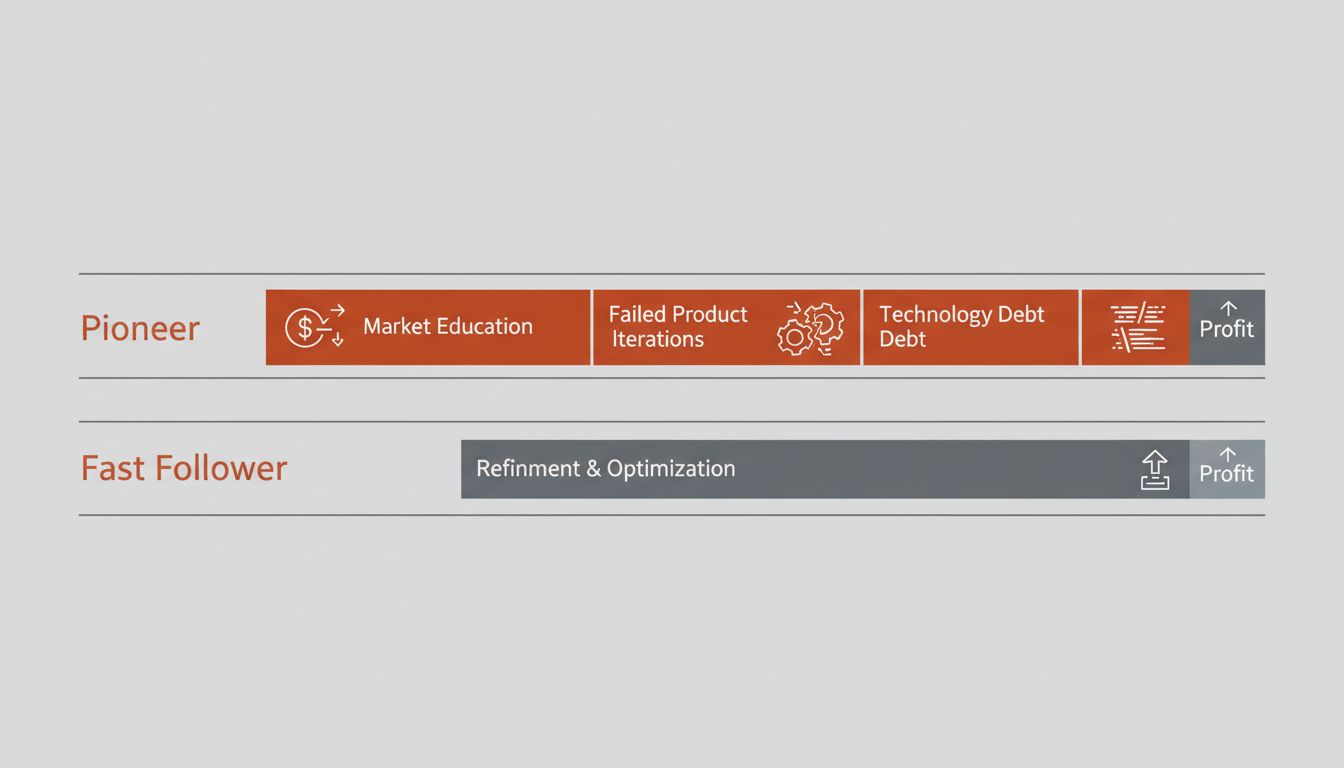
The costs of market creation are real and often fatal. Call it the pioneer tax: the capital spent on mistakes that a later entrant can simply avoid.
Tivo invented the digital video recorder category in 1999. The company spent heavily on marketing to explain the concept of time-shifted television to consumers who had never considered it. By the time cable companies bundled DVR functionality directly into set-top boxes, those customers understood exactly what they were buying. Tivo had paid for the education; the cable companies collected the enrollment.
This pattern appears wherever a genuinely new product category emerges. The pioneer spends on customer acquisition for people who churn, on product features that customers turn out not to want, and on business models that need to be rebuilt mid-flight. The second entrant reads the autopsy and builds accordingly.
Snapchat largely built the ephemeral messaging category. Instagram and Facebook studied what users actually engaged with, then copied the Stories format directly. By 2018, Instagram Stories had more daily active users than Snapchat’s entire platform. The copy was executed with better distribution, better integration, and a more polished product. Snapchat’s CEO Evan Spiegel publicly complained that Facebook had stolen the feature. He was right. And it worked.
The Technology Window Problem
First movers also face a structural timing problem that rarely gets discussed honestly. When a company enters a market early, it builds on the technology that exists at the time. By the time the market is large enough to matter, better technology often exists, and the first mover is encumbered by its original architecture.
Myspace was built when social networking was a narrow, technically limited exercise. The platform’s architecture reflected those constraints. When Facebook entered, it was able to build on more capable infrastructure, and more importantly, it had observed what Myspace’s users actually wanted (and what frustrated them). Facebook didn’t just copy Myspace; it built a cleaner, faster, more customizable product that addressed the specific complaints Myspace users were already making publicly.
This is the technology window in action. The first mover builds the best product possible given the tools available at time T. The second mover builds at time T+2, when better tools exist and the first mover’s mistakes are documented. The structural advantage flows to the later entrant, not the pioneer.
Netscape built the first commercially successful browser on mid-1990s technology and assumptions. Microsoft’s Internet Explorer arrived later, bundled with Windows, and eventually crushed Netscape on market share. Netscape won the invention; Microsoft won the market. (The story of what Microsoft won and lost in that era is more complicated, as this site has explored elsewhere.)
Why Second-Place Often Means First in Profit
There’s a closely related phenomenon on the revenue side. Markets that have been established by a pioneer tend to develop clearer price points, cleaner customer segmentation, and more rational competitive dynamics by the time the second entrant arrives. The second mover doesn’t have to guess what customers will pay; they have evidence.
This is part of why second-place companies frequently outperform on margins. They didn’t pay the customer education costs. They didn’t fund the failed product iterations. They didn’t build the distribution infrastructure from zero. They acquired a version of all of that at a discount, by learning from the pioneer’s public record.
AMD’s trajectory against Intel illustrates a version of this at the chip level. Intel paid the costs of building the x86 ecosystem over decades, and AMD spent years running behind on margins. But when AMD’s execution improved under Lisa Su, the company was able to take share with better-specified products targeted at segments Intel had defined. The margin story that followed is a useful case study in what happens when a second-mover finally gets the execution right.
When First-Movers Do Win
The second-mover thesis isn’t universal, and the exceptions reveal where the first-mover advantage actually holds.
First movers win when network effects are strong and fast. If the value of a product increases sharply with each new user, the pioneer’s head start compounds rather than erodes. WhatsApp’s early user base in markets where SMS was expensive gave it a network that was genuinely hard to displace. The second entrant doesn’t just need a better product; they need to convince enough users to switch simultaneously to make the new network worth joining.
First movers also hold their lead when proprietary data is the product. A company that has been collecting user behavior, training data, or transaction history for years has an asset that a better-funded newcomer can’t replicate quickly. The data moat is real, even if many companies overstate its depth.
And first movers win when the window of opportunity is narrow. Some markets move fast enough that a two-year head start is genuinely insurmountable. In those cases, the pioneer has converted its early position into durable infrastructure before the second mover can execute.
But notice what all three of those conditions require: the first mover has to transform its early lead into something structural before the second mover arrives with better execution. That transformation is hard, expensive, and most companies don’t complete it.
The Real Lesson for Founders
The practical implication isn’t “don’t be first.” Sometimes you are first because no one has done what you’re doing, and that’s fine. The implication is about how to think about competitive position.
If you are the first mover, your job is to complete the structural transformation before the inevitable second entrant arrives with your lessons learned. That means converting early users into locked-in customers, building network effects before the window closes, and not conflating market education with market ownership. Many first movers make the mistake of believing their pioneer status is itself a moat. It isn’t. It’s a head start on a course that the next runner has already mapped.
If you are the second mover, your advantage is real but it demands discipline. The pioneer’s mistakes are a gift, but only if you read them carefully and build differently, not just better. Copying a product feature is easy. Understanding why the first mover made the decisions they made, and building an architecture that avoids those structural traps, is harder and more valuable.
The graveyard of tech companies is full of inventors. The roster of market leaders is full of fast followers who showed up second, studied carefully, and executed without the pioneer tax.
What This Means
The first-mover advantage is real in a narrow set of conditions: strong network effects, proprietary data accumulation, or a market window that closes quickly. Outside those conditions, being second is frequently better than being first. The pioneer educates the market, documents the mistakes publicly, and often builds on inferior technology. The second entrant inherits a pre-educated customer base, a roadmap of failures to avoid, and the option to build on better tools.
This doesn’t mean that timing is irrelevant or that incumbency doesn’t matter. It means that the value of being first is routinely overstated, and the value of being a disciplined, well-informed second entrant is routinely understated. Founders who treat “we’re first” as a durable advantage are often the ones funding the education of their eventual successors.