
In August 2012, Knight Capital Group deployed a software update to their trading systems. The update was meant to fix and extend their order routing code. Within 45 minutes of markets opening, the firm had lost $440 million. They were effectively bankrupt by mid-morning. The fix worked exactly as intended. That was part of the problem.
Knight’s case is extreme, but the underlying dynamic is not. In large codebases, fixing a bug correctly, in isolation, can reduce overall system reliability. This sounds paradoxical until you understand what reliability actually means in a complex system.
The Setup: Code That Accumulates Assumptions
Knight Capital had a legacy system component called Power Peg, which had been dormant for years. During the 2012 deployment, engineers reused an old feature flag to activate new “SMARS” routing functionality. The problem: Power Peg was still present in some servers and still responded to that same flag. Eight of their servers got the new code. One did not. When the flag was flipped, that ninth server started running Power Peg instead of SMARS.
Power Peg, in its original design, was built to rapidly accumulate a large position in a stock. It had no safeguards appropriate for live market conditions in 2012. Pointed at real markets with real money, it bought and sold millions of shares in a loop, moving markets against itself.
None of the code involved was broken in the traditional sense. The bug, if you want to call it that, was that the engineers had not fully accounted for what the old code would do when the new code activated a shared signal. The fix introduced an assumption: that the flag was no longer used by anything else. In a codebase large enough and old enough, that assumption was wrong.
Why Large Codebases Are a Different Animal
Small codebases are tractable. You can hold most of the important state and behavior in your head. When you fix something, you can reason about the ripple effects with reasonable confidence.
Large codebases are not just bigger small codebases. They have properties that emerge from their size and age: implicit contracts between modules that were never written down, behaviors that other parts of the system have come to depend on (even if those behaviors were originally bugs), and flag or signal namespaces that get reused because no one has a complete map of what’s already taken.
This is what engineers sometimes call “accidental coupling.” Two components that were never designed to interact become linked through a shared resource, a global variable, an environment flag, a timing dependency. When you change one component to fix a real problem, you break the implicit contract that the other component was relying on.
The classic analogy is Chesterton’s Fence: before you remove something, understand why it’s there. In code, the fence is often a bug that other code has learned to work around. Fix the bug and the workarounds break.
What Happened and Why It Escalated
Knight’s monitoring systems flagged errors within minutes. The logs were showing something was wrong. But the alerts were not clearly tied to the source of the problem, the team didn’t have a fast rollback path for that specific deployment, and the people who might have recognized the old Power Peg behavior were not in the room.
This is the second-order failure that large codebases enable. The first failure is the bug itself (the stale flag reuse). The second failure is that the system’s complexity made the root cause hard to identify quickly. The more complex the codebase, the wider the gap between “something is wrong” and “we know exactly what is wrong and how to stop it.”
Knight’s deployment also went out to production without a clean rollback mechanism, which is a separate failure of process. But even good process struggles when the space of possible failure modes is enormous and poorly mapped. You can’t write a runbook for every possible way an unexpected interaction could manifest.
What We Can Learn
The Knight Capital story is often used to argue for better deployment practices, and that lesson is valid. But it undersells the deeper issue, which is about how we reason about correctness in systems with hidden dependencies.
A bug fix is only correct relative to a model of the system. If your model is incomplete (and in a large codebase, it usually is), your fix can be locally correct and globally wrong. The engineers who deployed that code were not negligent. They were working with an incomplete map, as most engineers do most of the time.
A few practices push back against this:
Flag hygiene. Feature flags and configuration keys should be treated like public API surface. Once a key exists, assume something you don’t control might be responding to it. Before reusing a flag name, audit every place that key appears in the full codebase, including dormant code paths. Dead code isn’t always dead.
Explicit deletion over disabling. Code that is no longer supposed to run should be deleted, not left in place with a flag that might get reused. Dormant code that can be activated is a liability. This is related to why deleting a database column is harder than it sounds: removal requires understanding all the places something is used, which is exactly the work people avoid.
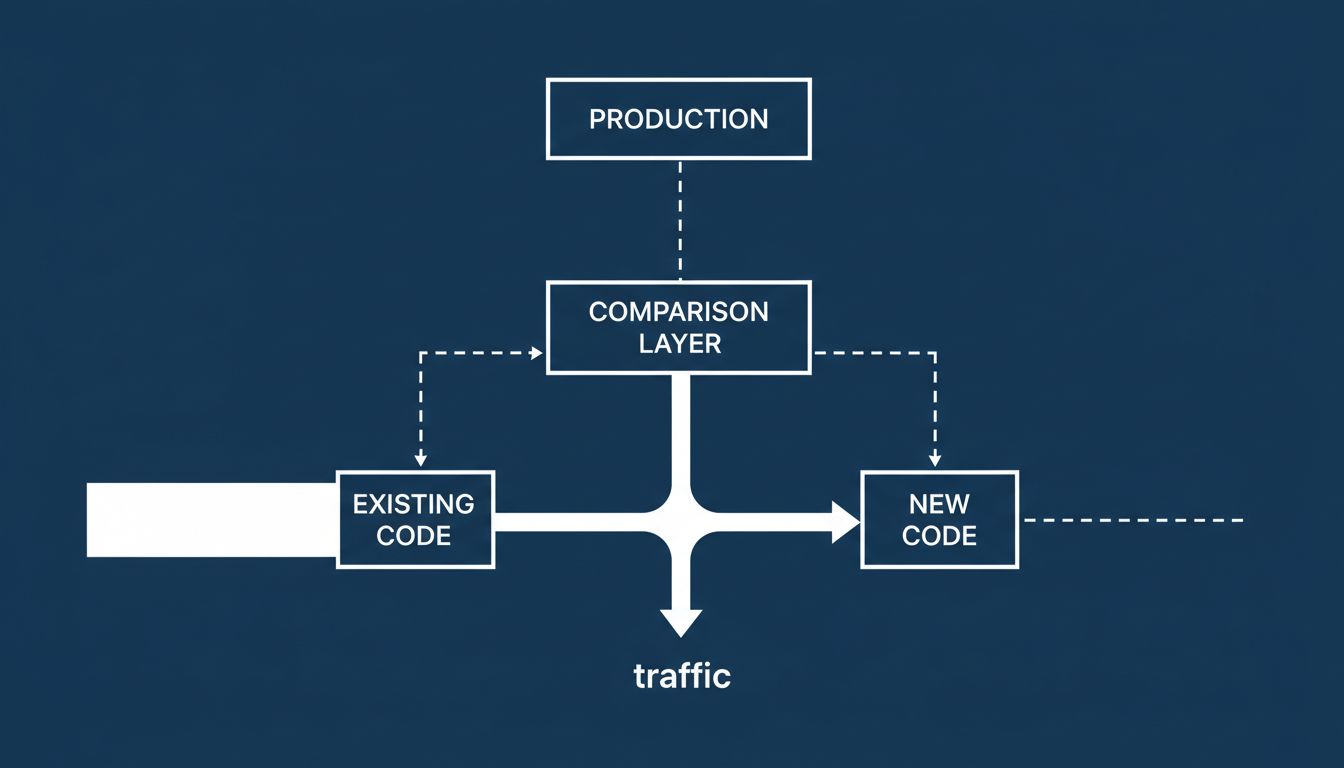
Staged rollouts with behavior comparison. If you’re changing something in a critical path, route a small percentage of traffic through the new path and compare behavior against the old path before full deployment. This is table stakes in systems where a bug costs real money per second.
Treat alerts as hypotheses, not conclusions. When Knight’s alerts fired, the team didn’t have a fast path from “something is wrong” to “here is what is wrong.” Monitoring tells you a symptom. Diagnosing the cause under pressure in a complex system is a different skill, and it requires that the people in the room have enough context to generate the right hypotheses quickly.
There’s also a harder truth here that doesn’t have a clean solution: in very large codebases, there is no complete map. The system knows more about itself than any person does. This is uncomfortable but it’s the baseline condition for most mature software. The answer isn’t to pretend otherwise. It’s to build systems that fail gracefully and recover quickly, so that when the incomplete map leads you into a hidden dependency, the blast radius is manageable.
Knight Capital’s blast radius was not manageable. The company was absorbed by Getco within months. Forty-five minutes of unexpected behavior erased a firm that had operated successfully for years.
The bug fix was correct. The system just had too many things that depended on the bug being there.