
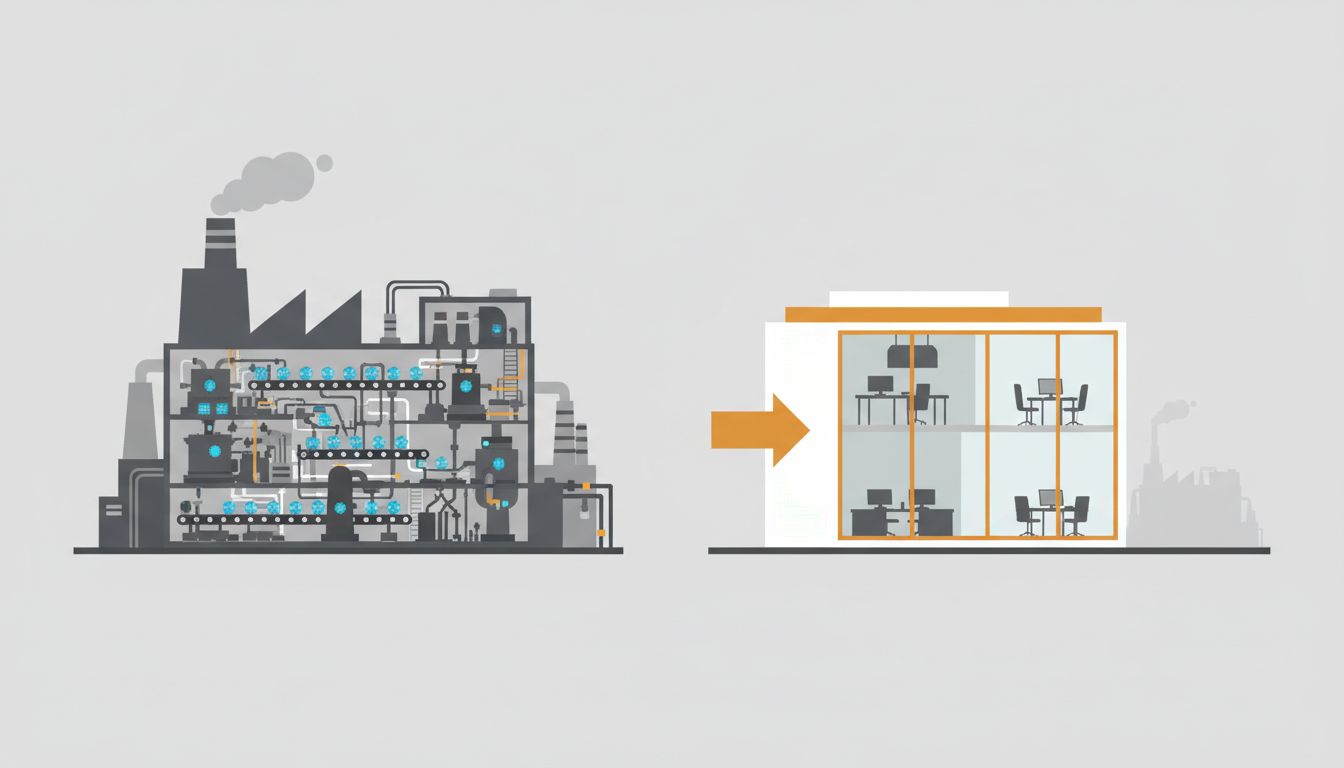
Intel spent decades building some of the most advanced semiconductor factories on earth. It designed chips, manufactured them, packaged them, and shipped them. The company employed more than 100,000 people at its peak. It won the PC era and the server era, and it spent accordingly on both.
AMD, for most of that same period, was losing money.
Then something changed. By the early 2020s, AMD was posting operating margins competitive with Intel’s, and in several quarters, surpassing them. Revenue at AMD grew from roughly $5 billion in 2017 to over $23 billion in 2023. Intel, despite remaining the larger company by revenue, saw its operating margins compress sharply and announced tens of thousands of layoffs. The market capitalization gap between the two companies, once enormous in Intel’s favor, closed dramatically.
The explanation for this reversal is not simply that AMD made better chips (though for a period, it did). The deeper explanation is structural. AMD had, by necessity, built a business model that the economics of being number two actually favor.
The Setup: Why Winning Costs So Much
Intel’s dominance required owning the entire production chain. Being the market leader in semiconductors meant setting the manufacturing standard, which meant building and operating fabrication plants (fabs) that cost several billion dollars each to construct and require continuous capital investment to keep current. Intel’s capital expenditure routinely ran above $15 billion per year. That spending was the price of leadership.
The strategic logic made sense when Intel was winning on both manufacturing and design simultaneously. But it created a cost structure that was extraordinarily difficult to flex. Fixed costs this large don’t shrink when a competitor catches up on chip design. They stay fixed.
AMD, unable to compete on manufacturing investment, made a decision in 2009 that looked like capitulation at the time. It spun off its manufacturing operations into a separate company, GlobalFoundries, and became what the industry calls a fabless semiconductor company. AMD would design chips; someone else would build them.
This was, in the short term, a sign of weakness. AMD gave up control over its manufacturing process and became dependent on outside foundries. For years, that dependency hurt. When AMD’s chip designs improved under CEO Lisa Su starting around 2014, the company had to rely on TSMC to actually build them at competitive process nodes.

But the dependency came with a hidden advantage. AMD’s capital expenditure ran a fraction of Intel’s. The costs of keeping fabs operational, of building new ones to chase Moore’s Law, of the thousands of employees required to run them, all of that belonged to someone else. When AMD sold a chip, more of the revenue fell to the bottom line.
What Happened: The Margin Math
AMD’s fabless model created what economists call a variable cost structure where Intel had a fixed one. Intel had to sell enough chips to cover its fab costs regardless of market conditions. AMD’s cost base moved more closely with its revenue.
This is the core mechanic behind second-place profitability in many technology markets. The number one company typically owns the infrastructure that defines the market. That infrastructure is expensive to build, expensive to maintain, and impossible to quickly reduce when conditions change. The number two company often rents equivalent infrastructure (or builds less of it), runs leaner, and competes on the specific dimensions where it can win without replicating the full cost stack.
The pattern appears beyond semiconductors. In cloud computing, Microsoft Azure has consistently run at higher operating margins than Amazon Web Services on certain product lines, despite AWS being the larger and more established platform. Microsoft built Azure on top of existing enterprise relationships and software revenue streams that subsidized its growth; Amazon built AWS from the ground up, bearing the full infrastructure cost of pioneering the market.
In search advertising, the number one player (Google) spent years building proprietary infrastructure for ad auctions, indexing, and measurement. Microsoft’s Bing, which powers a much smaller share of searches, runs on infrastructure that benefits from decades of Microsoft’s enterprise software margins to cross-subsidize its existence. Bing doesn’t need to be as profitable standalone because it’s not.
This connects to a broader pattern that has been documented across tech markets: the company that defines a category often donates a decade of margins to do it.
Why It Matters: The Pioneer’s Tax
The company that builds the market pays what might be called the pioneer’s tax. It funds the research that competitors then read. It builds the sales infrastructure that educates customers, who then become reachable by competitors with lower acquisition costs. It makes the capital investments that set the technical standard, then watches competitors access equivalent capacity through the market it helped create.
AMD benefited from all three. Intel’s decades of x86 investment created a software ecosystem that AMD chips could run without AMD paying for it. Intel’s enterprise sales force educated the market; AMD could hire away experienced salespeople who already knew the buyers. And TSMC, partly funded by Apple’s enormous chip orders and others, built manufacturing capacity that AMD could access at scale without owning a single fab.
This is not a unique AMD story. The second entrant to a market regularly outperforms the pioneer precisely because it can underwrite its competition using the infrastructure the pioneer built and the lessons the pioneer paid for in mistakes.
What We Can Learn
The AMD case offers a specific and testable lesson for anyone thinking about competitive strategy in technology markets.
First: dominant market position requires investment that the market position itself makes unrecoverable. Intel couldn’t easily exit manufacturing once manufacturing was its moat. The moat became a liability when the moat stopped being sufficient.
Second: the cost advantages of being second are real and durable, not temporary. AMD has been fabless for fifteen years. That structural advantage didn’t disappear when its chip designs caught up. It compounded.
Third: the right response to being second is not to replicate the leader’s cost structure. AMD tried that once, when it operated its own fabs, and it nearly bankrupted the company. The strategic turn was to stop trying to win the same game Intel was playing and instead win the narrower game AMD could actually win: chip design, targeted at specific performance-per-watt and performance-per-dollar benchmarks, manufactured by someone else.
Intel’s current difficulties (sustained losses, layoffs, a stock price down sharply from its peak) are the product of a cost structure built for a competitive position it no longer fully holds. AMD’s current profitability is the product of a cost structure built for a company that couldn’t afford to be first.
Sometimes the more profitable seat is the one you were forced into.