
The Simple Version
Getting a server to stay online 99.999% of the time costs exponentially more than getting it to stay online 99% of the time. The last decimal place is where budgets go to die.
What ‘Five Nines’ Actually Means
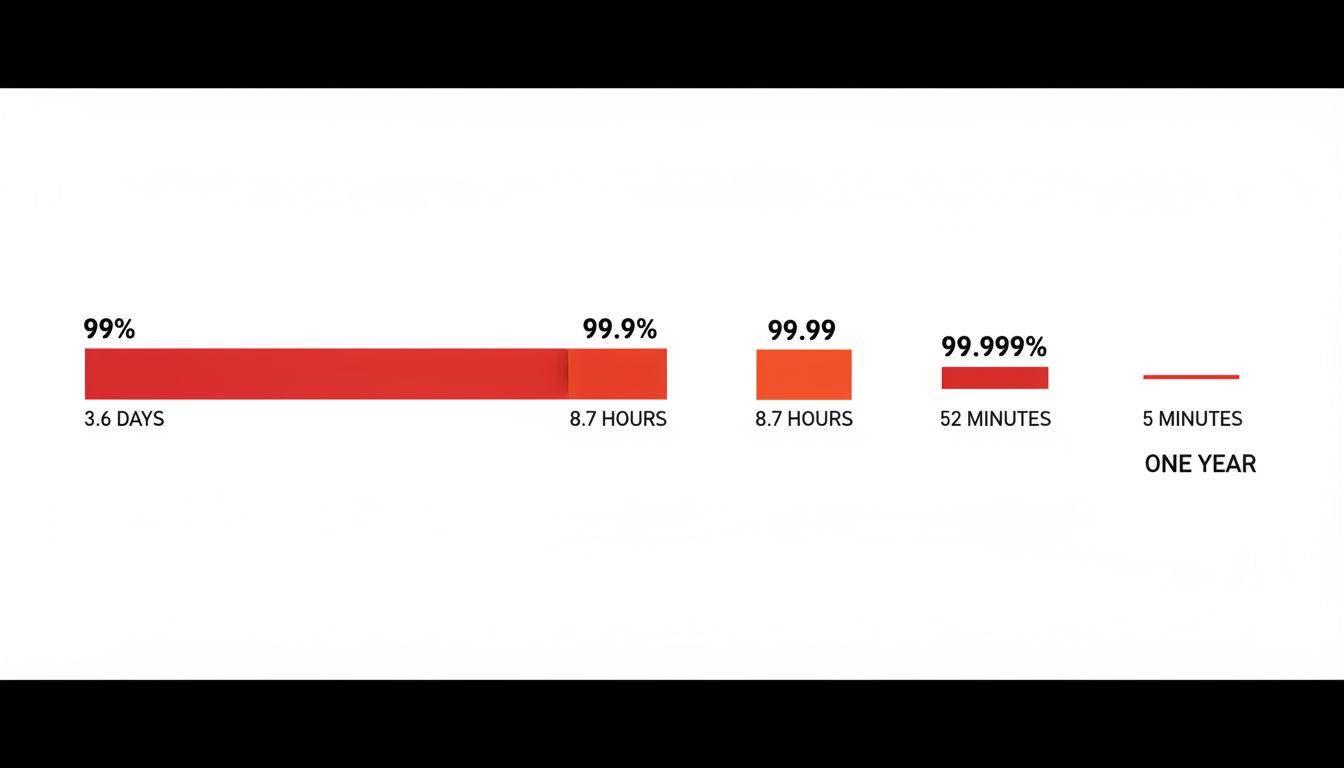
Uptime is measured in nines. One nine is 90% availability, which means roughly 36 days of downtime per year. Not acceptable for almost anything. Two nines (99%) gets you to about 3.6 days of downtime. Still rough. Three nines (99.9%) lands at around 8.7 hours per year. Four nines (99.99%) is about 52 minutes. Five nines, the industry gold standard for critical infrastructure, allows roughly 5 minutes and 15 seconds of downtime across an entire year.
That gap between four nines and five nines, roughly 47 minutes, is what separates a competently run service from one that requires an entirely different class of engineering. And that class costs a lot.
The Cost Curve Isn’t Linear, It’s Exponential
Here’s the part that surprises most people who haven’t lived inside infrastructure budgets. Moving from 99% to 99.9% uptime is a reasonable engineering project. You add redundancy, improve your deployment process, set up monitoring. Maybe it doubles your infrastructure costs.
Moving from 99.9% to 99.99% requires substantially more: redundant data centers, more sophisticated load balancing, automated failover that actually works under pressure, and a dedicated reliability engineering team. Costs can increase by an order of magnitude.
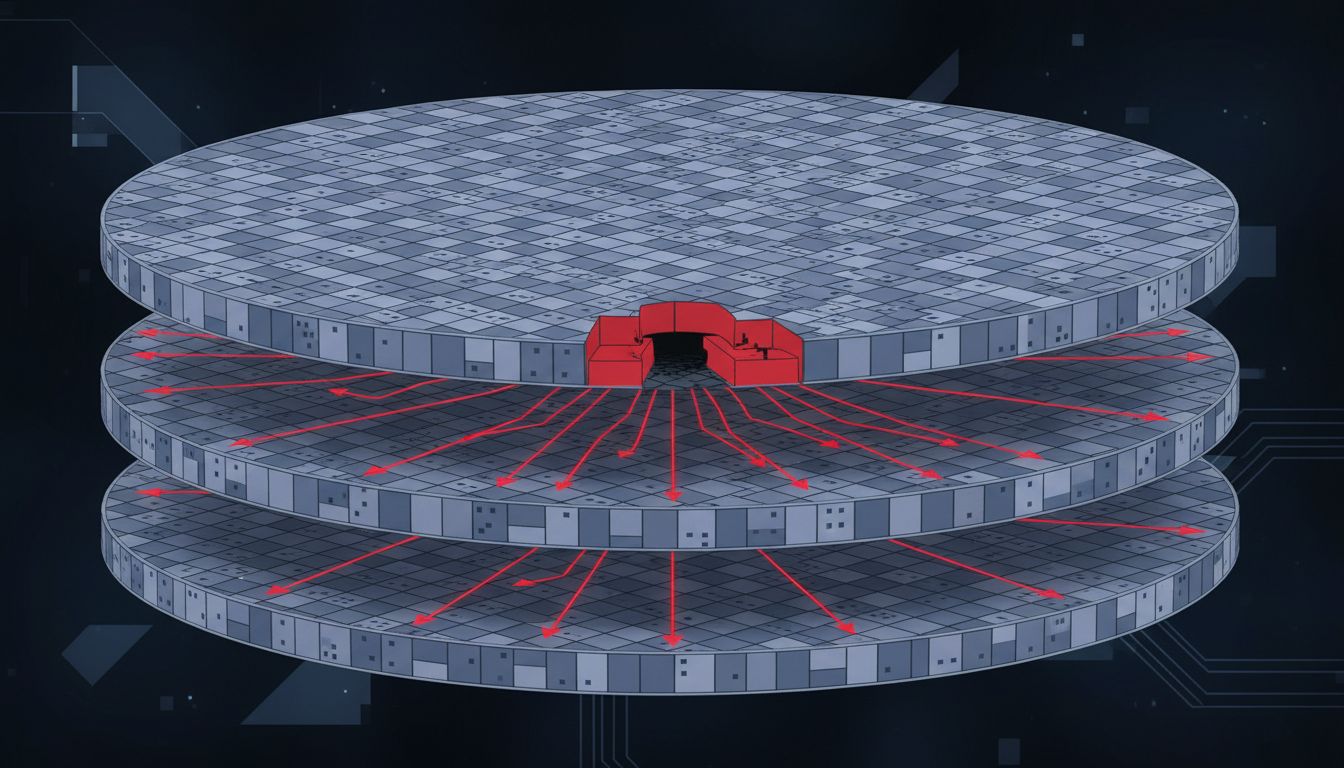
Moving from 99.99% to 99.999% is where things get genuinely extreme. You need redundancy in your redundancy. You need to assume that entire availability zones can vanish without warning. You need dark fiber agreements, backup power with tested failover, global traffic management, and engineering teams whose entire job is to break things in controlled ways so real failures don’t. Amazon, Google, and Microsoft have spent decades and billions building the infrastructure that makes five nines even theoretically achievable. When companies buy those services from AWS or Azure, they’re renting that accumulated investment.
The Hidden Cost: You Have to Test the Failure
The less obvious expense isn’t hardware or bandwidth. It’s the engineering time required to verify that your resilience actually works.
A system that has never failed and has never been forced to fail is not a reliable system. It’s an untested one. The discipline of chaos engineering, pioneered by Netflix with their Chaos Monkey tool (which randomly terminated production instances to expose weaknesses), exists because complex systems fail in complex ways that you cannot fully anticipate in advance. Netflix ran that program in production because they had no choice: the only way to know your failover works is to make it fail.
That kind of adversarial testing requires engineering time, organizational willingness to accept short-term pain for long-term confidence, and tooling. None of that is free. For companies without Netflix’s engineering depth, the alternative is finding out your redundancy doesn’t work during an actual incident, which is its own kind of expensive.
When Five Nines Is the Wrong Answer
This is the part of the conversation that rarely happens at the right time: most applications don’t need five nines. They need to be available enough that the people who need them can use them.
A content marketing site going down for 20 minutes is annoying. An air traffic control system going down for 20 seconds is catastrophic. These two systems should not be engineered to the same uptime standard, but the language of enterprise software sales doesn’t always encourage that conversation. ‘High availability’ and ‘enterprise-grade reliability’ are marketing terms. The actual SLA buried in the contract is where the number lives.
Choosing your uptime target is a business decision, not a technical one. It requires knowing the actual cost of downtime per minute (lost revenue, support overhead, contractual penalties, reputational damage) and comparing that against the cost of the infrastructure required to prevent it. Many companies never do that math explicitly. They inherit an uptime target from a previous vendor’s contract, or they accept the default SLA from a cloud provider, or an engineer makes the call based on technical preference rather than business need.
The financial logic only works one direction: if an hour of downtime costs you less than the annual premium for the infrastructure that would have prevented it, you’re paying for insurance that costs more than the thing it’s insuring.
Who Actually Needs Five Nines
Five nines is appropriate for a narrow category of systems: financial transaction processing, telecommunications core infrastructure, hospital systems, and platforms where downtime creates cascading failures across dependent services. Stripe processes payments. Twilio routes calls. These companies cannot tell their customers that 52 minutes of annual downtime is fine because it maps to 99.99% availability.
For everyone else, the right question is usually: what uptime can we achieve with the budget we have, and what does remaining downtime actually cost us? Three nines is genuinely good for many web applications. Four nines is excellent. Five nines is a commitment, not a feature checkbox, and the organizations that treat it casually are the ones who discover what it actually costs during a postmortem.
Reliable software is also a function of how it handles failure at the code level, not just infrastructure uptime. A system that degrades gracefully when a dependency goes down behaves very differently from one that cascades. Idempotency, for instance, is a quiet architectural choice that dramatically changes how a system recovers from interruption. Infrastructure is only part of the story.
Five nines is a real achievement when it’s warranted. The mistake is treating it as a default aspiration rather than a deliberate economic choice. The server that never sleeps doesn’t run on ambition. It runs on a very specific, very large budget, and someone should decide whether that budget is actually justified before the contracts are signed.