
There’s a pattern that shows up constantly in LLM deployments: something isn’t working quite right, so someone adds more instructions to the system prompt. The model ignores a constraint, so you restate it more forcefully. It produces the wrong tone, so you add a tone guide. Repeat until the prompt is 2,000 words long and the model is somehow worse than when you started.
This isn’t a fringe experience. It’s close to a law of LLM prompt engineering. Here’s why it keeps happening.
1. LLMs Don’t Read Prompts. They Weight Them.
When you write a system prompt, you’re probably imagining the model reading it the way a diligent employee would: sequentially, carefully, retaining all of it. That’s not what’s happening. The model is producing a probability distribution over tokens, shaped by every token in context, including your prompt. Instructions don’t carry equal weight. They interact, compete, and get diluted.
This is the core problem. A short, clear prompt creates a strong signal. A long prompt creates noise alongside signal. The model isn’t ignoring your instructions because it’s lazy; it’s balancing attention across hundreds or thousands of tokens simultaneously, and your most important rule is competing with everything else you wrote. As the mechanics of how LLMs actually process text shows, the retrieval process here is genuinely different from human reading, and intuitions built from human communication tend to mislead.
2. Instruction Density Creates Contradiction
The longer your prompt, the higher the probability that two instructions will conflict. Not obviously, but subtly. You might say “always be concise” in one section and “always explain your reasoning fully” in another. Both seem reasonable in isolation. Together, they create a tug-of-war the model resolves unpredictably depending on the specific question asked.
This isn’t hypothetical. Teams building customer-facing LLM tools regularly discover that adding a rule to fix one failure mode triggers a different failure mode elsewhere. The prompt becomes a patch stack, and the model’s behavior becomes harder to predict, not easier. You’ve essentially created a specification with internal conflicts, and you’re asking the model to resolve them on the fly.
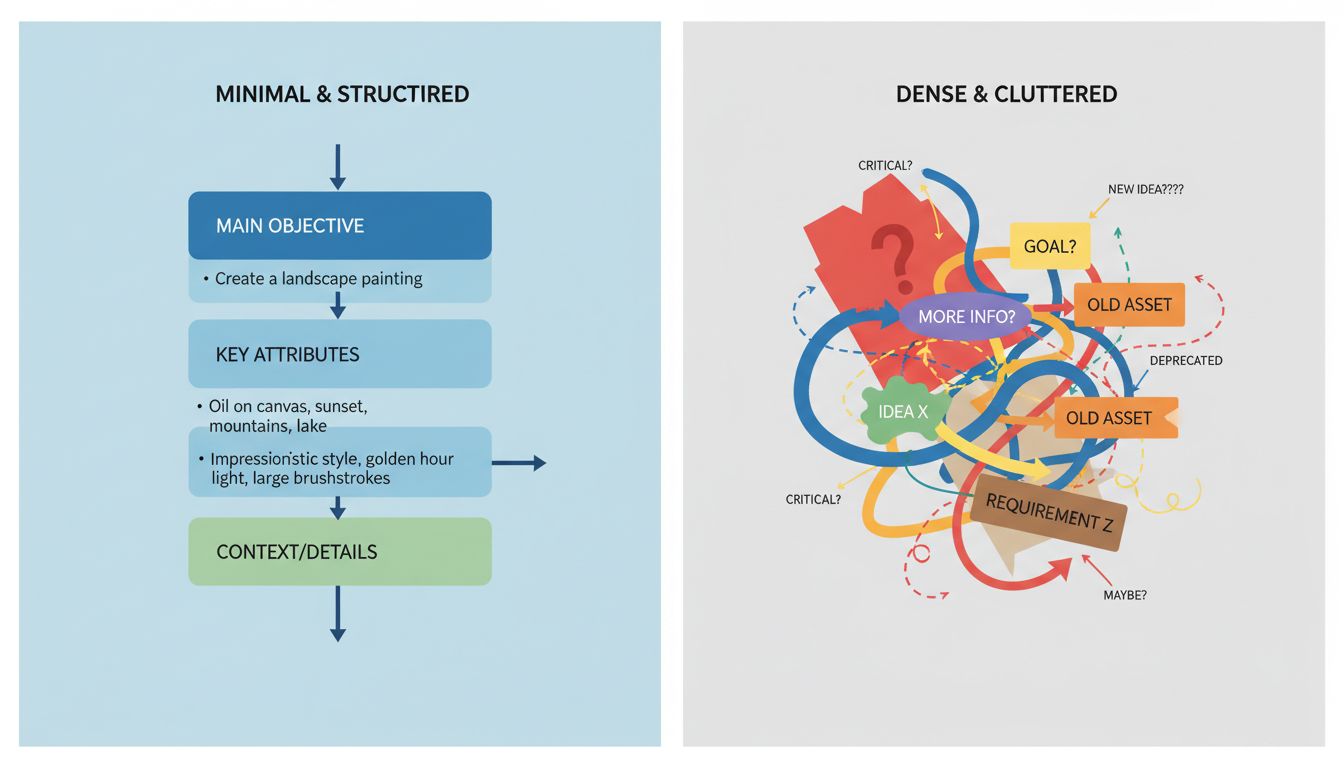
3. Long Prompts Bury the Things That Actually Matter
There’s reasonable evidence from attention research that LLMs attend more strongly to content at the beginning and end of a context window, with a relative dip in the middle. This “lost in the middle” effect, documented in research from Stanford and other groups, means that if you bury your most important constraint in paragraph seven of a twelve-paragraph system prompt, you may as well not have written it.
Prompt authors often do exactly this by accident. They lead with boilerplate about the assistant’s role and persona, put the critical behavioral rules in the middle, and close with formatting instructions. The formatting instructions get followed. The critical behavioral rules get treated as suggestions.
4. Verbosity Signals Uncertainty to the Model
This one is counterintuitive but worth taking seriously. Training data is full of human text, and in human text, verbose instructions often signal anxiety or lack of trust. Legal contracts are long because the parties don’t trust each other. Simple agreements between friends are short. When you write a sprawling system prompt full of “always,” “never,” and “under no circumstances,” you may be training the model’s context to interpret the entire setup as adversarial or high-stakes, which can shift its output distribution in ways you didn’t intend.
Conversely, a short, confident prompt can establish a clear register that the model maintains more consistently. Confidence in your prompt often produces more confident, coherent output.
5. Adding Rules Doesn’t Fix the Underlying Problem
When a model violates a constraint, the instinct is to restate that constraint more emphatically. But most violations aren’t happening because the instruction is absent or unclear. They’re happening because the task itself is ambiguous, the examples in the prompt are inconsistent, or the model’s base behavior is just genuinely hard to override through prompting alone for that class of problem.
In those cases, adding more words to the system prompt is treating a symptom. The real fixes are usually structural: better few-shot examples, a different task decomposition, a fine-tuned model for a very specific use case, or accepting that the constraint you want enforced requires a validation layer outside the model entirely. Context windows being larger doesn’t mean they’re smarter, and scaling prompt length doesn’t substitute for architectural clarity.
6. The Minimum Viable Prompt Usually Outperforms
In practice, prompts that specify only what genuinely needs specifying tend to outperform elaborate ones on most tasks. This isn’t a philosophical preference, it’s a practical observation from anyone who has A/B tested prompt variants seriously. A three-sentence system prompt that nails the model’s role, the output format, and one key behavioral constraint will typically beat a fifteen-paragraph prompt trying to anticipate every edge case.
The discipline required here is similar to deleting a feature rather than adding one. It’s harder to remove an instruction than to leave it in, because removing it feels like accepting risk. But that friction is exactly why prompt bloat happens, and exactly why fighting it takes deliberate effort.
7. If You Keep Adding Rules, Your Prompt Is Probably Wrong
A prompt that requires constant patching is usually the wrong abstraction for the task. If you find yourself adding a new rule every few days to catch new failures, you haven’t written a good prompt with some gaps. You’ve written a brittle specification that’s trying to enumerate solutions to a problem that requires a different approach.
The right response to that situation is usually to step back and ask what the model actually needs to understand to behave correctly, not what it needs to be forbidden from doing. Framing instructions around intent and role tends to generalize better than framing them around prohibited behaviors. A model that understands it’s acting as a careful technical reviewer will handle more edge cases correctly than a model presented with a list of fifty things not to do.
Longer prompts feel like more control. Usually they’re just more surface area for things to go wrong.