

Imagine you’re sitting in a board meeting in 1999. Someone pitches you on a search engine. You pass, because Google just launched and you figure the market is locked up. Reasonable call. Except the search engine that launched two years before Google was AltaVista, and the one before that was WebCrawler, and by the time Google arrived there had been well over a dozen search engines competing for the market. Google didn’t pioneer search. It perfected it.
This keeps happening, and it keeps surprising people, because we’ve built a mythology around first-mover advantage that the actual record doesn’t support. Being first into a market is often a liability dressed up as an asset.
The Pioneer Tax Is Real
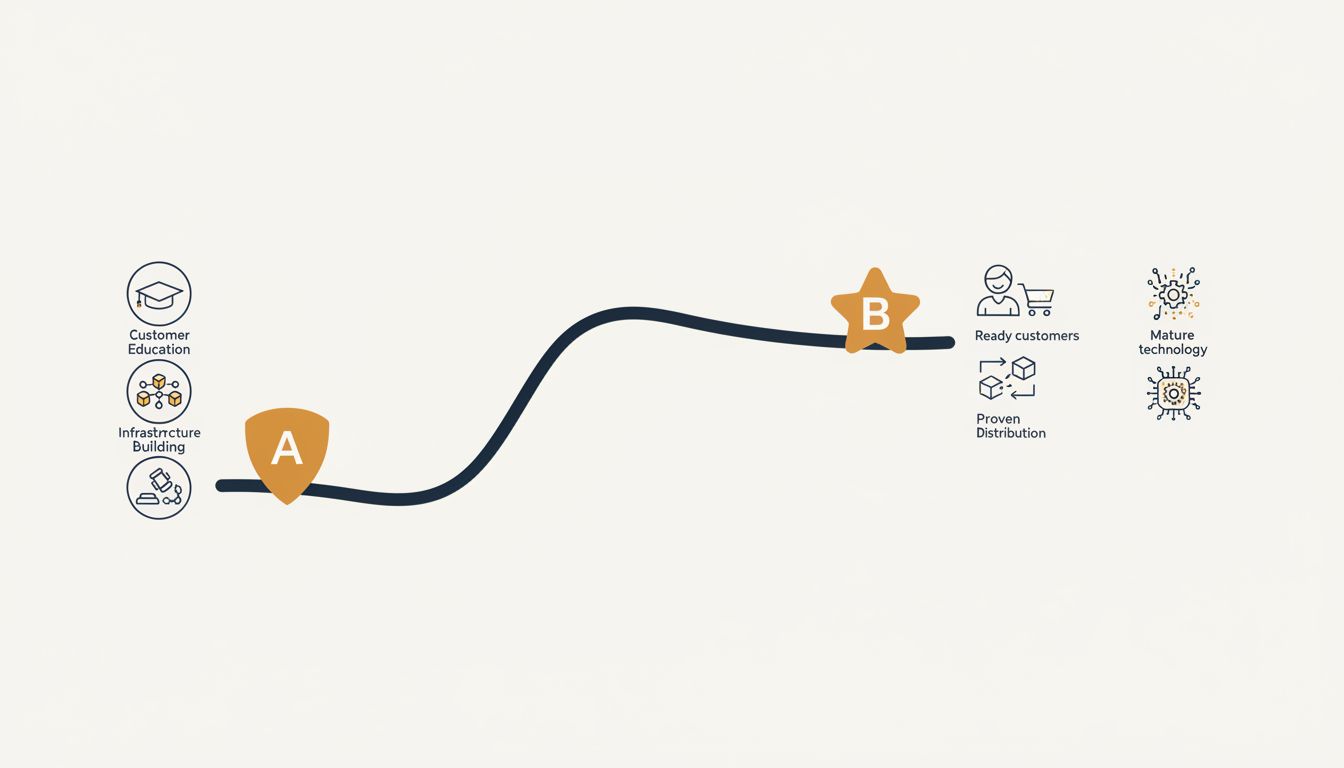
First movers pay for everything: customer education, distribution experiments, infrastructure that doesn’t exist yet, regulatory battles nobody has fought before. They’re not just building a product. They’re building the conditions under which a product can exist.
Netscape invented the commercial web browser in any meaningful sense, then watched Microsoft ship Internet Explorer for free with Windows and gut their business. Friendster built the template for social networking, burned through years and tens of millions of dollars figuring out how to scale a social graph, and collapsed under the load before MySpace showed up with lessons already learned. Myspace then repeated the mistake of building fast on a fragile foundation, and Facebook arrived with better architecture and a more defensible college-campus rollout strategy.
The pattern is consistent enough to have a name in academic strategy literature: “the first-mover disadvantage.” Researchers Peter Golder and Gerard Tellis studied dozens of consumer goods markets and found that market pioneers failed at rates dramatically higher than early followers, and that the companies we remember as “first movers” often weren’t actually first. The companies that achieved lasting market leadership entered, on average, thirteen years after the true pioneers. The pioneers are just forgotten.
What Followers Actually Inherit
When a second company enters a market, something valuable has already been built for them: proof.
Proof that customers will pay. Proof that the distribution channel works. Proof of which objections kill deals. Proof of which customer segment actually converts versus which segment just takes meetings. The first company spent years and enormous capital generating that proof through trial and error. The second company can read it like a manual.
This is not a small advantage. The first full-price customer can actually kill your startup by anchoring you to assumptions that haven’t been stress-tested. When you’re second, you inherit a set of stress-tested assumptions and can start from a much more honest baseline.
Second movers also get to hire from the pioneer’s workforce. The people who built the first version of a product, fought through the zero-to-one problem, and then watched the company struggle or fail are enormously valuable. They carry institutional knowledge about what doesn’t work, which is often more actionable than knowing what might work.
The Technology Timing Problem
There’s a structural reason why early entrants often can’t win even when they do everything right: the underlying technology isn’t ready.
General Magic, founded in 1990, was building something that looked a lot like a smartphone. It had a touchscreen, a messaging system, apps, and a marketplace. The founders included people who would go on to build major parts of the modern tech industry. It failed completely, and not because of bad execution. The cellular networks didn’t have the bandwidth. The batteries didn’t have the energy density. The processors didn’t have the speed. The device would have cost several thousand dollars and been practically unusable.
Apple launched the iPhone seventeen years later, after the entire technology stack had matured around the problem. They didn’t invent the smartphone. They entered at the moment when the components were finally good enough to build one that worked.
This plays out constantly in enterprise software. Companies that tried to sell cloud-based tools to enterprises in the early 2000s were running into security objections, compliance objections, and bandwidth objections that were entirely legitimate at the time. By the time Salesforce and its successors started winning large contracts, the objections hadn’t disappeared, they’d just become manageable. The second and third waves of cloud companies got to operate in an environment where the first wave had already negotiated the conceptual terms of the debate.
Incumbency Is a Trap, Not a Moat
Here’s what first-mover advantage actually is: it’s the opportunity to become an incumbent before anyone else. And incumbency is valuable, but it’s fragile in ways that don’t become obvious until a credible competitor arrives.
First movers build for the customers they have, not the customers who are coming. They accumulate technical debt in proportion to how fast they grew. Their pricing is set by what the market would bear when they were the only option, which is often either too high (because they could charge it) or too low (because they had to subsidize adoption). Their sales team has learned to sell a product that is increasingly not the product they’re selling.
When a well-funded second mover arrives with a clean architecture, a team that has studied the incumbent’s weaknesses, and pricing tuned to poach dissatisfied customers, the incumbent’s “moat” turns out to be more like a drainage ditch. The switching costs that seemed prohibitive get reframed as pain points. The integrations that seemed like lock-in become the thing customers complain about on comparison sites.
Salesforce did this to Siebel. Slack did this to email-based coordination tools and eventually to HipChat. Stripe did this to the incumbent payment processors who had treated developer experience as an afterthought. In each case, the winner wasn’t the pioneer. It was the company that arrived after the problem was understood and before the incumbent had figured out how to defend itself.
The Narrow Window Where First-Mover Matters
This is a real advantage in specific circumstances, and worth being precise about.
Network effects with high switching costs can lock in a first mover before followers can get traction. WhatsApp reaching critical mass in developing markets before competitors could establish footholds is a real example. The same goes for markets where distribution is controlled (if you land the exclusive deal with the largest retailer, latecomers are genuinely locked out) or where regulatory approval creates durable barriers (pharmaceutical patents, FAA certification for aircraft components).
Data network effects can also compound in ways that are hard to overcome. A company that has been accumulating training data or behavioral signals for years has something followers can’t easily replicate on a fast timeline. This is increasingly relevant in any product that uses machine learning as a core component.
But outside these specific conditions, first-mover advantage is mostly a story we tell after the fact, applied retroactively to winners who happened to be early. We ignore the pioneers who moved first and lost.
Why We Keep Getting This Wrong
Survivorship bias is doing most of the work here. We study Amazon and assume early entry into e-commerce was the decisive factor. We don’t study the dozens of e-commerce companies that entered before Amazon and collapsed. We study Google and conclude that moving fast in search was the advantage. We don’t study Excite, Infoseek, Lycos, or Ask Jeeves with the same attention.
The venture capital framing reinforces this. “Get there first” is a clean, actionable thesis that’s easy to pitch and easy to fund. “Wait until the market is understood and then execute better than the incumbent” is a harder pitch, even though it describes how a surprising number of major companies actually won.
There’s also a psychological component. Founders who are genuinely first into a market feel the urgency of that position viscerally. They’ve identified something real, they’ve built something real, and the prospect of a better-resourced competitor arriving and using their work as a blueprint is genuinely terrifying. That urgency gets encoded into the advice they give, the books they write, and the culture of the companies they build.
What This Means
If you’re founding a company, the relevant question isn’t “am I first?” It’s “do I understand the market better than whoever is currently in it?”
If you’re investing, a competitive market with an established pioneer isn’t automatically a red flag. Sometimes it’s the best possible signal that the opportunity is real and the timing is right.
If you’re studying why companies win and lose, strip out the origin stories and look at what the winning company actually knew and built that the pioneer didn’t. It’s almost never “they got there first.” It’s usually “they understood something the pioneer had learned the hard way, and they used it.”
The second company into a market pays for a lot. It pays the pioneer’s salary through competition, it pays for the category being explained to customers already, it pays in the form of a template it has to differentiate against. But it doesn’t pay the pioneer tax. And that tax is higher than most people building first-of-kind companies want to admit.