

Picture the founding team at Myspace in late 2004. They have 5 million users, a cultural moment, and a head start that looks insurmountable. A Harvard sophomore is building something similar in a dorm room, but Myspace is already the party. They have the users, the press, the momentum. The game feels over.
We know how this ends.
The mythology of the first-mover advantage is one of tech’s most persistent and expensive lies. Investors repeat it. Founders use it to justify burning cash before they’re ready. Business school professors teach it. And yet, the graveyard of pioneering companies is so crowded it should give anyone pause.
The Setup: What First-Mover Actually Means
Being first into a market means you pay every exploration cost. You educate customers who don’t yet know they need your product. You build infrastructure that doesn’t exist. You make the regulatory mistakes that teach everyone else what not to do. You run the A/B tests that the whole industry learns from, publicly, in real time.
The first mover is, in most cases, an extremely expensive research project that the second entrant gets to read for free.
This isn’t abstract. Look at the search engine market in the 1990s. AltaVista launched in 1995 and was genuinely impressive, handling millions of queries before most people knew what a search engine was. Lycos, Excite, and Yahoo followed. By the time Google arrived in 1998, the market had been educated, the use cases were understood, and the core problem (bad search results) had been identified by millions of frustrated users. Google didn’t have to explain what search was. They just had to do it better, with a clean interface and an algorithm that actually worked.
AltaVista built the runway. Google landed the plane.
What Happened: Facebook and the Lessons Myspace Paid For
Myspace’s story is useful because it’s clean. The company wasn’t stupid or complacent, at least not at first. They grew fast, they had real network effects, and they understood that social networking was going to be enormous. Their sin wasn’t laziness. Their sin was being first.
Being first meant Myspace had to figure out moderation, spam, identity, privacy, and monetization simultaneously, all while the product was already in the hands of millions of real users. Every mistake was live. Every misstep trained their competitors. The platform became cluttered partly because they were experimenting publicly with monetization before they had a clean model. The security problems they encountered (and failed to solve quickly) showed Facebook exactly what not to build.
Facebook launched at Harvard in 2004, spread to other universities, and opened to the general public in 2006. By then, Myspace had essentially written a detailed case study in what users hated about social networks. Facebook read it. They launched with a cleaner design, real-name identity baked in from the start, and a more careful approach to monetization.
By 2008, Facebook had passed Myspace in unique visitors. By 2011, Myspace was largely irrelevant.
This pattern shows up everywhere you look. TiVo invented the DVR category, spent years teaching consumers what time-shifting meant, and then watched cable companies roll out their own DVRs to an already-educated customer base. Napster taught the music industry (and a generation of users) that digital music distribution was possible and desirable, then got shut down, leaving the blueprint for iTunes and eventually Spotify. Friendster built the social graph before anyone knew what to call it, suffered under the weight of their own success, and handed the lesson plan to Myspace, who handed it to Facebook.
The pioneer dies. The fast follower thrives.
Why It Happens: The Structural Advantage of Going Second
There are a few concrete reasons the second mover wins, and they’re worth being specific about.
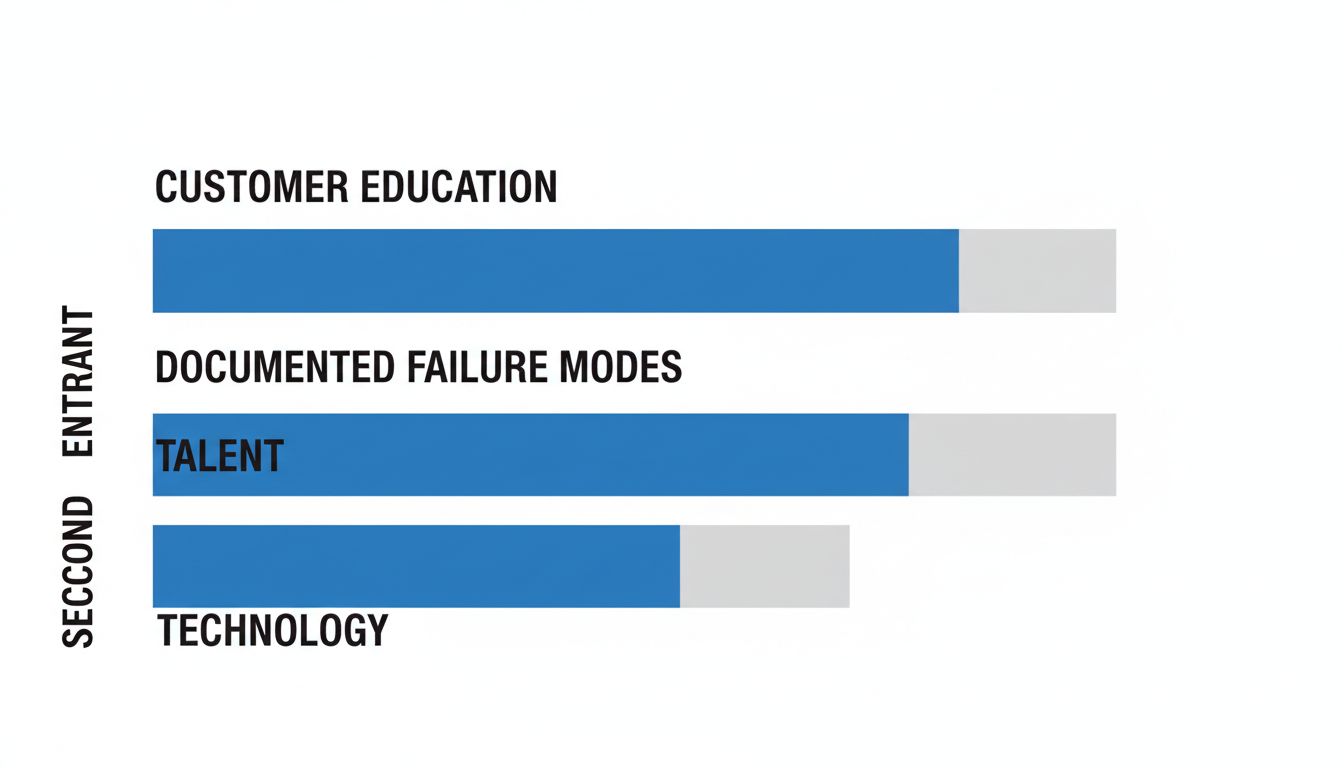
Customer education is done. The first company spends real money convincing people a product category matters. The second company walks into a room where that argument has already been won. This is a massive reduction in sales and marketing cost at exactly the moment when capital efficiency matters most.
The failure modes are documented. Every public stumble by the first mover is a free engineering and product lesson. The second company can build with the benefit of knowing what went wrong, often in granular detail because tech journalism covers failure obsessively.
Talent flows toward momentum. Once a market is proven, the best engineers and product people want to work in it. The first mover often had to hire before the space was prestigious. The second company, arriving when the category is hot, can recruit more selectively.
Technology catches up. Many pioneering companies are limited by the infrastructure available when they launched. Google benefited from cheap commodity hardware that didn’t exist when AltaVista was building. Spotify benefited from smartphone penetration and bandwidth that Napster couldn’t dream of. Being second often means building on a more mature technical foundation.
The Exceptions Are Real But Narrow
First-mover advantage does exist, but it’s conditional on specific circumstances that most companies don’t meet.
It holds when switching costs are extremely high and locking in customers early is structurally possible. Oracle built an early position in enterprise databases that proved durable, partly because ripping out a database system is a years-long project no sane CFO wants to authorize. It holds when network effects are so strong that the network itself becomes the moat, not the product, which is genuinely rare. It holds when a company can patent core technology and enforce those patents successfully, which is harder than it sounds.
For most software businesses, none of these conditions apply cleanly. The switching cost for a new web app is usually a weekend project. Network effects at most startups are weaker than the founders believe. And patents, especially in software, are slow and expensive to defend.
The honest read: first-mover advantage is real in commodity extraction, pharmaceuticals, and a handful of network-effects businesses. For the average tech startup, it’s mostly a story founders tell themselves to justify moving before they understand the problem.
What to Learn From This
The lesson isn’t to sit on your hands and wait for someone else to take the arrows. Markets can close. Being third or fourth usually means the window is gone.
The lesson is to calibrate what “being early” is actually worth. If you’re first, your job is to learn as fast as possible and iterate toward something defensible before the fast followers arrive. You can’t stop them from coming. You can try to be so far ahead by the time they show up that your head start has compounded into something real.
And if you’re the second company in, stop apologizing for it. You have more information than the pioneer had at launch. Use it. The first company proved the market exists and taught you what customers hate. That’s not a disadvantage. That’s a gift, and most second-movers waste it by copying too closely instead of leapfrogging.
Myspace built the road. Facebook built the destination. Know which one you’re building.