
The simple version
The first company into a new market spends its own money teaching customers that the product category exists. The second company shows up after that education is done and competes for customers who are already convinced.
What being first actually costs
Imagine you’re running a company in 2006 and you’ve just figured out that businesses will pay for software delivered over the internet instead of installed on their servers. Brilliant insight. Now go spend the next three years on sales calls explaining what “cloud” means to IT managers who think you’re trying to sell them weather forecasting.
That’s the pioneer tax. It’s not metaphorical. It shows up in your customer acquisition costs, your sales cycle length, your burn rate, and ultimately in whether you’re still around when the market finally takes off.
Salesforce spent years fighting this battle before enterprise software-as-a-service became an accepted category. They won, which makes them the exception people remember. The more common outcome is a company that does the hard work of creating a market and then runs out of runway just as competitors arrive, better funded and facing customers who are now educated and ready to buy.
Being first means you bear the full cost of market creation. You hire the anthropologists to figure out what customers actually want. You build the wrong version of the product, learn from it, then build the right one. You establish the pricing norms, often too low at first because you’re desperate for any traction. You absorb every early-adopter complaint and redesign your product around it.
All of that is genuinely valuable work. The problem is that none of it is proprietary. You’ve essentially done open-source market research.
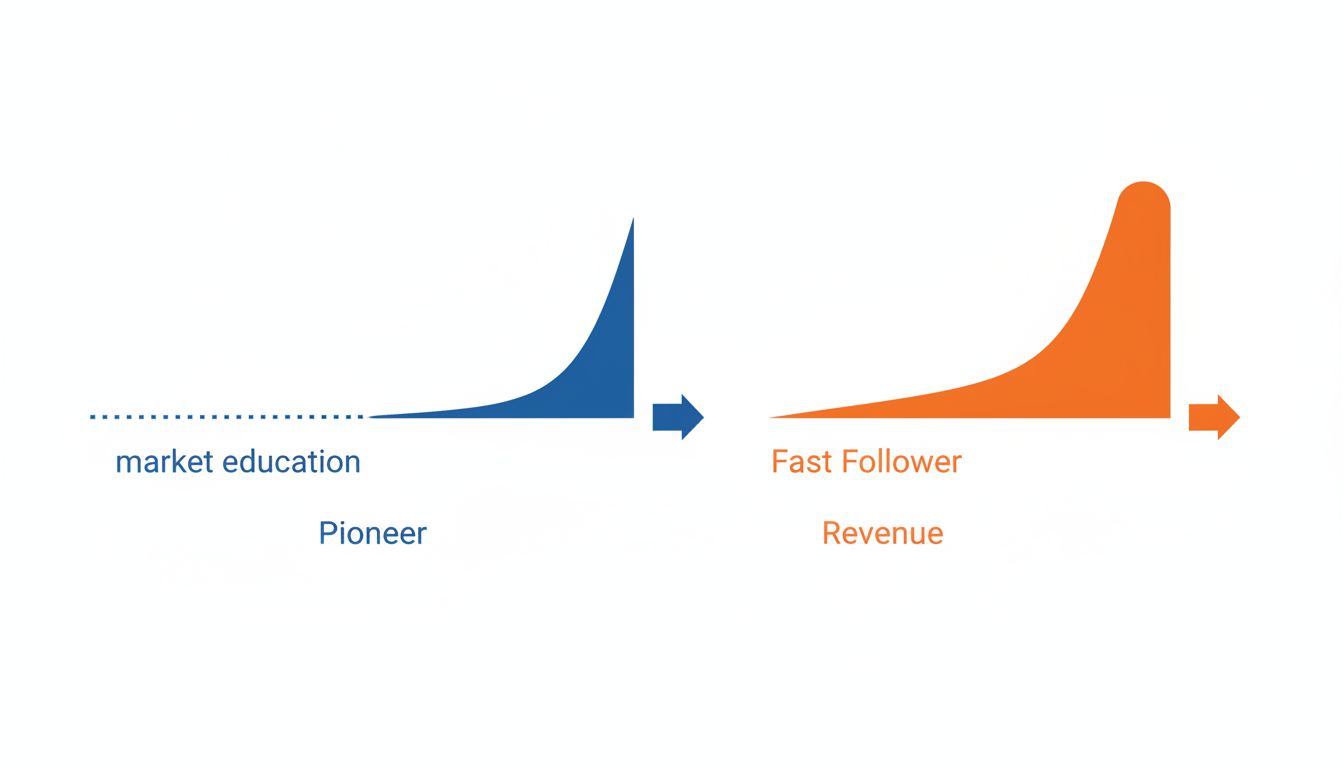
Why the follower has better information
The second company into a market can watch the pioneer’s mistakes from a comfortable distance and build something that skips the worst of them.
Google wasn’t the first search engine. By the time they launched, users had already learned to search, had already been frustrated by irrelevant results from AltaVista and Excite, and were actively looking for something better. Google didn’t need to explain what a search engine was. They just needed to be better.
Facebook wasn’t the first social network. MySpace and Friendster had already convinced hundreds of millions of people that the concept of an online social profile was worth having. When Facebook arrived with a cleaner interface and a college-campus rollout strategy, they were selling to a market that had already been trained.
This is the structural advantage that rarely gets discussed: the follower’s product feedback loop starts much faster. They’re not iterating from zero. They’re iterating from a known baseline, informed by a competitor’s public stumbles.
The lock-in myth
The standard counterargument is network effects. If the first mover builds a network, the argument goes, switching costs become prohibitive and the pioneer is protected. This is sometimes true. It is not usually true.
Network effects protect incumbents mainly in markets where the network itself is the product, and where the marginal value of each new user compounds meaningfully. Social platforms have this. Messaging apps have this, at least partially. Most B2B software does not have this in any meaningful sense.
For most products, what looks like lock-in is actually just inertia. And inertia breaks when a sufficiently better or cheaper alternative appears. The follower’s job is to be that alternative.
The other version of this argument involves patents and proprietary technology. First movers can protect their innovations legally. Sometimes. In software, patent protection is expensive to enforce, often ineffective, and increasingly unpopular with the talent you’re trying to hire. Technology advantages erode. Knowing your customers deeply does not.
When being first actually does win
This isn’t a universal law. There are conditions under which the pioneer holds the ground.
Distribution advantages can be durable. If the first mover secures exclusive contracts, preferred shelf placement, or deep integrations with platforms the follower can’t access, that’s a real moat. Qualcomm’s early dominance in CDMA patents gave them licensing leverage that compounded for decades. That’s first-mover advantage working as advertised.
Brand in certain categories matters enormously. Being first to own a position in a customer’s mind (Kleenex for tissues, Xerox for copying) creates a semantic advantage that’s genuinely hard to dislodge. But this requires not just being first, but being so dominant early that your brand name becomes the category name. That’s a high bar.
Capital intensity can protect pioneers. If building the product requires infrastructure investment so large that replication is impractical, the pioneer’s head start compounds. This applies to some semiconductor fabs, some telecom infrastructure, some energy projects. It rarely applies to software.
For most tech companies, none of these conditions apply. What they have instead is a head start, which sounds like an advantage but functions more like a longer runway for making expensive mistakes before the competition arrives.
The real lesson for founders
If you’re building in an established category, the pioneer tax has already been paid for you. Your job is to understand why the category leader’s customers are dissatisfied, build specifically for that dissatisfaction, and move fast while the incumbent is protecting its existing revenue instead of cannibalizing it.
If you’re building in a genuinely new category, you should be clear-eyed about what you’re taking on. You’re not just building a product. You’re funding a market education campaign on behalf of every competitor who will follow you. That’s a legitimate strategy, but it requires enough capital to survive until the market matures, and a defensible position that doesn’t evaporate the moment well-funded followers arrive.
The romanticization of being first is understandable. It makes for a better founding story. But the economics usually favor whoever enters second, with better information, lower customer acquisition costs, and a product shaped by the pioneer’s public failures.
History remembers the companies that won. It does not carefully track whether they were first.