
The Real Bottleneck Is Idleness
There is a persistent assumption in software engineering that performance problems are computation problems. The code is too slow, the algorithm is too naive, the CPU is working too hard. Engineers spend weeks optimizing loops and data structures, hunting the inefficiency in the logic. Most of the time, they are looking in the wrong place entirely.
Profiling data consistently tells a different story. In networked applications, which describes nearly all production software today, the dominant cost is not computation. It is waiting. A typical web service handling a user request might spend 5% of its elapsed time doing actual computation and the remaining 95% blocked, waiting on a database to respond, an external API to return, or a file system to hand back bytes. The CPU sits idle, the thread is parked, and the user waits.
This is not a flaw in a particular codebase. It is the natural consequence of how modern software is built: as a network of services, each of which depends on responses from other services. The question worth asking is not how to make the computation faster, but how to stop treating idle time as inevitable.
Why Sequential Code Feels Natural but Costs Dearly
The mental model most programmers start with is sequential execution. Do this, then do that, then do the next thing. It mirrors how humans think about instructions and it produces code that is easy to read and reason about. The problem is that sequential execution, applied to I/O-bound work, is extraordinarily wasteful.
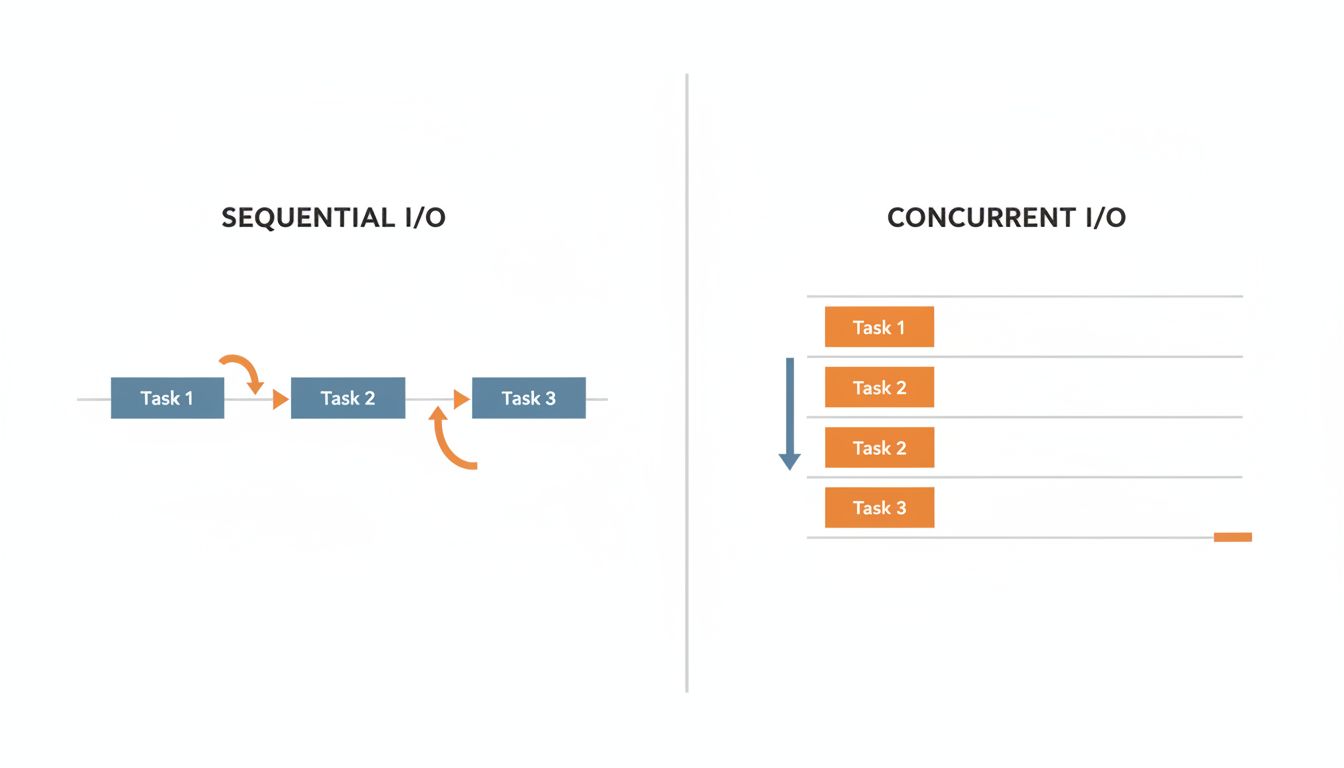
Consider a common pattern: a service that receives a request, queries a database for a user record, calls an external API to fetch account details, queries the database again for recent activity, and then assembles a response. Each step takes, say, 50 milliseconds. Done sequentially, the total latency is 200 milliseconds, plus whatever computation happens at the end. But three of those four operations are independent. They do not need each other’s results to begin. Done concurrently, the latency collapses to roughly 50 milliseconds, the time of the slowest individual call.
The code that does these operations sequentially is not broken in any obvious sense. It produces the right answer. It passes all the tests. It looks reasonable in a code review. But it is operating at a fraction of its potential throughput and introducing latency that every user absorbs on every request.
This is the insidious part: sequential I/O is invisible in a way that a slow algorithm is not. An O(n²) sort will eventually make itself known as data grows. Sequential I/O just quietly makes everything a little slower than it needs to be, forever.
Concurrency Is the Fix, Not a Complexity Tax
The counter-argument to parallelizing I/O is usually that concurrent code is harder to write and harder to debug. This was a reasonable concern for a long time. Thread-based concurrency involves locks, race conditions, and deadlocks that can be genuinely treacherous.
But modern runtimes and languages have substantially changed this calculus. Python’s asyncio, JavaScript’s async/await model, Go’s goroutines, and Java’s virtual threads (shipped in Java 21) all provide ways to write concurrent I/O code that looks nearly as simple as sequential code. The cognitive overhead has dropped considerably. Running three independent API calls with Promise.all() in JavaScript, or asyncio.gather() in Python, requires roughly the same mental effort as writing them sequentially and produces dramatically better results.
The cost of not doing this compounds at scale. A service handling a modest load of 1,000 requests per second, where each request blocks for 150 milliseconds of unnecessary sequential I/O, is holding connections and memory hostage for a third of a second when it could be holding them for a fifth of that time. This is the kind of headroom that delays infrastructure scaling decisions and reduces the margin when traffic spikes unexpectedly.
The Hidden Cost of Redundant Round Trips
Concurrency addresses how you do necessary work. But a second category of idle time comes from work that should not be necessary at all.
Caching is widely understood but widely under-applied. Many systems fetch the same data repeatedly within a single request lifecycle, or across requests where the underlying data has not changed. A user’s permissions, their account tier, their preference settings: these are read far more often than they are written. Fetching them from a database on every request is not correctness-preserving caution. It is a habit that scales linearly with request volume in a way that a cache would not.
The same logic applies to N+1 query patterns, one of the most common and costly problems in applications that use object-relational mappers. Fetch a list of 100 orders, then fetch the customer record for each one individually, and you have converted one potential query into 101 actual queries. The application appears to work correctly in development with small datasets and falls apart gracefully enough in production that the problem stays invisible until the system is genuinely stressed. Tools like query analyzers and APM platforms surface these patterns, but only if someone is looking.
Measuring Before Optimizing Is Not Optional
The argument for measuring before optimizing is old enough to feel like a cliché. It is still right. Assumptions about where time is being spent are frequently wrong, and optimization effort directed at the wrong layer produces nothing useful while consuming real engineering time.
Distributed tracing tools (Jaeger, Honeycomb, Datadog APM) make the structure of a request’s time budget visible in a way that was much harder a decade ago. A flame graph showing where a request’s 300 milliseconds actually went is worth more than a week of intuition-driven optimization. Typically it shows something unexpected: a single slow dependency, a query that was assumed to be fast but is not, a synchronous operation in a path that was assumed to be async.
The payoff for getting this right is not marginal. Systems that eliminate unnecessary sequential I/O, add targeted caching, and resolve query inefficiency routinely see latency improvements of 50 to 80 percent without any changes to business logic or algorithms. The computation was never the problem. The idle time was.
Software that runs fast is not usually software where the algorithms are cleverer. It is software where someone noticed that the program was spending most of its time standing still, and decided that was worth fixing.