

The simple version
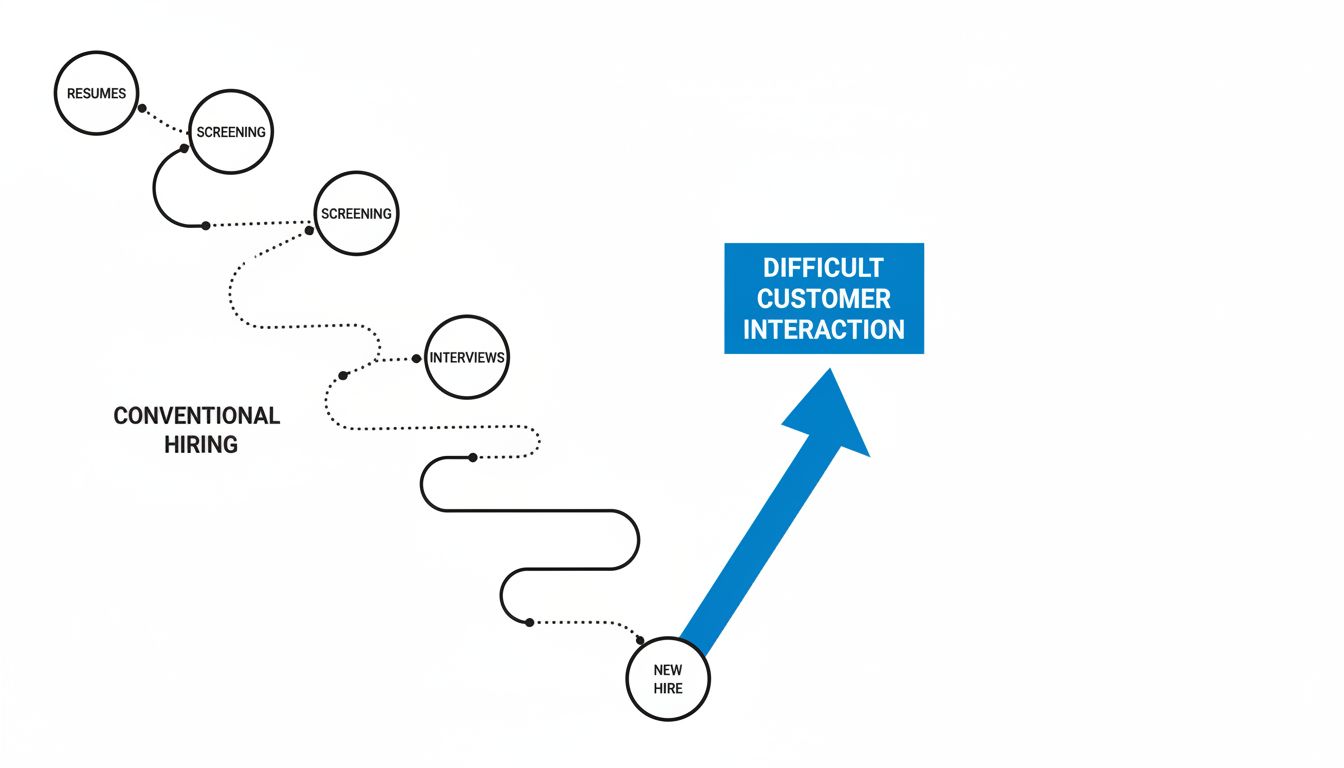
The customer who made your life miserable in year one often understands your product’s real problems better than you do. That person is worth hiring.
Why this sounds wrong at first
Picture it: you’re six months into building something. You have maybe a dozen customers. One of them is a nightmare. They file detailed bug reports at 11 p.m. They push back on your roadmap. They want things you haven’t built and things you’ll never build. Your team groans when their name appears in Slack.
The instinct is to manage them at arm’s length, maybe eventually fire them. And sometimes that’s right. Some customers are just draining, and the math never works out. There’s a whole calculus to that decision.
But there’s a different kind of difficult customer, and founders confuse the two constantly. One is difficult because they’re a bad fit. The other is difficult because they care more than anyone else you’ve met, understand your domain deeply, and have incredibly high standards for what good looks like. The second type is a recruiting opportunity you’re probably treating like a support ticket.
What they actually bring
Early startup hiring has a problem that doesn’t get talked about enough: you need people who can operate with almost no context, generate their own standards, and care about the product without being told to. Those people are rare and genuinely hard to find through normal channels.
Your demanding customer has already solved most of that problem. They know the domain. They know your product’s weaknesses in specific, articulable terms. They’ve already demonstrated that they care enough to push hard for something better. They’ve essentially been doing unpaid product work for you this whole time.
This is different from the generic advice to “hire people who are passionate about your mission.” Passion is easy to perform in an interview. What’s hard to fake is months of detailed, sometimes combative feedback that shows someone thinking seriously about the right way to solve a problem.
Where this pattern actually shows up
You see this in a lot of early-stage companies once you start looking for it.
Salesforce’s early customer success culture was partly built on people who came from the enterprise software world and had spent years being frustrated by it. They didn’t just want jobs at Salesforce; they had specific grievances about how enterprise software failed and specific ideas about what better looked like. That’s a different energy than someone who applied because it seemed like a good company.
Hubspot’s growth in its early years was driven significantly by people who had been in small marketing teams, had been ignored by expensive enterprise tools, and had very loud opinions about what the category was missing. Some of those people became customers first.
The pattern matters in B2B software especially, but it shows up anywhere the product solves a real professional problem. The person who has been living inside that problem, frustrated by every existing solution, is carrying knowledge that you cannot easily hire or train into someone.
The actual process of doing this
This is not complicated, but it requires overcoming a reflex.
When a customer starts showing up in your inbox with a level of specificity and intensity that most people don’t bother with, pay attention to what they’re actually saying. A customer who says “your export function is broken” is mildly annoying. A customer who says “your export function assumes a flat data model, which means anyone with relational data structures hits this wall, here’s what I’d expect instead” is telling you something. They have a mental model of your product that’s sophisticated enough to diagnose root causes. That’s unusual.
The next step is just talking to them, not about the bug, but about them. What do they do? What does their team look like? Have they thought about making the jump from wherever they are now? You’re not making a pitch; you’re finding out if there’s a fit. Many of them won’t be right for the role or won’t want it. But the conversation is worth having.
What you’re looking for is whether their standards translate into building, not just critiquing. Some people are excellent at identifying problems and poor at tolerating the ambiguity of solving them inside a small company. You want the ones who are frustrated enough to want to fix it from the inside.
The timing question
This works best when it’s early. Once your company has thirty employees and established culture, onboarding a demanding ex-customer into a mid-level role becomes complicated. They arrive with strong opinions about what you should be doing, and so does everyone else already there, and the collision can go badly.
In the first ten to twenty hires, that kind of collision is exactly what you want. You don’t have entrenched culture yet. You’re still figuring out what good looks like. A hire who comes in with conviction, specific knowledge, and high standards doesn’t disrupt culture at that stage; they help create it.
One thing to be honest with yourself about: this only works if you’re actually listening to difficult customers rather than just tolerating them. Founders who treat every pushback as noise to be managed will never see the signal. If you’ve been responding to demanding feedback with damage control instead of curiosity, you’ve probably already let a few of these people slip away.
The people who are hardest to satisfy when they’re customers are often the ones who build the best products when they’re on your team. That’s not a paradox. It’s the same quality expressing itself in two different contexts.