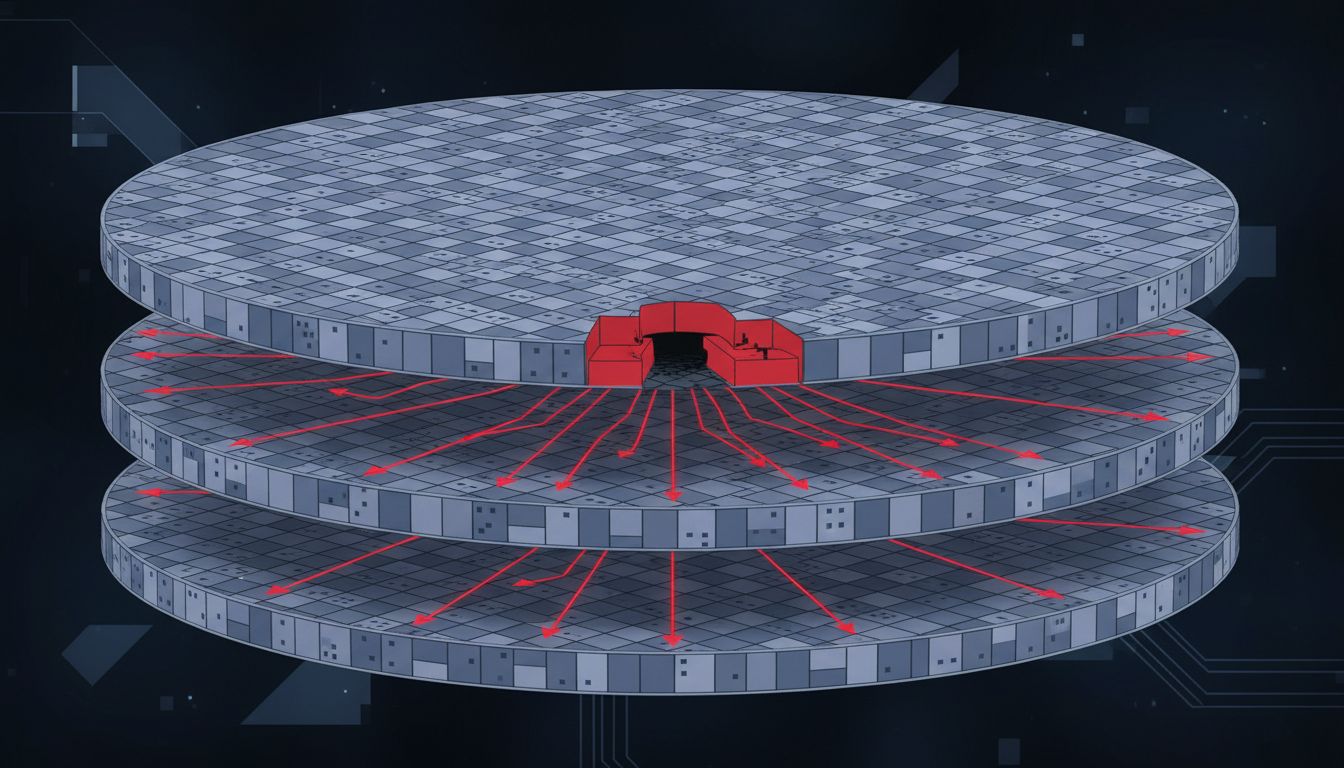

A crash is honest. Your program stops, a stack trace appears, and at least you know something went wrong. Concurrency bugs are dishonest. They let your system keep running, keep serving traffic, keep writing to databases, while producing subtly wrong results that can persist for hours or days before anyone notices.
This is the most underappreciated danger in concurrent programming, and it’s why I think the field’s traditional focus on preventing deadlocks misses the point. Deadlocks are visible. Silent data corruption is not.
Crashes Tell You Where to Look. Race Conditions Don’t.
When a program crashes, you get a signal. A null pointer dereference, an out-of-bounds access, a panic. These are loud failures. They demand attention. Engineers respond to them quickly because the system is obviously broken.
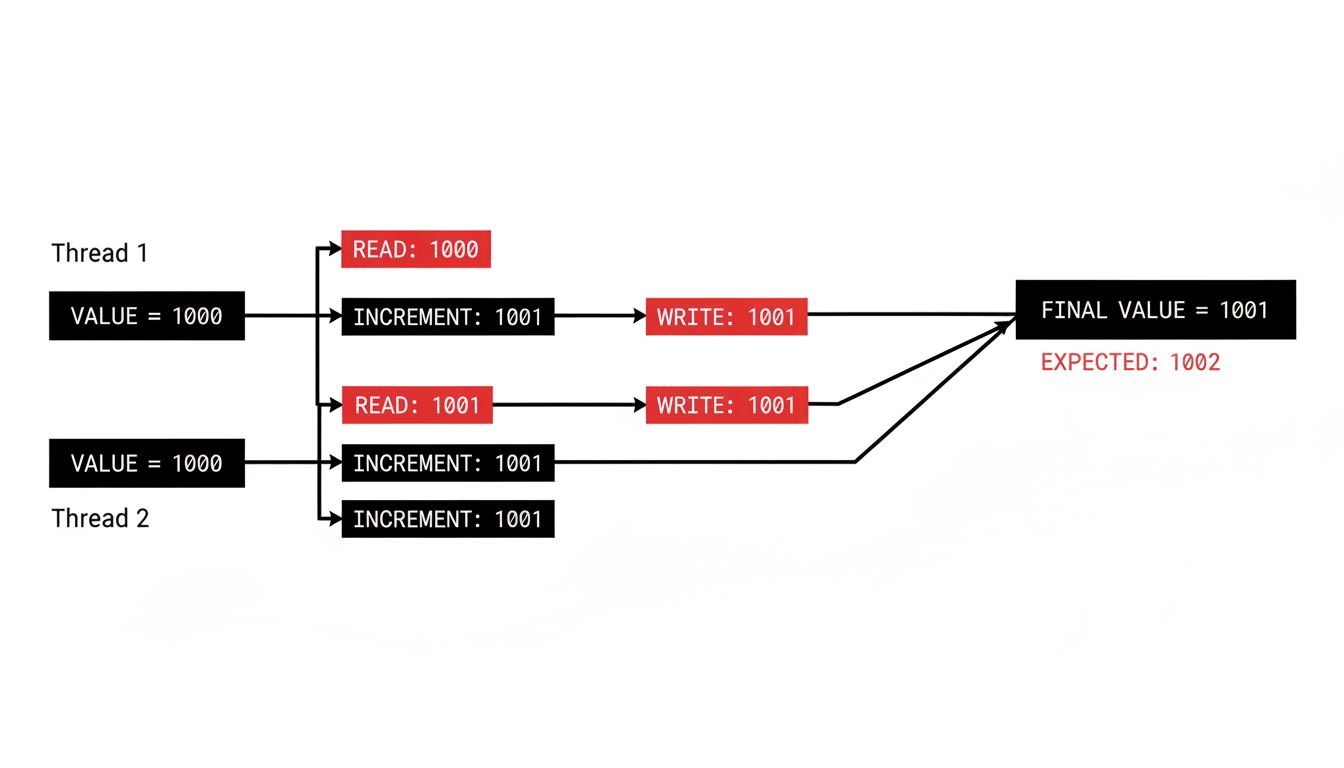
A race condition produces none of this. Two threads read a shared counter, both increment their local copy, both write back, and suddenly you’ve lost an update. The counter reads 1001 when it should read 1002. Your inventory system thinks it has one more item than it does. Your billing system charges a customer incorrectly. Your analytics report shows the wrong number, and someone makes a business decision based on it.
The program never crashed. No alarm went off. The bug may not reproduce reliably under testing because it depends on thread scheduling that varies with load. You’ll find it when a user reports something inexplicable, or when an audit turns up inconsistencies, or possibly never.
The Damage Accumulates Before Anyone Notices
A crash has a natural blast radius. It affects the request or process that was running at the moment of failure. A concurrency bug can write bad data that persists in your database, propagates through downstream systems, and gets cached everywhere before a single human being flags it as wrong.
This is not hypothetical. Banking systems have double-posted transactions due to race conditions in payment processing. Healthcare applications have served stale medication data because two threads updated a cache without proper synchronization. E-commerce platforms have oversold inventory because their stock-decrement logic wasn’t atomic. In each case, the application kept running. Users kept interacting with it. The damage accumulated quietly.
A crash stops the accumulation. A concurrency bug accelerates it.
The Problem Gets Worse as You Scale
Here is where the danger compounds. Race conditions often depend on timing, and timing depends on load. A bug that manifests once per million operations means nothing in a low-traffic system. It means several incidents per day once you’re handling serious volume.
This creates a perverse situation: the bug was always there, but it becomes statistically significant only as your system succeeds. The code that passed all your tests under light concurrent load becomes unreliable exactly when reliability matters most. And debugging it at that scale is genuinely difficult, because production load is often impossible to reproduce in a test environment with enough fidelity to make the bug appear on demand.
To understand why this happens at the hardware level, it helps to know what’s actually going on inside a CPU when multiple threads share memory. Cache coherence protocols, memory barriers, and out-of-order execution mean that even simple-looking operations are not atomic by default.
The Counterargument
Some engineers argue that modern languages and frameworks have made this less of a problem. Rust’s ownership model prevents data races at compile time. Go’s concurrency primitives encourage channel-based communication. Immutable data structures in functional languages reduce shared mutable state.
This is partially true, and it matters. But it doesn’t eliminate the problem. Most production code is not written in Rust. Go’s channels prevent some race conditions but don’t prevent logical concurrency errors at the application level. And language-level protection doesn’t help when the concurrency spans multiple services, processes, or database transactions, which is exactly where modern distributed systems live.
A microservices architecture introduces distributed concurrency that no single language’s type system can protect against. Two services updating the same database record in response to the same event, with no coordination, will produce race conditions regardless of what language each service is written in.
The Fix Starts with Treating Correctness as Visible
The reason concurrency bugs are so dangerous is that we’ve built monitoring for crashes and not for silent corruption. We get paged when a service goes down. We rarely get paged when a counter is off by one.
The first step is changing that. Invariant checks, consistency assertions, and anomaly detection on data outputs should be as standard as uptime monitoring. If a transaction log shows a balance going negative when it shouldn’t, that’s a signal, and it should fire an alert the same way a 500 error does.
Beyond monitoring: design for atomicity where it counts, use database transactions correctly, treat shared mutable state as a liability, and test concurrent paths explicitly rather than assuming the happy path is the only path.
Crashes are engineering problems. Silent data corruption from concurrency bugs is an engineering problem that also becomes a trust problem, a compliance problem, and sometimes a legal problem. The failure mode that lets your program keep lying to you is strictly more dangerous than the one that makes it stop. Build accordingly.