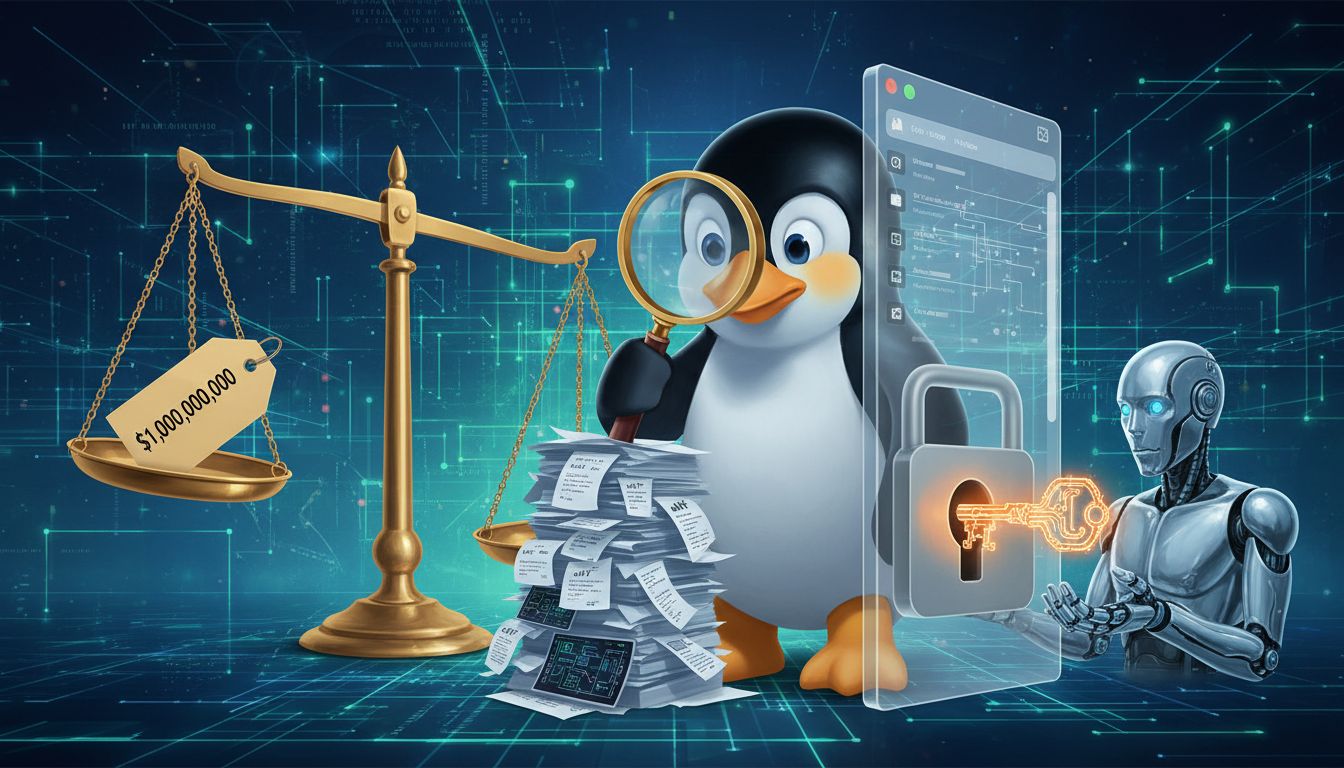
Today’s items share a theme: provenance matters less than what a thing does once it’s in the system. The Linux kernel cares about competence more than origin, 1Password hides credentials from the agent using them, and OpenAI’s trillion-dollar valuation is still being haggled over.
1. 1Password hides the password from agents, not the agents from banks
The clean idea in 1Password for Agents is that the agent never sees your password. Per TechCrunch, the agent presents a unique digital key to 1Password to prove its identity. You get an alert and approve the attempt, and 1Password fills in the credentials itself. Launch support covers Anthropic’s Claude Duet, OpenAI’s Dots and ChatGPT Work, Grok Bot, Meta’s Muse and agents from Town.
That removes the lazy shortcut of pasting a secret into an agent, where a copy may linger for next time. The harder question is the one the source leaves open: what does the agent hold once it’s signed in, and what happens if the agent is compromised? Anyone building on this will ask that first, and the coverage doesn’t answer it.
The bank side shows the other gap. Axios reports that U.S. banks are detecting agentic activity in accounts, and most can’t tell whether it traces to a user’s request. Bankers called it “horrifying,” and Chase says customers shouldn’t give their credentials to anyone. My read: 1Password fixes custody of the password, not attribution. A bank still has to know a bot is on the other end, and nothing here says banks will recognize 1Password’s agent identity.
2. Arc is dying, but the engine under it lives on in Dia
Arc isn’t being shut down by a startup that ran out of money. The Browser Company was acquired by Atlassian for $610 million in 2025, per TechCrunch, and stopped active Arc feature development that year. The end date is December 22, 2026. New accounts closed Thursday. On November 23, Arc Search loses its AI features and sign-in and sync. On December 22, Arc stops working on Mac and Windows, and personal data is deleted within 30 days.
The company’s stated reason is that keeping a browser secure takes constant work that is growing in the age of AI, and it wants its engineers on Dia. The detail I find more revealing is the engine. CEO Josh Miller said Arc runs on the proprietary Arc Development Kit, which also powers Dia, so open-sourcing Arc would mean open-sourcing ADK, which he called core to the company’s value.
That makes the “beloved product dies” story look different. It reads less like a verdict on enthusiast browsers than like a company keeping the asset and retiring the interface. The company itself concedes that Arc’s novelty tax and complexity limited mainstream adoption. Users who wanted the code released got a polite no, and it follows directly from how the product was built.
3. Linux maintainers drop the AI disclosure tag, not the quality bar
At the Linux Kernel Maintainers Summit in Prague, Sasha Levin announced that maintainers decided to deprecate the Assisted-by tag, according to The Register. Contributors no longer need to say they used AI. Torvalds told the column’s author he thinks “don’t use AI for commit messages” arguments are “entirely misguided” and that the kernel wants “competent people to use AI as a tool.“
This isn’t a free pass. Torvalds separates two problems: AI finds real bugs that pile work onto overworked maintainers, and people generate patches without understanding the code. He wants to discourage drive-by patches while welcoming newcomers who want to learn. Greg Kroah-Hartman says AI bug reports went from obvious slop to “real” reports in recent months.
The tradeoff is that a disclosure tag was a cheap triage signal, and now reviewers must judge every patch on its merits. That works only if maintainers have the time, and their time is exactly what the report flood is eating. The Register’s columnist also predicts hand-coding will be rare by 2030, but that is opinion. The documented change is narrower: the kernel is policing competence, not tools.
4. The UK puts a 14-year price tag on cutting subsea cables
The Register’s headline says the UK is threatening subsea cable saboteurs with 14 years in prison. The text we have is only that headline, so the specifics are unknown: what conduct counts, who it applies to, and whether it is a proposal or already law.
Fourteen years puts cable damage in the range of serious crimes, not vandalism. That is notable on its own, because it treats physical networks as something to deter attackers from, not just something to repair. The supplied material doesn’t confirm any link to Russia, so I won’t assume one. What operators should watch is the bill’s detail, since penalties on saboteurs say nothing yet about what monitoring or resilience duties land on cable owners.
5. OpenAI’s $1.25T round is still being negotiated
The headline number isn’t closed. TechCrunch, citing CNBC, says OpenAI is working on a raise of up to $30 billion at a $1.25 trillion pre-money valuation, led by Coatue and UAE investors. Terms are still being negotiated. A Bloomberg report a month earlier had a $1.4 trillion valuation for the same size round, so the reported figures differ.
The UAE money may come paired with a deal for more compute capacity, which ties capital and infrastructure together. Even at $1.25 trillion, the round would be well above the $852 billion post-money valuation from March, and it would be the most valuable private company ever. OpenAI filed confidentially for an IPO in June, so a bigger private round raises the bar for its own debut.
Anthropic raises the stakes. CNBC reports it is seeking $1.5 to $2 trillion for its public debut, after a $65 billion raise at $965 billion in May. My read: these numbers are now less about raising money than about setting the price for going public. For founders, that means the top of the market is being priced by two companies that haven’t yet faced public-market scrutiny.