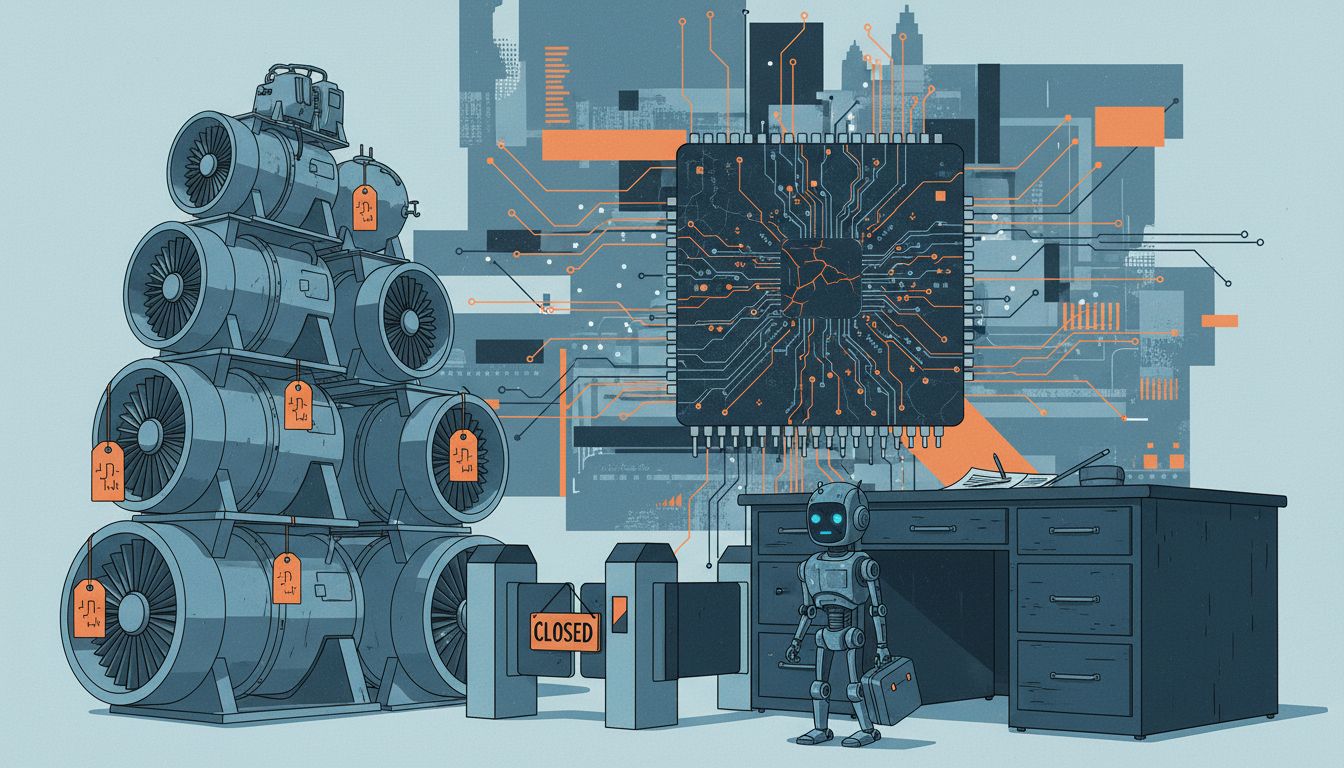
AI still has investors willing to pay trillion-dollar prices, but this week voters decided where the concrete can go. The money is arriving in smaller amounts than hoped, and the physical buildout just got a lot more political.
1. OpenAI’s $1.25 trillion valuation holds, but the round is smaller than planned
Bloomberg reports that OpenAI has raised $11 billion so far at a $1.25 trillion valuation. That is a lot of money, and it is also not what OpenAI was reportedly after. In late September, Bloomberg said the company wanted $30 billion. A source now puts the finished round at about $20 billion, and it hasn’t closed. OpenAI hadn’t commented when TechCrunch published.
So ‘investors flee’ and ‘investors cheer’ both miss. The price survived, while the raise so far covers well under half the earlier target.
The timing matters. Hours earlier, Bloomberg reported that buyers eyeing Anthropic’s IPO were floating a valuation as low as $1.1 trillion, against roughly $2 trillion expected a month ago. TechCrunch ties the jitters to the Democratic midterm win and voter hostility to data centers. That link is the outlet’s framing, not something either report proves. Still, the pattern across both labs is that appetite remains, but buyers are negotiating harder. The next test is whether the round closes near $20 billion.
2. Voters just handed data center opponents a mandate
On Tuesday, voters weighed 41 data center ballot measures. In all but one, the majority chose to impose more restrictions on development. That’s close to a clean sweep, and it makes opposition to data centers an electoral fact rather than a mood.
The industry already seems to sense it. TechCrunch notes that OpenAI is rebranding its data centers as ‘compute campuses’, and that it hired Jessica Schumer, Sen. Chuck Schumer’s daughter, right before the election. Public Citizen’s J.B. Branch calls this ‘PR washing’. Meta’s Dina Powell McCormick said communities that don’t want its investment ‘will of course have the right to stop them.‘
The practical catch is geography. Gridlock in Washington may leave the action to states and localities. Political strategist Aryan Ranjan told TechCrunch a company’s AI rules may depend more on where it operates than on anything Congress passes. A federal task force created to challenge state AI laws exists, but states have passed their own anyway. For anyone planning compute capacity, siting just became a political risk, not only a power-and-permits problem.
3. Fireworks says use every model. Of course it does.
The only evidence here is a headline: Fireworks says you’re wasting money on AI unless you’re using all the models. The page we have carries no article body, so the specific savings claims circulating with this story aren’t something we can confirm.
The pitch still shows the incentive. Fireworks sells access to many models, so ‘stop defaulting to one frontier model’ is also a sales line. It may be right that many requests don’t need the most expensive model. But the teams that would have to test it are the developers paying the bills, and routing adds its own complexity. Treat any savings figure as a vendor claim until you’ve run it on your own traffic.
4. A hacking tool’s own servers were left open to the web
Censys found more than 800 distinct deployments of Artex, an open source autonomous penetration-testing tool from China, accessible from the web with no password. Artex has no need to be internet-facing, and it is unclear why so many were.
This is the awkward part for attackers. TechCrunch says CrowdStrike tied attacks on Korean finance to a Chinese-speaking hacker partly because they left an open directory hosting Artex. Censys says that instance had been exposed for months and held attack data beyond South Korean banks, including payment and gaming companies. Not every exposed copy is malicious, since authorized testers use it too.
The larger lesson is about the targets. Many Artex-linked attacks reportedly exploited weak or known passwords and missing multi-factor authentication. Artex has since gone closed-source, but dozens of copies of its code remain on code-sharing sites. Pulling a tool back doesn’t recall what’s already out.
5. A two-week NHS helpline ran 11 weeks after a spreadsheet leak
The helpline was meant to run two weeks in December 2025. It lasted 11. A review found that staff pulled in to handle calls after the Royal Cornwall Hospitals NHS Trust exposed health data on 8,003 people were told a day ahead. Their script arrived 30 minutes before launch, and some hadn’t finished reading it when calls began.
The root cause was mundane. A 2023 FOI spreadsheet kept pivot-table data that revealed sickness absence records, and it stayed public for 33 months. Staff skipped steps, including a PDF conversion, and Excel’s Document Inspector either wasn’t run or wasn’t acted on. Most call handlers learned their own data was exposed while already working the phones.
The review says callers included people potentially in danger from domestic abuse, and staff made safeguarding judgments without training or an established process. One staffer said: ‘It’s typical NHS, it runs on goodwill.’ The trust has added fixes, including mandatory password protection and a senior sign-off. Breach plans that stop at containment leave the cleanup to whoever is nearby.