
A heisenbug is a software defect that changes behavior when you try to observe it. The name is a nod to Heisenberg’s uncertainty principle: the act of measurement disturbs the system being measured. In software, the analog is surprisingly literal. Add a print statement and the bug disappears. Attach a debugger and the timing shifts. Deploy a fixed binary to staging and everything works fine until it doesn’t.
This isn’t mysticism. It’s a window into how brittle our assumptions about deterministic systems actually are.
1. The Observer Effect Is Not a Metaphor
When Werner Heisenberg described measurement uncertainty in quantum systems, he was talking about photons disturbing electrons. When a debugger disturbs a race condition, the mechanism is completely different but the structural problem is the same: your measurement tool changes what you’re measuring.
Adding a console.log statement introduces a function call, which takes time, which modifies memory layout and thread scheduling. In a multithreaded program racing on shared state, that extra microsecond is enough to push a write past a read and make the bug disappear. The bug existed because of a precise timing relationship. You disrupted that relationship trying to see it. This isn’t a flaw in your debugging technique. It’s the technique revealing something true about the system: the bug lives in timing, not logic.
2. Race Conditions Are the Canonical Heisenbug Factory
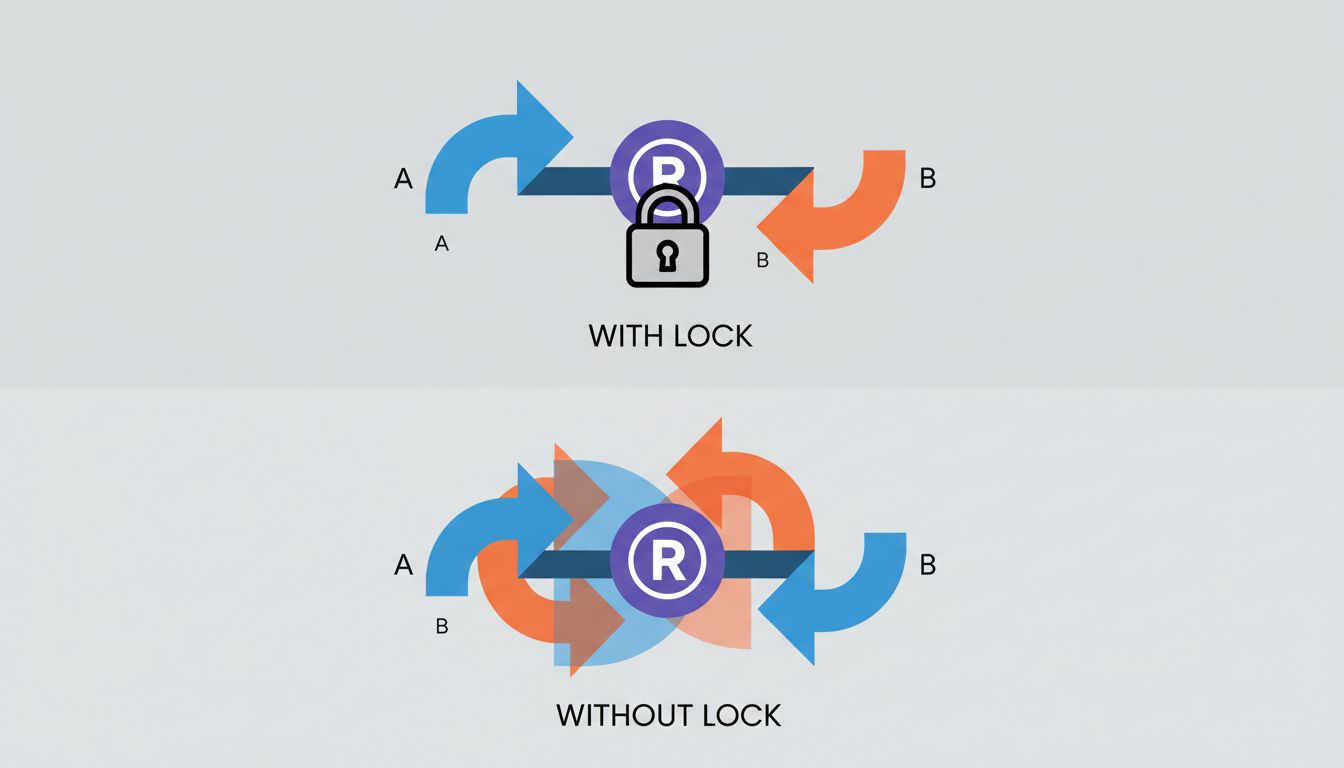
Most heisenbugs in production code are race conditions. Two threads access shared state without adequate synchronization, and the result depends on which one gets scheduled first. That scheduling decision is made by the operating system based on factors your application has no control over: CPU load, interrupt timing, cache pressure, and on modern hardware, speculative execution pipelines.
The reason these bugs hide so well is that correct behavior is the common case. A race condition where thread A nearly always writes before thread B reads will pass thousands of test runs and then fail once on a Tuesday afternoon under load. When you investigate, you change the load. The bug retreats. As the related problem of concurrent bugs illustrates, the error isn’t in any single line of code — it’s in the relationship between lines executing in two different contexts simultaneously.
3. Memory Layout Changes Everything
A subtler category of heisenbug emerges from how programs use memory. In C and C++ especially, undefined behavior — reading uninitialized memory, writing past array bounds, using a freed pointer — produces results that depend entirely on what happens to be in memory at the moment. In debug builds, compilers often zero-initialize memory or add guard bytes. In release builds, they don’t. The same logical error produces different symptoms depending on which binary you’re running.
This is why a bug that crashes reliably in development mysteriously stops crashing in production, or vice versa. You haven’t fixed anything. You’ve changed the memory contents the bug is operating on. This is also why valgrind and address sanitizer are useful not just for finding bugs but for making them reproducible: they instrument memory in a way that turns undefined behavior into defined (crashing) behavior, trading the heisenbug for a regular bug you can actually catch.
4. Logging Can Serialize What Concurrency Was Racing
One of the more counterintuitive heisenbug patterns: you add logging to diagnose a concurrency problem, and the logging itself serializes the threads enough to eliminate the race. Log writes typically acquire a lock on the output stream. That lock introduces a synchronization point that wasn’t there before, and your previously-racy code now behaves correctly, not because you fixed it, but because your instrumentation accidentally fixed it.
This is documented well enough that experienced engineers treat “the bug disappears when I add logging” as a strong signal pointing toward a race condition, not as confusion. If you’ve encountered this, the bug that disappears when you add logging is exactly what you’re dealing with. The logging is acting as an inadvertent mutex. Remove it, ship to production, and the race is back.
5. Heisenbugs Expose the Limits of Deterministic Testing
The standard software testing model assumes that given the same inputs, a function produces the same outputs. This assumption is correct for pure functions operating on local state. It breaks down the moment your function touches shared mutable state, system time, thread scheduling, or network I/O. Most real production code touches at least one of these things.
Deterministic testing catches deterministic bugs well. It is structurally bad at catching heisenbugs, because your test harness introduces its own timing and memory patterns that differ from production. Property-based testing and fuzzing help by expanding the input space, but they don’t fully solve the timing problem. Formal verification tools like TLA+ let you model concurrent systems and prove properties about all possible interleavings, which is why they’re used for distributed protocols at companies like AWS and Microsoft. They’re expensive to write but they find the races your test suite will never catch.
6. Production Is a Different Computer Than Your Laptop
Heisenbugs often appear in production and nowhere else because production has different hardware, different load, different OS scheduler behavior, and different memory pressure. A race condition that requires two threads to execute within 50 nanoseconds of each other might never manifest on a developer’s single-core laptop running one request at a time. On a 64-core production server under genuine concurrent load, it happens constantly.
This isn’t just a scale problem. Modern CPUs with out-of-order execution and non-uniform memory access patterns mean that the same code, on different hardware, produces different effective interleavings. The Java memory model and C++ memory model both include careful specifications for this reason, defining which reorderings compilers and hardware are allowed to make. Most programmers never read these specifications. Most heisenbugs live in the gap between what programmers assume and what those specifications actually guarantee.
7. The Fix Is Often Structural, Not Surgical
Because heisenbugs are symptoms of non-determinism in your design, patching them line-by-line rarely works. You add a lock, the race moves. You fix the initialization order, a different path through the code skips it. The right response is usually to rethink the shared state entirely: eliminate it where possible, make data structures immutable, use message passing instead of shared memory, or reach for higher-level concurrency abstractions that prevent the race category rather than just this specific race.
This is a harder conversation to have when a production system is on fire and the pressure is to deploy something. But a quick fix to a heisenbug is often just a new race condition waiting for the right timing to surface. Understanding what the bug is actually telling you — that your system has more non-determinism than your model assumed — is the prerequisite to fixing it in a way that doesn’t come back.