The Phantom That Only Exists When You’re Not Looking
You’ve reproduced a crash reliably. You add a print statement to see what’s happening. The crash stops. You remove the print statement. The crash comes back. This experience is common enough that programmers have a name for it: a Heisenbug, borrowed from Werner Heisenberg’s uncertainty principle, which holds that the act of measuring a quantum system disturbs it. The analogy is imprecise but the intuition is right. Observation changes behavior.
What makes this phenomenon worth understanding isn’t the novelty. It’s what it reveals about the hidden assumptions baked into most software: that operations happen in a fixed order, that nothing important occurs between one line of code and the next, and that time is essentially free. Heisenbugs expose all three assumptions as fiction.
Timing Is the Most Common Culprit
The majority of bugs that vanish under observation are race conditions. Two threads read from and write to shared memory. The bug occurs when thread A reads a value, thread B updates it, and thread A then makes a decision based on stale data. The window for this to go wrong might be measured in microseconds.
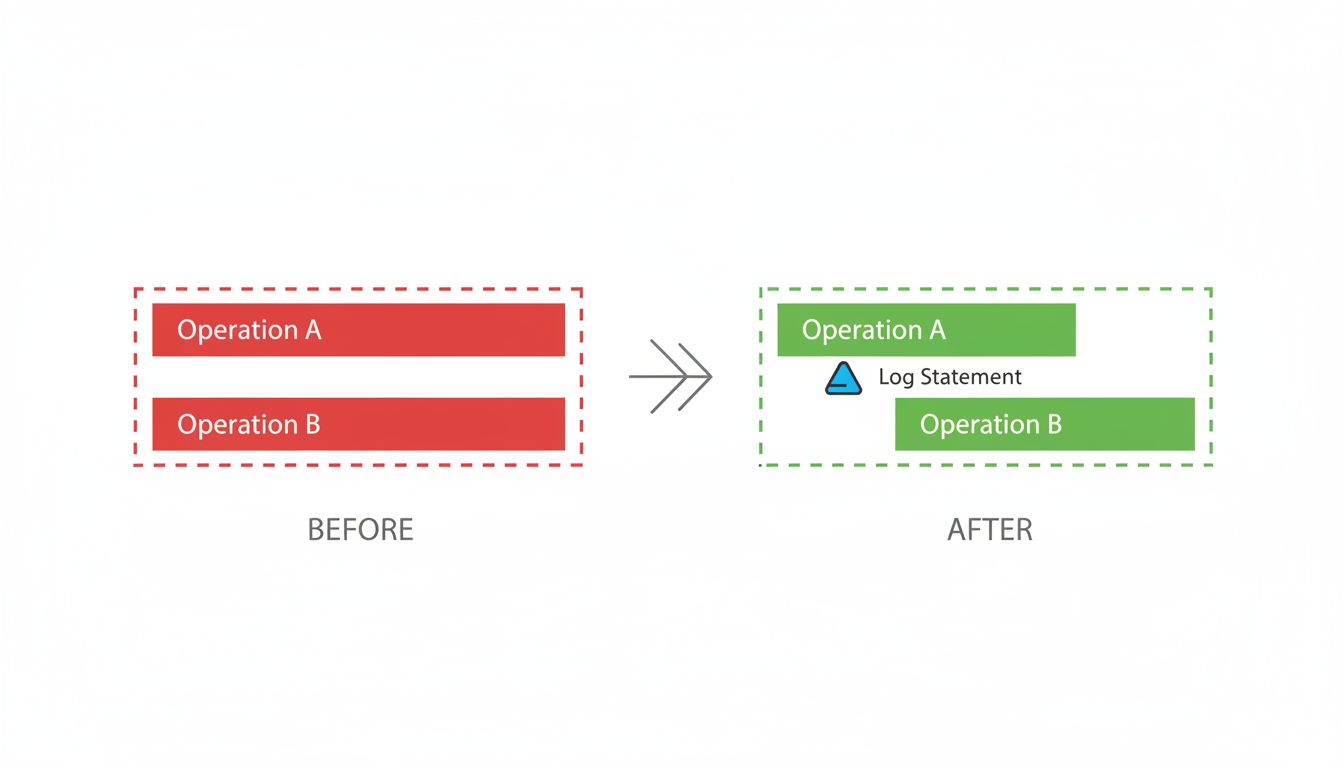
Add a log statement and you change the timing. Logging isn’t free. Writing to a file, acquiring a lock on that file, formatting a timestamp — all of this takes real time. Inserting even a few hundred microseconds of delay can push the two threads out of their dangerous overlap. The bug disappears, not because you fixed anything, but because you accidentally widened the gap between the two operations.
Remove the log statement and the gap closes. The race is back.
This is why experienced engineers treat a Heisenbug as a near-certain signal of a concurrency problem. The debugging process itself has become a timing oracle: if adding overhead makes it go away, something in your code is depending on operations completing in a particular order that isn’t guaranteed.
The Optimizer Adds Another Layer of Complexity
There’s a second mechanism that gets less attention: compiler and CPU optimization. Modern processors don’t execute instructions in the order you wrote them. They reorder operations, speculatively execute branches, and cache values in registers rather than writing them back to memory immediately. This is invisible under normal circumstances because the processor guarantees the reordering won’t change the observable behavior of a single-threaded program.
The guarantee breaks down across threads. Thread A might write a value to a variable that it holds in a register, fully intending to flush it to main memory eventually. Thread B, running on a different core, reads from main memory and sees the old value. The processor and the compiler both behaved exactly as designed. The bug is in the assumption that a write in one thread is immediately visible to another.
Logging statements, because they typically involve system calls and memory barriers, force the processor to commit pending writes. The act of logging essentially synchronizes state that wasn’t being synchronized. The bug hides.
This is the same category of problem that produced a famous class of concurrency bugs related to the volatile keyword in Java, and it’s part of why the Java Memory Model was completely overhauled in Java 5. Without explicit synchronization primitives — locks, atomic operations, memory barriers — you cannot reason about what one thread will see when another thread writes.
Why This Bug Is Expensive to Fix
Race conditions and memory visibility bugs are notoriously expensive to resolve, not because the fix is complicated, but because the diagnosis is. You can’t reproduce them on demand. You can’t add the usual tools without altering the behavior. Standard debuggers, which pause execution and step through instructions one at a time, change the timing so dramatically that the bug becomes invisible for the entire debugging session.
The practical consequence is that these bugs often make it to production. An engineer reproduces a crash in a test environment, adds logging to investigate, can’t reproduce it anymore, and concludes it was a fluke. This is one reason why the engineer who fixes a bug rarely has full information about why it existed in the first place. The fix gets marked as “unable to reproduce” and the code ships with the race condition intact.
Production then has different load, different hardware, different timing characteristics. The bug appears again, often in a more damaging context.
How to Actually Find These Bugs
The right tool for diagnosing a Heisenbug is one that doesn’t alter timing. Thread sanitizers, which instrument code at compile time to detect unsafe memory access patterns, can find race conditions without injecting significant delays into the critical path. Google’s ThreadSanitizer, available in Clang and GCC, has found race conditions in production code at companies including Mozilla and Google itself, often in code that had been running in production for years without obvious incident.
For bugs that seem timing-sensitive, the mental model shift is important: stop asking “what value is this variable?” and start asking “who else can write to this variable, and when?” Logging shows you a snapshot. It can’t show you the gaps between snapshots, which is precisely where the bug lives.
Formal analysis tools like model checkers can exhaustively explore thread interleavings, which is how NASA’s Jet Propulsion Laboratory uses them for flight software verification. For most commercial software that’s impractical, but the principle applies: you need something that can observe all possible orderings, not just the ordering that happens to occur when you’re watching.
The deeper lesson is that a bug that hides when you look at it isn’t a mystery. It’s a measurement problem. The moment you treat it as one, you have a much better chance of actually fixing it.