
The Hype Is Obscuring Something Useful
There’s a small industry of people selling prompt engineering as a specialized technical skill, something adjacent to programming that requires its own courses, certifications, and job titles. Some of it is useful. Most of it is repackaging.
The core insight keeps getting buried: writing a good prompt requires the same thinking that produces a good brief, a clear technical spec, or a well-structured argument. The interface is new. The cognitive work isn’t.
This matters for how you spend your time. If prompt engineering feels like a mysterious new discipline you haven’t mastered yet, you’re probably underestimating skills you already have and overestimating how exotic the new ones are.
What a Prompt Actually Is
Strip away the jargon and a prompt is a specification for a task. It tells a system what you want, what constraints apply, what format the output should take, and what context is necessary to do the job correctly.
That’s also what a good design brief is. And a well-written ticket. And a clear email to a contractor who has never worked with you before.
When prompts produce bad outputs, the failure modes are almost always the same ones you see in poor communication generally: vague goals, missing context, ambiguous constraints, and no stated criteria for success. Tell an AI “write me a summary” and you’ll get the same frustrating result you’d get if you asked a new employee to “put together something on that project.”
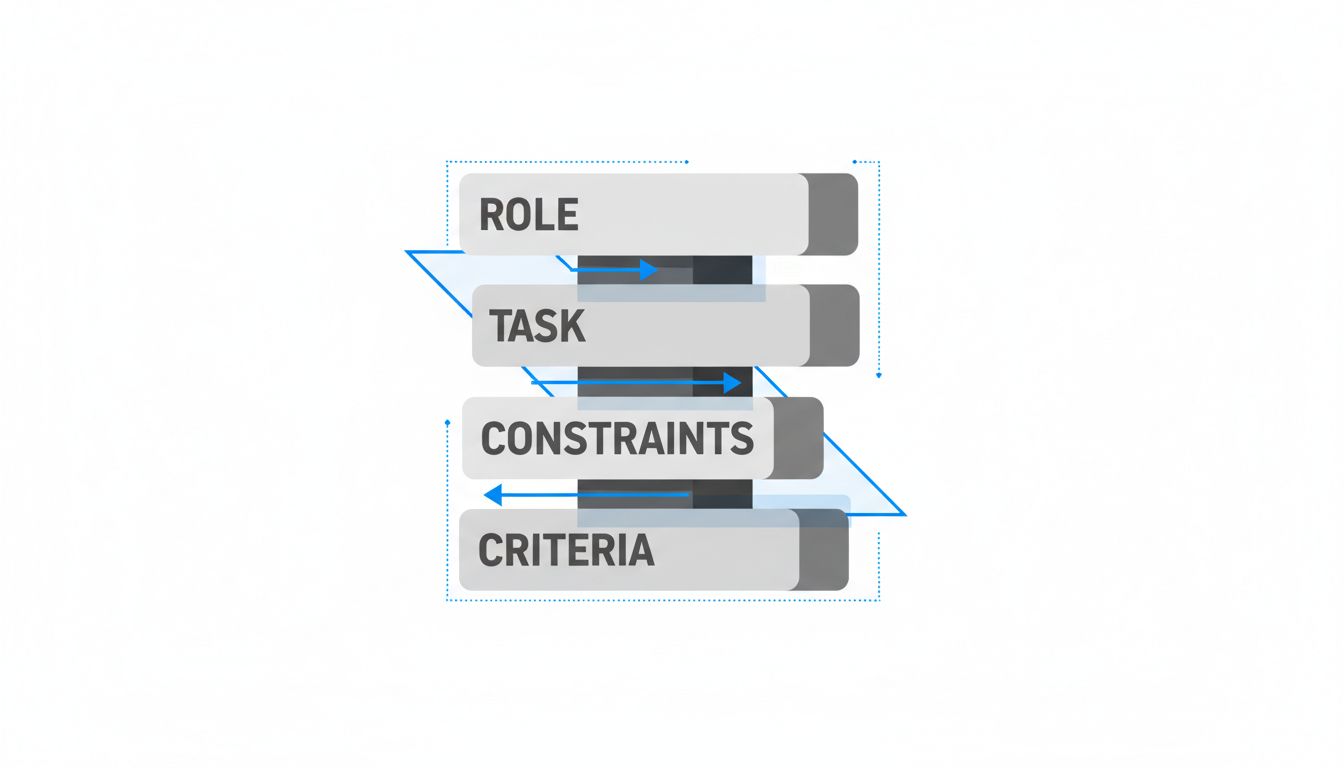
The structured thinking required here breaks into four components you can apply immediately:
Role and context. Who is doing this task, and what do they need to know to do it well? “You are a technical writer summarizing this for a non-technical stakeholder” produces different output than an uncontextualized request, for the same reason a good manager briefs people before asking them to present.
Task specificity. What exactly do you want? Not “analyze this” but “identify the three biggest risks and explain each in one sentence.”
Constraints. Length, format, tone, what to exclude. These aren’t pedantic details. They’re how you prevent the model from making decisions you should be making.
Evaluation criteria. What does a good output look like? If you can’t answer this before you prompt, the issue isn’t with the model.
The Part That Actually Takes Practice
Knowing the framework doesn’t automatically make you good at applying it, just like knowing the structure of a persuasive essay doesn’t make you a strong writer. The skill is in execution, and execution requires reps.
What you’re actually practicing when you get better at prompting is the ability to articulate your own thinking precisely. This is harder than it sounds. Most of us carry around a lot of implicit knowledge and unstated assumptions about what “good” looks like in a given domain. Prompting forces you to make those explicit, because the model has none of your context by default.
This is why domain experts often write better prompts than generalists, even with less exposure to AI tools. A senior engineer who has reviewed hundreds of pull requests has clear, internalized criteria for code quality. When they prompt a model to review code, they can specify what they’re actually looking for. Someone without that background writes “check if this is good code” and wonders why the output isn’t helpful.
The practical implication: if your prompts are producing mediocre outputs, the question to ask is whether you could explain what a great output looks like to a smart person who had never seen your work before. If not, that’s the thing to fix first.
Where the Craft Actually Lives
There are genuinely advanced techniques in prompting. Chain-of-thought prompting, where you ask the model to reason through a problem step by step before answering, reliably improves performance on complex tasks. Few-shot examples, where you show the model several examples of the output format before asking for the real one, are useful when format matters more than content. Breaking complex tasks into sequential sub-tasks produces better results than trying to accomplish everything in one prompt.
But notice what these techniques have in common: they’re all things that also improve human task completion. Walking through your reasoning before reaching a conclusion. Showing someone examples before asking them to replicate a format. Breaking a hard problem into smaller pieces.
The models reward good thinking hygiene because they were trained on human output, and human output reflects what good thinking produces. There’s no secret syntax. There’s no magic incantation. As one angle on this suggests, the improvement you see over time usually comes from you getting clearer, not the model getting smarter.
One technique worth adding to your regular practice: after you get an output, ask explicitly what assumptions the model made in producing it. You’ll often find it filled in gaps in ways that don’t match your actual intent, which tells you exactly what to specify more clearly in your next attempt.
What This Means for How You Work
If prompt engineering is structured thinking with a new interface, then the most valuable investment isn’t in learning prompt-specific tricks. It’s in getting better at the underlying skills: clarity of thought, precision in communication, and the ability to decompose a complex goal into its component parts.
The practical test is this: take your next important prompt and write it as if you were briefing a capable but completely uninformed contractor. Every assumption made explicit. Every constraint stated. Every success criterion defined. Then read it back and ask whether anyone who received it would have genuine ambiguity about what you wanted.
That discipline, applied consistently, will improve your AI outputs more than any collection of prompting tricks. It will also make you a better writer, a clearer thinker, and a more effective collaborator with humans. Which is a better return than most technical skills offer.