
What Happens When an AI Model Trains on Its Own Output
There’s a feedback loop problem building quietly inside the AI industry, and it doesn’t announce itself with a crash. It announces itself with text that sounds right but means less and less. Researchers call it model collapse. Understanding it requires thinking about what training data actually is, and what happens when the source of that data changes.
1. The Training Signal Gets Corrupted, Silently
When a language model trains on human-written text, it’s learning a distribution: the statistical patterns of how humans actually express ideas, including all the variation, contradiction, and idiosyncratic phrasing that comes with real thought. That variation is signal. When the model then generates text and that text ends up back in the training pool for the next model, something subtle but serious happens. The generated text is already a compression of the original distribution. It’s smoother, more average, more “on pattern.” Training on it amplifies those patterns and discards the edges.
Think of it like photocopying a photocopy. The first copy loses a little fidelity. The copy of the copy loses more. By the fifth generation, you’ve got a document that’s technically legible but has lost everything that made the original crisp. Each model generation that trains on the previous generation’s output pushes the distribution toward a blander, more homogenous center.
2. The Tails of the Distribution Disappear First
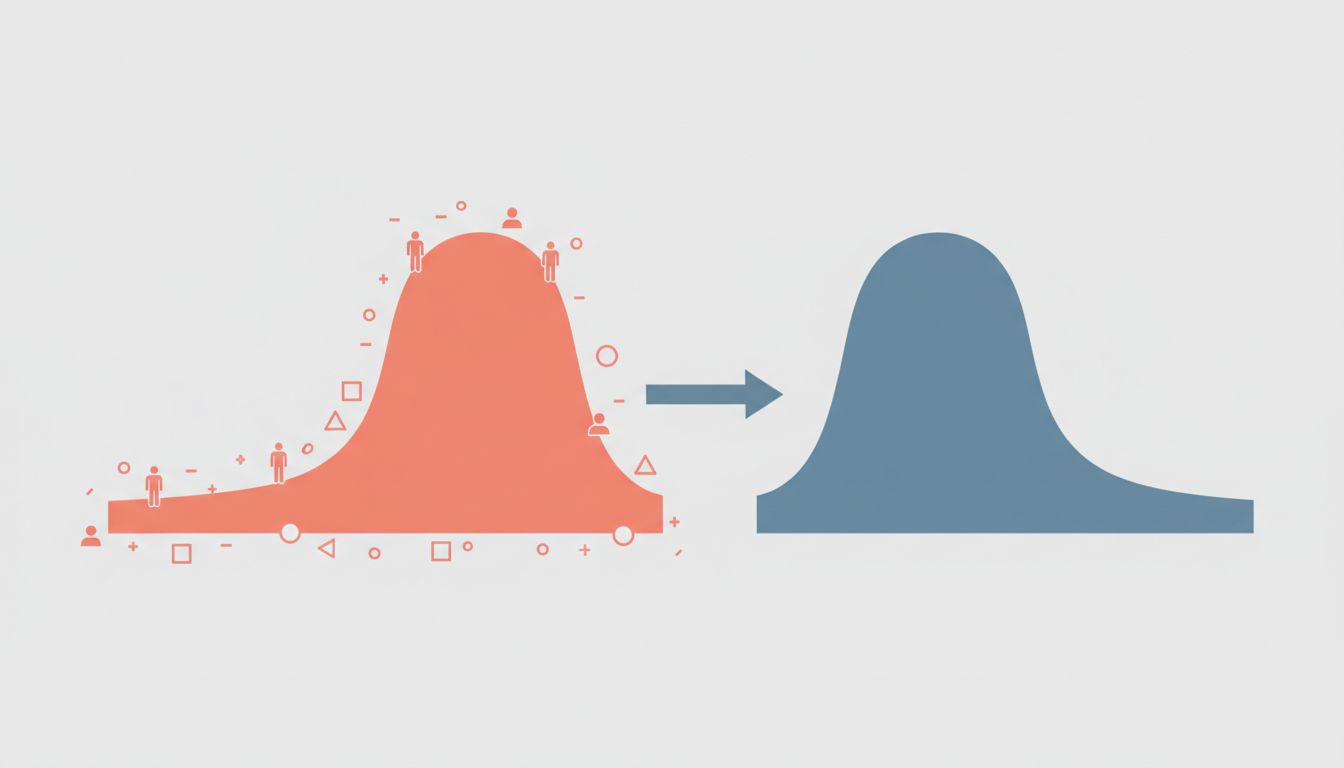
Researchers at the University of Oxford and other institutions have studied this formally. Their finding is that model collapse doesn’t just flatten output quality uniformly. It specifically destroys the tails of the distribution first, meaning rare but valid outputs get pruned away while common outputs get over-represented. In language terms: unusual but correct phrasings, minority viewpoints expressed in training data, low-frequency facts, edge-case reasoning patterns. These erode across generations of self-training.
This is important because “rare” doesn’t mean “wrong.” A lot of valuable knowledge is rare. The correct way to handle a particular network timeout condition might appear in only a handful of forum posts in the original training corpus. If that information doesn’t survive model collapse, the model starts confidently hallucinating a more common (and incorrect) alternative. The model hasn’t gotten dumber in some global sense. It’s gotten systematically overconfident about the majority case, which is a specific and dangerous failure mode. Your LLM is most confident when it should be least trusted.
3. The Internet Is Already Filling With Model-Generated Text
This would be a contained theoretical problem if AI-generated text stayed neatly labeled and segregated from training sets. It isn’t and won’t be. A 2023 study estimated that a substantial fraction of text appearing on the open web is already AI-generated, and that fraction is growing. The Common Crawl dataset, which is a primary source for training many large models, scrapes the open web continuously. There is no reliable filter that separates human-written from AI-generated text at scale.
This means the next generation of models trained on web data will inevitably ingest significant quantities of output from current models. The pipeline is already contaminated. The question isn’t whether model collapse will happen in production training runs, it’s how much it’s already happened and how to detect it. We don’t have great answers to either question yet.
4. Synthetic Data Is a Tool, Not a Replacement
Not all self-generated training data is poisonous. There’s a real distinction between using synthetic data to augment a grounded dataset versus using it as a primary source. DeepMind’s AlphaGo and its successors demonstrated that self-play can produce superhuman performance, but only because the environment provided an unambiguous external reward signal. The game rules don’t collapse. Every game of Go is grounded in the same fixed rules, so the model can’t drift off into averaging its own hallucinations.
Language is different. There’s no external referee scoring each sentence. When a language model generates training examples for itself without grounding, it’s essentially marking its own exam and then studying for the next one based on those marks. You can use synthetic data productively when it’s tightly constrained, for example, generating code that gets actually executed and tested against real inputs. That’s an external signal. But using a model’s prose outputs to train better prose generation, without human curation or external grounding, is exactly the mechanism that produces collapse.
5. Detection Is Hard Because the Model Sounds Fluent
The insidious thing about model collapse is that it doesn’t produce obvious garbage. A collapsed model doesn’t start outputting random tokens or malformed syntax. It outputs polished, grammatically correct, confident text that covers the most common cases and fails quietly on the unusual ones. This is what makes it genuinely hard to catch in evaluation pipelines that test for fluency and surface correctness.
If you’re evaluating model outputs primarily by asking other models to score them, which is a common approach in RLHF (reinforcement learning from human feedback) pipelines, you’ve created a closed loop where the evaluator and the generator share the same blind spots. Both models have the same tails missing from their distributions. The evaluator rates the collapsed output as perfectly reasonable, because from inside that distribution, it is. This is a version of the quietest bug being the one your tests are built to miss.
6. The Defense Is Genuine Human Data, and It’s Getting Scarcer
The most direct mitigation is simple to state and hard to execute: keep grounding training on data that was actually produced by humans, not by previous model generations. High-quality human-written text is finite. The great common-crawl era, where you could just scrape the open web and get mostly human-written text, is closing. What’s left is either already in training sets or will be increasingly mixed with synthetic content.
This is creating real competitive pressure around proprietary human-generated datasets. Agreements with publishers, partnerships with professional communities, licensed archives of human expertise. The value isn’t just in the information itself but in the guarantee that a human wrote it, which is a strange thing to have to say but here we are. The models trained on the cleanest, most reliably human-produced data in 2026 and 2027 will likely have a meaningful edge over those that didn’t bother to care. Keeping that signal clean isn’t glamorous work, but it’s the kind of unsexy foundation that tends to matter enormously later.