
The Tracker Is Not the Territory
Every engineering team treats its bug tracker as ground truth. Jira boards, GitHub Issues, Linear tickets — these are the official record of what is broken. Triage meetings sort by severity. Sprint planners weigh fixes against features. The whole apparatus of software maintenance runs on the assumption that if a problem is real, it has been filed.
That assumption is wrong, and most teams know it without quite saying so.
The bugs that cause the most long-term damage to a software system are often the ones no one ever files. Not because they are minor. Because they are invisible by nature, or known informally in ways that never become formal, or because the systems engineers build to surface problems are themselves the reason the problems stay hidden.
The Workaround That Becomes the Workflow
The most common category of unfiled bug is the one that has already been routed around. A developer discovers that a certain API call fails intermittently when called under load, so they add a retry with exponential backoff and move on. The fix works well enough. No ticket gets filed because there is nothing left to file: the symptom is gone. The underlying cause remains.
This is how technical debt accretes invisibly. The retry logic masks a race condition in the database layer. A year later, the database layer is refactored, the race condition resurfaces in a different form, and the new developer who encounters it has no history to draw on. The original discoverer may have left the company. The workaround lives in the code, undocumented. The knowledge it encoded lives nowhere.
Organizations that rely on tribal knowledge for their workarounds are betting on continuity they cannot guarantee. The retirement, the resignation, the reorg — any of these can convert a managed problem into an acute one overnight.
The Problems That Feel Like Features
A second category is harder to see: behaviors that engineers have misclassified as intentional. Software accumulates quirks, and over time those quirks get rationalized. Users learn to work around them. Support teams document them as “known behavior.” New engineers are told, implicitly or explicitly, that this is just how the system works.
The consequences range from minor friction to genuine security exposure. A permissions check that fails silently, returning empty results instead of an error, might be documented as “graceful degradation.” In practice, it means users sometimes see nothing when they should see data and have no way of knowing which state they are in. That is a bug. It will probably never be filed because everyone involved has categorized it as a design choice.
This is related to the quietest bug being the one your tests are built to miss. Tests are written to verify expected behavior, and expected behavior is defined by the people writing the tests. When the expected behavior is itself wrong, the tests pass confidently, the CI pipeline goes green, and the bug remains unfiled because there is no mechanism to surface it.
The Observability Gap
Many bugs cannot be filed because the infrastructure to observe them does not exist. A system that lacks adequate logging, tracing, or metrics cannot tell you what it is doing, only whether it is up. Uptime is not health.
Consider a recommendation engine that degrades gracefully when its model returns low-confidence scores by falling back to a simpler heuristic. From the outside, the system is working: it returns results, latency looks normal, error rates are flat. Inside, the fallback is triggering far more often than intended because the model has drifted. Users are getting worse recommendations. No alert fires. No ticket gets filed because there is no signal that anything is wrong.
This is the observability gap: the distance between what monitoring systems can see and what is actually happening in production. Engineering teams that invest heavily in testing and deploy pipelines but underinvest in production observability are flying partially blind. They know a lot about what should happen and relatively little about what does.
The Social Architecture of Silence
Not all unfiled bugs are products of technical blindness. Some are products of organizational dynamics that make filing feel costly.
When a team is behind on a deadline, developers learn quickly what kinds of issues will be treated as blockers and what kinds will result in pressure to ship anyway. A junior engineer who surfaces a tricky edge case in the authentication flow during crunch time is, in practice, creating work for themselves with uncertain reward. The safer path, socially, is to note the issue in a Slack thread, get informal acknowledgment, and move on. The Slack thread eventually scrolls off the screen. The bug stays in the code.
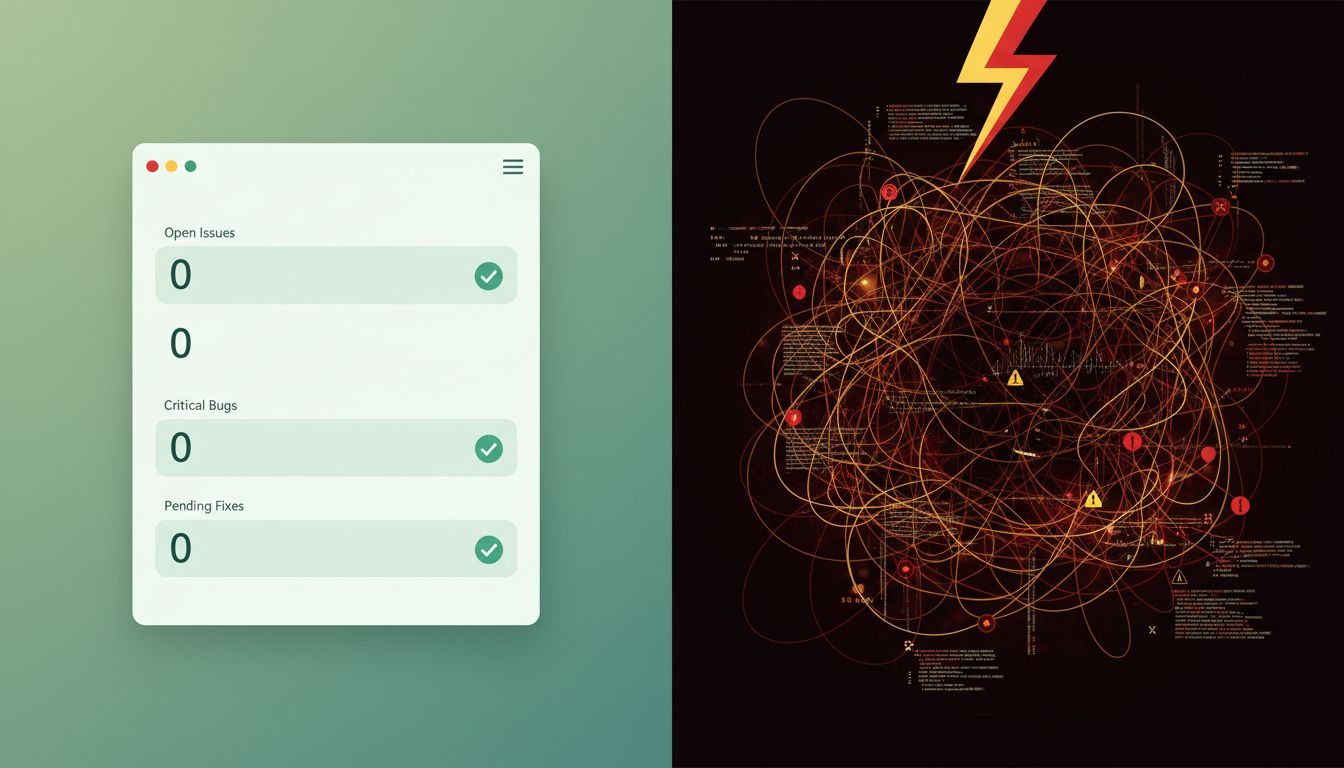
This is not a failure of individual engineers. It is a predictable response to incentive structures. Teams that reward shipping over surfacing problems get exactly what they incentivize: a clean tracker and a messy codebase. The bug tracker reflects the bugs that felt safe to file, not the bugs that exist.
Some organizations compound this with cultures where filing a bug on someone else’s code is treated as an accusation. The informal norm becomes: if it is not your code, you do not file a ticket; you send a message. The message may get acted on. It may not. It almost certainly gets lost.
What Postmortems Miss
The blameless postmortem is one of the better ideas in site reliability engineering. When something breaks in production, teams gather, document the timeline, identify contributing causes, and produce action items without assigning individual fault. The goal is systemic improvement.
The problem is that postmortems only happen after incidents. They are retrospective by design. The bugs that produce slow degradation rather than acute failure, the ones that quietly worsen user experience over months, rarely trigger postmortems because they rarely trigger incidents in the traditional sense.
A checkout flow that works 97% of the time and fails 3% of the time without an error message will not page anyone at 3am. It will lose the company a meaningful fraction of revenue, distributed invisibly across thousands of sessions. Unless someone is watching the right metrics and connects the pattern, there is no incident, no postmortem, no action items. The bug lives indefinitely.
The broader point is that incident-driven improvement processes are structurally biased toward sudden, visible failures. The gradual, quiet ones accumulate in the space between the alarms.
What It Looks Like to Actually Fix This
Fixing the unfiled bug problem requires treating it as a systems problem, not a discipline problem. Telling engineers to file more tickets does not work. The conditions that prevent filing have to change.
A few approaches have actual traction in practice. First: making observation easy enough that anomalies surface without human initiative. Tools like distributed tracing (Jaeger, Tempo, Honeycomb) give teams the ability to understand production behavior at a level of detail that makes certain classes of invisible bug findable. The investment is real, but so is the return.
Second: creating a genuine low-friction path for informal bug knowledge to become formal records. Some teams run lightweight “bug archaeology” sessions during retrospectives: not to file new bugs, but to surface things people know informally and decide, explicitly, whether to file or close. The act of deciding matters more than the outcome. Ambiguous knowledge becomes explicit policy.
Third: separating the act of filing from the act of committing to fix. A tracker full of low-priority bugs is not a failure; it is honest. Teams that discourage filing because it creates backlog pressure are optimizing the tracker at the expense of the system. The backlog should reflect reality, even when reality is uncomfortable.
The hardest part is cultural. Engineers need to trust that surfacing a problem will not be treated as creating a problem. That distinction sounds obvious. It is not obvious in practice, and it is not established by policy documents. It is established by how leadership responds the first few times someone files a ticket on something inconvenient.
What This Means
The bug tracker measures the bugs that made it through a filter. That filter is shaped by tooling, social norms, incentive structures, and the limits of observability. Teams that optimize for a clean tracker are often optimizing the filter, not the underlying system.
The most important bugs in a codebase are frequently the ones no one has named yet. They exist in the gap between what your monitoring sees, what your tests check, what your culture allows people to say out loud, and what your postmortem process treats as worth examining. Shrinking that gap is less glamorous than building features and harder to measure than sprint velocity. It is also, for any software system that needs to stay healthy over years rather than months, more important than either.