

Every productivity conversation about meetings focuses on the same target: the recurring standup that could have been an email, the all-hands that accomplishes nothing, the two-hour planning session that leaves everyone exhausted and no closer to a decision. These are real problems. But they’re also visible ones. You can see them on your calendar, cancel them, and feel the immediate relief.
The meetings doing the most damage to your focus aren’t the ones you scheduled. They’re the ones you never saw coming.
What an Unscheduled Meeting Actually Looks Like
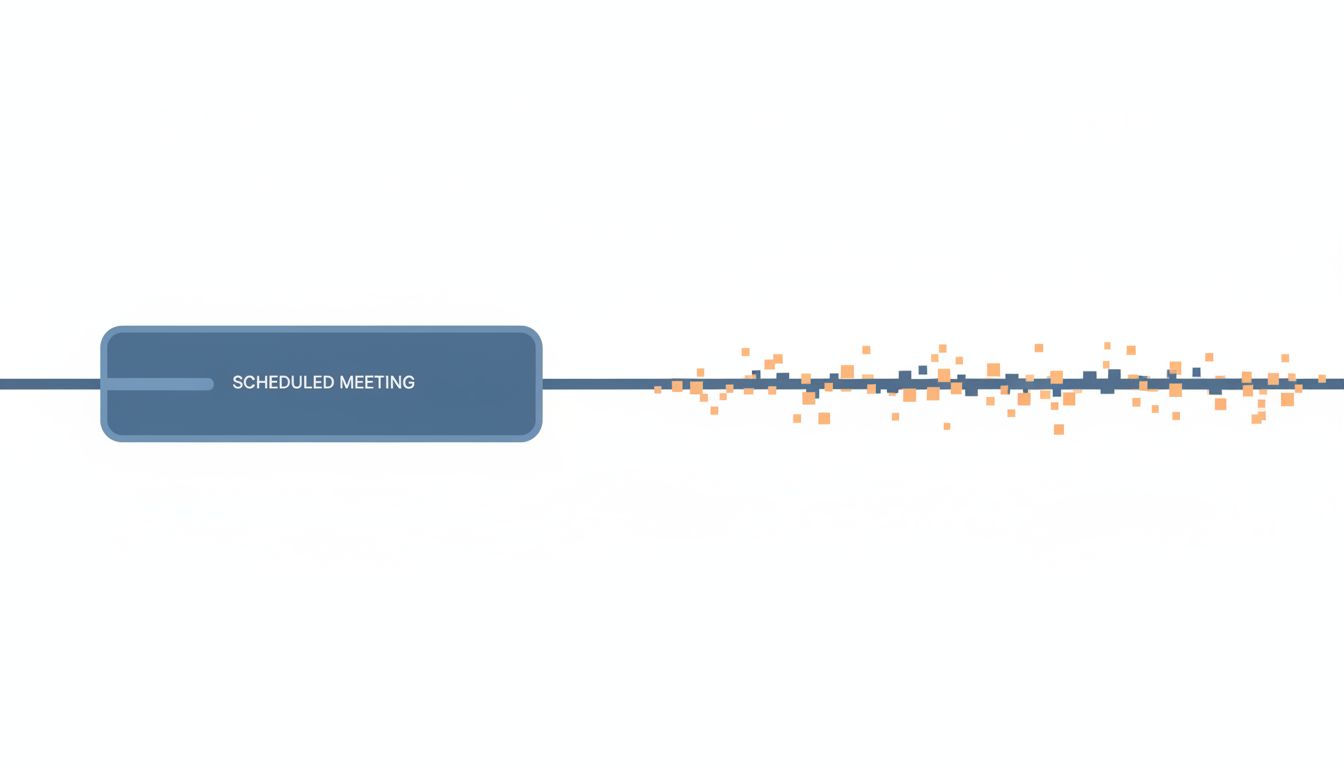
An unscheduled meeting is any interruption that requires you to context-switch, engage with someone else’s agenda, and then rebuild your concentration afterward. It might be a Slack message that says “got a quick sec?” and turns into a 20-minute conversation. It might be someone stopping by your desk with a question they could have looked up. It might be the impromptu hallway chat that somehow becomes a product discussion, or the “quick call” that appears in your calendar with 15 minutes notice because someone needs an answer now.
None of these show up in your weekly meeting load. None of them get counted when someone asks how many meetings you’re in. But each one carries a hidden cost that scheduled meetings often don’t: the cost of unexpected context-switching.
Gloria Mark’s research at UC Irvine has shown repeatedly that it takes around 23 minutes to return to a task after an interruption. The interruption itself might last five minutes. The actual time cost is nearly five times that. Do that four times in a morning and you’ve lost the morning, even though you were never technically “in a meeting.”
Why These Interruptions Are Harder to Fix Than Bad Meetings
Bad meetings are fixable because they have owners. Someone scheduled them, which means someone can cancel them. You can audit your calendar, identify the recurring offenders, and make the case for eliminating them. There’s a clear before and after.
Unscheduled interruptions have no owners and no clear mechanism for removal. They feel organic, even necessary. When a teammate asks for your input on something, saying “I’ll get back to you later” can feel like bad collaboration. When a question lands in Slack, leaving it unanswered feels rude or obstructive. The social friction of refusing an unscheduled interruption is much higher than the friction of declining a calendar invite.
This is what makes them so sticky. They aren’t inefficiencies you can point to and eliminate. They’re embedded in how your team communicates, what responsiveness is expected to look like, and how trust is built or broken in your organization.
How to Surface What You Can’t See
Before you can fix unscheduled interruptions, you have to make them visible. The most effective way to do this is to track them manually for one week. Every time you switch away from focused work because of an external interruption, log it. Note the time, the channel (Slack, in-person, phone), and roughly how long it took before you were back in flow.
Most people who do this are surprised by the results. The raw number of interruptions is usually higher than expected, but the more useful discovery is the pattern. You’ll likely find that certain channels generate most of your interruptions, certain people or teams are the source of most requests, and certain times of day are disproportionately affected.
Once you can see the pattern, you have something actionable. If Slack is the dominant channel, you have a concrete reason to establish office hours or set explicit response-time expectations with your team. If in-person interruptions are the problem, physical or symbolic signals (headphones, a visible focus indicator, a closed door) can shift behavior without requiring a policy conversation. If the interruptions cluster in the morning, you have the data to make the case for protecting morning blocks as no-interruption time.
This isn’t about becoming unavailable. It’s about making your availability intentional rather than reactive. The goal is the same thing you’d want from a better meeting: a predictable structure that respects everyone’s time, including yours.
Building an Environment That Defaults to Async
The deeper fix is cultural rather than individual. Organizations that default to synchronous communication, where the expectation is that people respond immediately and are always available for a quick conversation, will always have an unscheduled meeting problem. You can optimize your own behavior, but you’re swimming against the current.
Shifting a team toward async defaults doesn’t mean slowing down decision-making. It means front-loading clarity. When someone would normally ping you with a quick question, an async culture asks them to write out the question with enough context that you can answer it without a back-and-forth. This takes more effort on their end, but it produces a better question, a better answer, and no interruption.
Teams that make this shift well usually start small. They establish explicit norms around response times (“we reply to Slack messages within four hours, not four minutes”), create shared documentation so common questions have answers that don’t require asking, and model the behavior at the leadership level. When managers stop sending “got a minute?” messages and start sending well-framed async questions, the team follows.
The irony is that this makes actual synchronous time more valuable. When you do get on a call or walk into a room together, it’s because the problem genuinely requires it. That’s a better use of everyone’s time than a calendar full of meetings that could have been emails and a day full of interruptions that nobody counted.
The Metric You’re Probably Not Tracking
Most teams track meeting hours. Some track deep work hours. Almost none track interruption frequency, and that’s precisely why unscheduled meetings keep winning.
If you want to change how your day actually feels, start measuring what’s actually costing you. A week of honest interruption tracking is more useful than a month of calendar optimization. You’ll find the real problem faster, and you’ll have the evidence you need to fix it at the right level, whether that’s your own habits, your team’s communication norms, or your organization’s expectations around availability.
The meetings on your calendar are a known quantity. You’ve probably already done the work of finishing and clearing what shouldn’t be there. The meetings that aren’t on your calendar are the ones still winning. Start counting them.