
The simple version
Your brain has a window each day when it does genuinely hard thinking well. Most people fill that window with meetings and email, then wonder why real work never gets done.
What chronobiology actually tells us
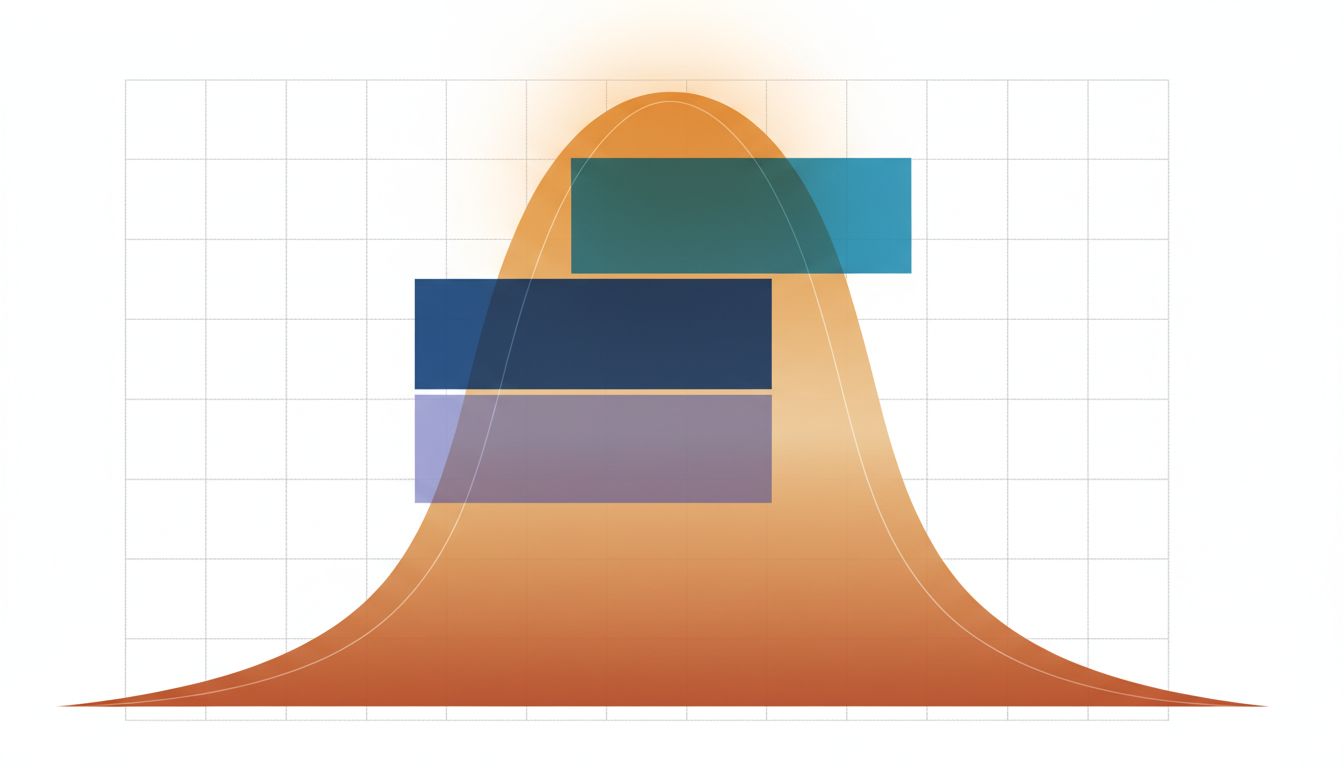
Researchers who study circadian rhythms have established that cognitive performance isn’t flat across the day. Alertness, working memory, and the ability to hold complex ideas in mind all peak at predictable times, and those peaks vary by person. Most people fall into a morning-peak pattern, with a dip in early afternoon and a partial recovery later in the day. A meaningful minority, sometimes called evening types, run about three to four hours later.
The point isn’t that everyone is sharpest at 10am. The point is that you have a window, it’s real, and it’s probably only two to three hours long. Outside that window, you can still work, but you’re running on a lower cognitive budget. You make slower decisions, miss connections between ideas, and write worse prose.
This isn’t a motivation problem. It’s a biology problem that your calendar is making worse.
The scheduling trap
Open calendars are a tragedy of the commons. When you make your calendar visible to colleagues, the most meeting-friendly time slots fill first. Those slots are usually mid-morning, which for most people is peak cognitive territory.
The result is a week that looks productive but feels hollow. You’re in motion constantly but finishing little that required genuine thought. You’ve traded your best thinking hours for coordination hours, then used your low-energy afternoon to attempt the deep work that deserved your morning.
This compounds. When you consistently do hard thinking in your cognitive trough, you start to associate difficult work with frustration and fatigue. Some people conclude they’re just not good at that kind of work. Often, they’ve just never done it at the right time.
How to find your window
You probably already have a sense of this. Think about the last time you were genuinely absorbed in hard work, where time passed without friction and you produced something you were satisfied with. What time of day was it?
If you can’t recall clearly, run a simple experiment. For one week, track your energy and focus on a three-point scale (low, medium, high) every ninety minutes. Don’t rely on how busy you were. Busy is not the same as cognitively sharp. Note when you found it easy to hold a problem in mind, when reading something complex felt effortless versus labored, when you were generating ideas versus executing routine steps.
After a week, the pattern is usually obvious. Two or three time slots will consistently score high. That’s your window.
Protecting the window
Knowing your peak hours is useless if you don’t defend them. Here’s how to actually do it.
Block it as a recurring event. Put a two-hour block in your calendar during your peak window every day. Label it something that signals unavailability to colleagues, “deep work” or “focus block” works fine. A visible block gets respected more often than a theoretically free slot.
Set your default meeting availability to exclude it. Most calendar tools let you configure working hours or set specific times as unavailable. Use this. If your meeting window starts at 11am instead of 9am, the morning fills with work instead of logistics.
Use the first ten minutes of the block to set a single goal. Not a task list. One thing you want to have made meaningful progress on when the block ends. This sounds obvious but it matters, because without it, the block becomes a free-floating anxiety about everything you haven’t done.
Don’t check messages before the block starts. Email and Slack don’t just take time, they redirect your attention and prime you for reactive thinking. If you open your inbox first thing, you spend the next two hours half-thinking about what you read. Your peak window then becomes a glorified follow-up session.
If your work genuinely requires you to be responsive in the morning, you have more of a structural problem than a scheduling problem. But most people who believe this are wrong. The urgency is usually perceived rather than real. A two-hour response delay rarely causes actual damage.
The harder part
None of this is technically complicated. The difficulty is that protecting your best hours requires saying no to things that feel productive. Meetings feel productive. Answering messages feels productive. Being available feels like good citizenship.
But your to-do list is built to grow, not shrink, and filling your peak window with coordination work is one of the main reasons it stays that way. The emails get answered. The meetings happen. The hard project you actually need to advance sits in amber for another week.
The practical reframe is this: the best thing you can do for your colleagues is show up to the collaborative parts of work having already thought clearly about the hard problems. You’re more useful in a meeting at 2pm if you spent 9 to 11am actually working through the issue on the agenda. Protecting your focus window isn’t selfish. It makes the rest of your day better for everyone around you.
Start with one day. Pick your likeliest peak window, block it, and treat it as non-negotiable for that one day. See what you finish. Then ask whether you can afford not to do this every day.