
The Setup
In 2020, Basecamp published a set of internal working norms they called their “company handbook.” Most of it attracted little attention. But one section stopped a lot of people cold: the company had formally decided that real-time communication was a last resort, not a default. Chat was for things that could wait. Meetings were for things that had already failed to resolve themselves asynchronously. The scheduled meeting, in their framing, was a sign that something had gone wrong upstream.
This wasn’t posturing. Basecamp had been building toward this position for years, and their own product reflected it. They wrote about it in It Doesn’t Have to Be Crazy at Work. Jason Fried and David Heinemeier Hansson argued that the modern office (and by extension, the modern Slack workspace) had become a machine for interruption, dressed up as a machine for collaboration.
Most people read that and nodded, then went back to scheduling standups.
But Basecamp actually ran their company this way. And the outcome is worth examining carefully, because it exposes something that most productivity frameworks get completely backwards.
What Happened
The canonical story of Basecamp’s communication structure is that they replaced synchronous meetings with written updates. But the more interesting story is what filled the space.
When you remove the scheduled meeting as the default coordination mechanism, people don’t stop coordinating. They coordinate differently. They write things down because they have to. They think before they speak because speaking (or the Slack equivalent) costs more social friction than typing into a void. They make decisions in documents that persist, rather than in conversations that evaporate.
The unscheduled exchange (the one that happens when one person genuinely needs another person’s input, not because a calendar block told them to) turns out to be much more information-dense than its scheduled counterpart. It has a specific trigger. It has a specific question. The person asking it has usually already tried to answer it themselves.
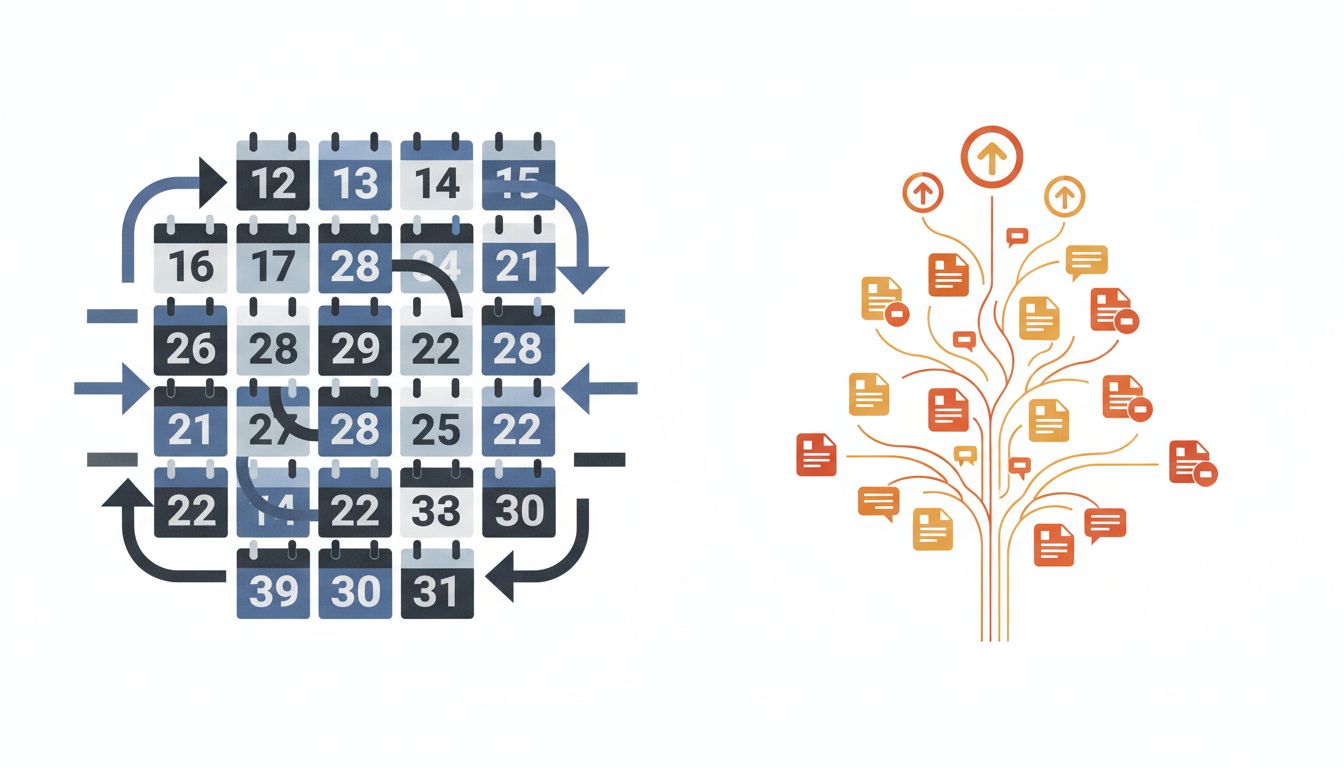
Compare that to the weekly sync. The weekly sync exists because coordination is necessary and humans default to solving coordination problems with meetings. But the weekly sync is scheduled before anyone knows what will need coordinating. It’s a placeholder for work that hasn’t happened yet. So it fills with status updates (information the attendees could read) and open-ended discussion (which is valuable but rarely requires everyone in the room).
Basecamp’s insight was that the scheduled meeting bundles several distinct things together: information sharing, decision-making, social cohesion, and the performance of coordination. These are separable. Only one of them actually requires synchronous presence, and that one (real decision-making under uncertainty, with people who have genuinely different information) can often wait until the decision is actually ready to be made.
Why It Matters
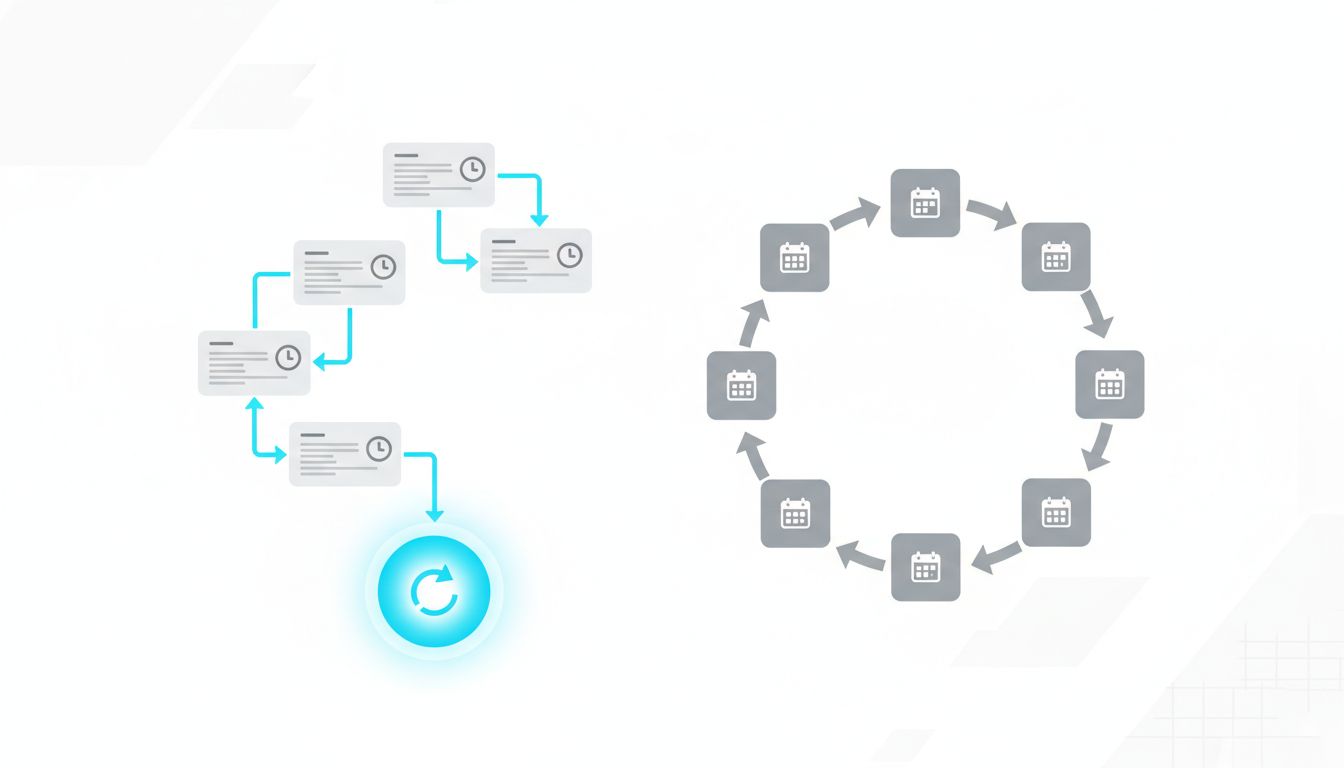
There’s a concept in systems thinking called “coordination overhead,” which is the cost of getting people aligned relative to the cost of the work they’re aligning around. In small teams, this overhead is low. As organizations scale, it tends to grow faster than the productive work itself. Meetings are the most visible form of coordination overhead, but they’re not the only one. Every interruption, every status request, every “do you have a minute” is overhead.
The problem with scheduled meetings is that they create the expectation of coordination, which generates its own overhead. If you have a weekly sync on Friday, people will hold questions until Friday. Ideas that could have been acted on Tuesday will sit in someone’s head for three days. And when Friday arrives, the questions have either answered themselves (making the meeting unnecessary) or they’ve compounded with other unresolved questions (making the meeting chaotic).
Asynchronous-first organizations sidestep this by making the cost of asking a question low and immediate. You write it down. The other person reads it when they’re ready. The response comes when it’s ready. There’s no holding pattern.
This sounds simple. It is not simple. It requires people to write well, to ask specific questions, to tolerate not having an immediate answer, and to trust that the silence between messages is work, not avoidance. These are skills that most organizations have actively trained out of their employees by making meetings the default.
There’s also something worth naming about what gets lost. The hallway conversation, the lunch where someone mentions an idea that turns into a project, the kind of ambient awareness you get from being in a room with people who are thinking about the same problems. Basecamp acknowledges this. Their answer is essentially that those things are real but overvalued, and that what replaces them (clearer writing, more deliberate discussion, better documentation) is more durable. That’s a defensible position, but it’s a position, not a universal truth.
What We Can Learn
The lesson here is not “cancel your meetings.” That’s the surface reading and it’s wrong. The lesson is about where coordination work actually happens.
When Basecamp removed the scheduled meeting as a reflex, they didn’t remove coordination. They forced coordination into forms that are more inspectable. A Slack message you can search. A document you can link to. A decision with a written rationale that a new hire can read six months later. The scheduled meeting produces minutes (if you’re lucky) and memories (which decay). The written exchange produces a record.
If you’re running a software team, this maps directly onto something you probably already believe about code. Readable code is slower to write and faster to delete, and the same principle applies to decisions. A decision made slowly, in writing, with explicit reasoning, is faster to revisit and reverse than one made in thirty minutes in a conference room and reconstructed from memory three months later.
The practical implication is this: before you schedule a meeting, ask what problem the meeting is solving. If the problem is “I need information,” write a message. If the problem is “I need alignment,” write a proposal and let people respond. If the problem is “I need a decision made and it genuinely requires negotiation between people with conflicting information and incentives,” schedule the meeting. That last category is smaller than you think.
The unscheduled meeting (the one that happens because someone actually needs it, not because the calendar demanded it) is doing more work than the one you blocked off two weeks ago. It has a real agenda. It has a specific trigger. It ends when the problem is solved, not when the block expires.
Basecamp built a company around that distinction. Whether their specific norms are right for your team is a separate question. The underlying observation is not.