

The Setup
In early 2023, Shopify did something that most companies talk about but never actually do: it deleted its meetings.
Not metaphorically. Not as a culture initiative that quietly fades by Q2. Shopify’s leadership literally removed all recurring meetings with more than two people from every employee’s calendar. More than 76,000 recurring events, gone overnight. Employees woke up to open calendars and, presumably, a mix of relief and mild panic.
The policy came with specific rules. No meetings on Wednesdays. No meetings with more than 50 people without executive sign-off. Meeting-free periods built into the work week by default, not by personal negotiation. Kaz Nejatian, Shopify’s COO and VP of Product, framed it simply: meetings are a tax on work, and like any tax, you want it as low as possible.
This wasn’t a productivity hack. It was a diagnosis.
What Actually Happened
The meetings that came back after the reset were revealing. Some recurring syncs returned quickly because people genuinely missed the coordination they provided. Most didn’t come back at all, which tells you something important: they were never doing the work their organizers thought they were.
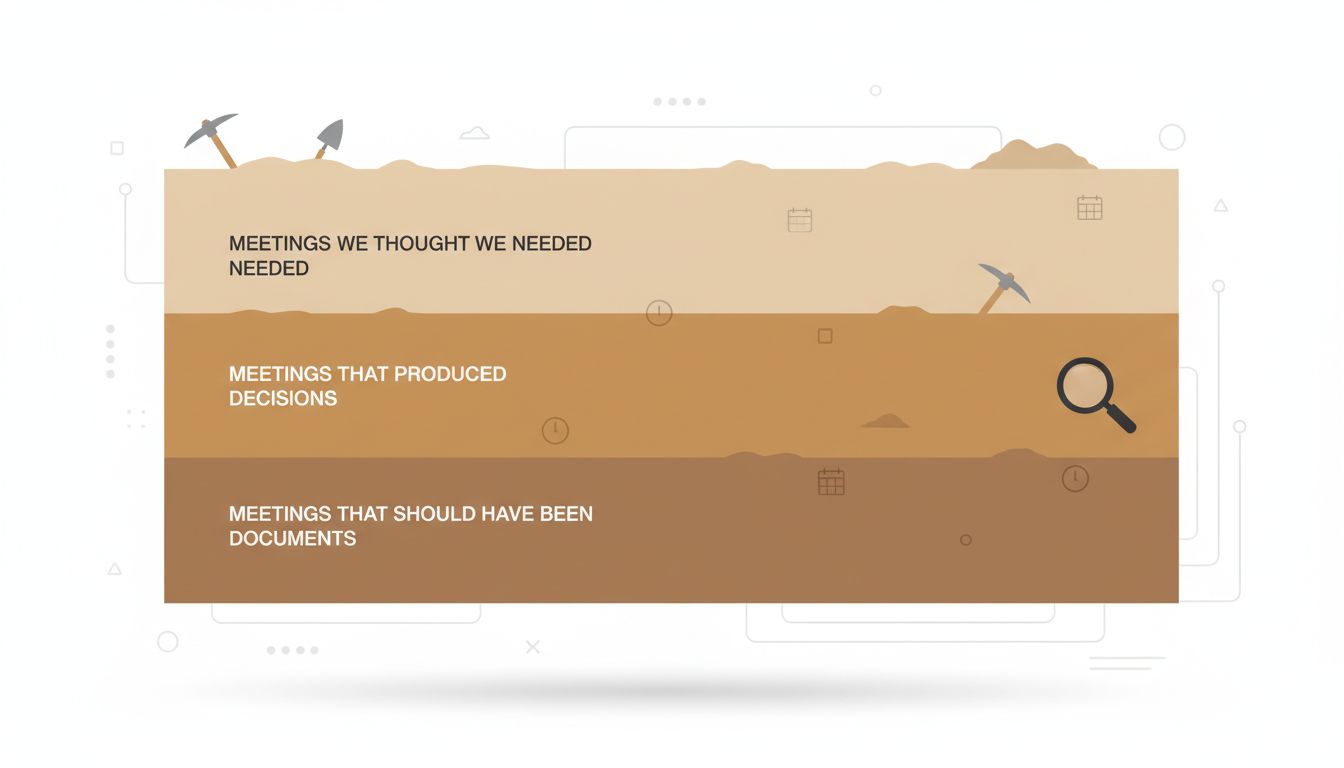
The calendar audit forced everyone to ask a question they’d been avoiding. What decision does this meeting produce? If the answer was “we share updates” or “we stay aligned,” that wasn’t a meeting. That was a ritual wearing a meeting’s clothes.
Shopify’s diagnosis matches what most engineers and product managers privately believe but rarely say out loud: a large portion of meetings exist to make people feel informed rather than to make anything better. They’re a social technology for managing anxiety, not a decision-making tool.
The real cost isn’t the hour on the calendar. It’s the two hours of context-switching before and after, the preparation that goes nowhere, and the work that didn’t happen because six people were in a room agreeing on things they already agreed on.
Why This Matters Beyond Shopify
Shopify is a useful case study not because it’s unusual, but because it made visible a problem that’s normally invisible. Most organizations never audit their meetings because the cost of a bad meeting doesn’t appear anywhere. It doesn’t show up as a bug report. It doesn’t appear on a balance sheet. The hours just evaporate.
This is what makes meeting culture so hard to fix. The people scheduling meetings usually believe they’re being responsible. They want alignment. They want buy-in. They want to avoid the thing that happens when a decision gets made and someone important didn’t know about it. These are real concerns. The problem is that meetings are often the most expensive solution to them.
There’s a structural dynamic worth naming here. In most organizations, scheduling a meeting is essentially free for the person doing the scheduling. You send a calendar invite, and the cost gets distributed across everyone you invited. If you invite ten people to an hour-long meeting, you’ve spent ten hours of company time with a two-second action. That asymmetry encourages overuse.
The meeting organizer is almost never the one who bears the highest cost. That burden falls on people with deep-work schedules: engineers, writers, analysts, anyone whose best output comes from sustained, uninterrupted concentration. A single poorly-timed meeting doesn’t just cost the hour. It costs the whole block of focused work on either side of it. The invisible costs are worth examining more carefully if you haven’t already.
What You Can Learn From the Wreckage
Shopify’s experiment offers a few principles worth adopting, regardless of whether your company is willing to go as far as a full calendar wipe.
Treat your recurring meetings as debt. Every recurring meeting you set up is a standing obligation that compounds over time. Review yours quarterly. Not as a general intention to meet less, but as a literal audit. For each recurring meeting, write down the decision it produced in the last month. If you can’t, cancel it and wait to see if anything breaks.
Make the outcome the prerequisite, not the byproduct. Before scheduling any meeting, write one sentence: “This meeting will produce [specific decision or output].” Not “we will discuss” or “we will align on.” If you can’t write that sentence, the meeting isn’t ready. It might never be. Sometimes what looked like a meeting problem is actually a clarity problem, and you can solve it with a well-written document and a reply-by date.
Audit who actually needs to be there versus who feels like they should. Shopify’s reset revealed that many recurring meetings had grown to include people who were there for visibility, not contribution. There’s nothing wrong with keeping people informed, but a meeting is a wildly expensive way to do it. A written summary sent after the fact costs a fraction of the time and lets people read it when they’re ready, not when you scheduled it.
Watch what doesn’t come back. If you cancel a meeting and no one notices, that’s your answer. The meeting was doing less work than the empty slot would have. The work that gets done in the absence of a meeting is often more valuable than the meeting itself.
Build asymmetric tools into how you communicate. Written updates, shared documents, and recorded walkthroughs let people engage on their own schedule. This isn’t about being remote-first. It’s about respecting that not everyone is at their best at 2pm Tuesday when you decided to schedule your sync.
The Harder Lesson
The Shopify story is satisfying because it involves a bold, visible action. But the more uncomfortable takeaway is about the meetings that aren’t recurring, that aren’t huge, that you schedule one at a time because something feels unresolved.
Many of those meetings are also unnecessary. The thing that feels unresolved is often a question you haven’t fully thought through yet. The meeting becomes a way of outsourcing that thinking to a room full of people, when what you actually needed was another hour alone with the problem.
This isn’t always true. Some problems genuinely require real-time conversation to resolve. Disagreements with real stakes, decisions where emotional buy-in matters, situations where you need to read the room. But you probably know the difference, and if you’re honest, most meetings you call don’t qualify.
Shopify’s calendar reset worked because it forced everyone to justify the meeting from scratch rather than inherit it by default. You can apply that same test to any meeting you’re about to schedule. Justify it from scratch. If it holds up, book it. If it doesn’t, write the document instead.
The calendar you free up is just a side effect. The real gain is the habit of asking whether the meeting was ever the right tool in the first place.